


S Corp Health Insurance Tax Savings
Table Of Contents

When your S Corp pays for your self-employed health insurance (SEHI) and dental / vision premiums, including coverage for your family, that amount is added to Box 1 Wages on your W-2 (and generally Box 16 State Wages too). So, your income is artificially increased by the annual amount of premiums. However, there are two huge concepts you need to love and embrace.
Concept One: Box 1 Goes Up, Box 3 and Box 5 Do Not
First, Box 3 Social Security Wages and Box 5 Medicare Wages do not get increased by the amount of premiums paid. Here is a silly looking, but illustrative W-2-
| Box 1 Wages | 50,000 | Box 2 Federal Tax Withholdings | 21,735 |
| Box 3 Social Security Wages | 40,000 | Box 4 SS Withholdings | 2,480 |
| Box 5 Medicare Wages | 40,000 | Box 6 Medicare Withholdings | 580 |
| Box 16 State Wages | 50,000 | Box 17 State Tax Withholdings | 4,347 |
Don’t get tweaked on the federal and state tax withholdings. We’ll explain that in a later chapter.
Spoiler Alert: When WCG CPAs & Advisors builds your shareholder payroll plan, we increase income tax withholdings to help budget for the K-1 income that is combined with your W-2 income on your individual tax return. This allows you to land on tax neutrality as a household without needing separate estimated tax payments. Beauty!
Back to the W-2. Your focus should be on Box 3 and Box 5; these are the boxes that we want to reduce to the best of our abilities and with reasonableness.
Box 4 and Box 6 are the Social Security and Medicare taxes computed on the amounts in Box 3 and Box 5. As you can see, your Box 1 compensation is $50,000, but only $40,000 is being used to compute Social Security and Medicare taxes. Why is this? Some taxable fringe benefits, such as self-employed health insurance premiums, are added to Box 1 Wages but not Box 3 or Box 5. Boom!
Explained another way; if we determine that $50,000 is a reasonable total compensation package, and your health insurance premiums are $10,000, then $40,000 is paid as cash wages subject to Social Security and Medicare taxes. The other $10,000 is health insurance compensation included in Box 1 but excluded from Boxes 3 and 5. Together, your W-2 reports $50,000 of Box 1 compensation.
Here is the payoff. That $10,000 skipped Social Security and Medicare taxes at 15.3%, which is 7.65% from you as the employee plus 7.65% from your S Corp as the employer (and you own both pockets). That is $1,530 that stays with you, every year, just for running your health insurance through the S Corp correctly. Yay!
How does this translate to the corporate tax return? Line 7 of Form 1120S is “Compensation of officers” and the $50,000 in Box 1 above would be entered there (we’ll chat about the effects of solo 401k plan deferrals in a bit). Line 22 of Form 1120S is “Ordinary business income.” Line 7 as compared to Line 22 is one of the ways the IRS will consider a challenge of your S Corp with respect to reasonable shareholder salary (the IRS also compares the distributions on your K-1, reported in its own Box 16 with Code D, to the wages on your W-2, both connected by your Social Security Number).
Got it? Good. Next concept.
Concept Two: Deducted by the S Corp, In and Out on Your Form 1040
The second concept is that health insurance premiums are deducted on Line 7 of Form 1120S as officer compensation. Therefore, the cash wages paid to the shareholder plus health insurance directly reduce Line 22 on Form 1120S, which is the taxable ordinary income generated by the S corporation. Easy. Done.
However, your W-2 shows $50,000 in taxable wages and this will appear on Line 1a of your Form 1040. Hmmm… how does that work? We know what you are thinking; you are paying income taxes on the full $50,000 since the W-2 shows $50,000 but you were paid $40,000. Where are the tax savings?
This concern would be true except that the tax code treats you as self-employed for health insurance. IRC Section 1372 treats a greater than 2% shareholder as a partner when it comes to fringe benefits, and IRC Section 162(l)(5) then says your “wages … from the S corporation shall be treated as such individual’s earned income.” Translation; your W-2 wages stand in for self-employment income, and therefore the premiums are deducted on the self-employed health insurance line of Schedule 1 on your Form 1040 (Line 17 on recent versions, computed on Form 7206) as an adjustment to income. This is a dollar-for-dollar reduction in arriving at your adjusted gross income (AGI).
Just to reiterate; the premium goes into Box 1 (and generally Box 16 for your state) and comes back out through the self-employed health insurance deduction, so that piece is an in and out on your individual tax return (we accountants really do call it that… income comes in, but is adjusted out). Meanwhile, the S Corp already deducted the premium as compensation, which reduces the ordinary business income flowing through on your K-1. Deduction on the business tax return. In and out on the individual tax return.
Sidebar: Does your state allow the self-employed health insurance deduction? Usually, but not automatically. Most states start with your federal adjusted gross income or federal taxable income and then make their own additions and subtractions, so the in and out carries over. Colorado, for example, starts with federal taxable income and has no addback for it. A handful of states build their own income figure from the ground up and decide deduction by deduction. New Jersey has its own version of the deduction for greater than 2% shareholders, while Pennsylvania has no provision for the federal deduction and applies its own rules to whether the premiums are taxable wages in the first place. Check your state before assuming the “out” follows you home.
One catch. The deduction on your individual tax return cannot exceed your Medicare wages (Box 5) from the S Corp. If your premiums are $10,000 and your Box 5 wages are $6,000, the “out” is capped at $6,000 while the “in” is still $10,000. Yet another reason not to starve your salary.
If this doesn’t resonate quite yet, don’t worry. However, we have seen this screwed up several times when clients run their own payroll and / or prepare their own individual tax returns. Know that you should see a self-employed health insurance deduction on Schedule 1 of your Form 1040 if your S Corp is paying your premiums.
To make things even stranger, a lot of taxpaying citizens are accustomed to health insurance either being 100% provided by their employer or a payroll deduction in some fashion. This works well for employees since the payroll deduction is usually pre-tax and therefore the tax benefit is immediate. However, for the employee turned S Corp owner, this can be a small derailment during the transition.
Here is why. That pre-tax payroll deduction runs through a cafeteria plan (IRC Section 125), and a greater than 2% shareholder is not allowed to participate in one. Prop. Treas. Reg. 1.125-1(g)(2) says the term employee does not include a 2-percent shareholder of an S corporation. Family members on your payroll are generally shut out too, thanks to the stock attribution rules of IRC Sections 1372(b) and 318.
So, you will not see a pre-tax health insurance deduction on an S Corp owner’s paystub. The premiums get added to your Box 1 wages instead, and you take the deduction on your individual tax return. Backwards from what you are used to, same destination. If you run your own payroll, be careful; most payroll software has a specific pay item for 2% shareholder health insurance, and using the regular employee pre-tax deduction is the classic mistake.
To recap; we have an increase in Box 1 compensation by the amount of premiums and our reasonable compensation testing is improved, but Social Security and Medicare taxes are computed on a lesser amount. Winner winner chicken dinner!
Another way to view your health insurance is that it is costing you about 60 cents on the dollar; roughly 15 cents in payroll tax savings (below the Social Security wage base) and another 25 cents in income tax savings. A Schedule C owner can generally get the income tax deduction too, but the health insurance deduction does not reduce self-employment tax. With an S Corp, properly handled shareholder health insurance is included in Box 1 compensation but excluded from Social Security and Medicare wages. Schedule C gives you the income tax deduction. The S Corp gives you that plus a payroll tax trick. Health insurance might still cost an obscene amount of money, but at least we’re buying it with tax-favored dollars.
Big Alert: If you are eligible for a subsidized health plan through your spouse’s employer (or your own day job), the self-employed health insurance deduction is off the table for those months, even if you never enroll. Eligibility is the test, not enrollment. Your S Corp can still pay the premiums and add them to your W-2, but the “in” no longer has an “out.” And if your spouse is paying their share of the premium pre-tax through payroll, there is no second deduction hiding over here. The tax code gives us plenty of deductions. It generally does not give us the same deduction twice, despite our best efforts.
What the IRS Says (Fact Sheet 2008-25)
There are more examples of this stuff in a later chapter dedicated to reasonable shareholder salary. Also, the handling of health insurance in this manner is encouraged by the IRS as outlined in Fact Sheet 2008-25. Here is the blurb if you can’t get enough-
The health and accident insurance premiums paid on behalf of the greater than 2 percent S corporation shareholder-employee are deductible by the S corporation as fringe benefits and are reportable as wages for income tax withholding purposes on the shareholder-employee’s Form W-2. They are not subject to Social Security or Medicare (FICA) or Unemployment (FUTA) taxes. Therefore, this additional compensation is included in Box 1 (Wages) of the Form W-2, Wage and Tax Statement, issued to the shareholder, but would not be included in Boxes 3 or 5 of Form W-2.
The IRS goes on to confirm that the policy can be in the shareholder’s name, provided the S Corp pays or reimburses the premiums and reports them as wages on the W-2 (Notice 2008-1). The premiums may also be separately identified in Box 14. The full Fact Sheet can be downloaded here-
S Corp Savings With Health Insurance
Here is a summary of the savings assuming a 40% compensation target and a $10,000 annual health insurance premium. Same massive disclaimer as our first savings table in our Avoiding or Reducing Self-Employment (SE) Taxes section, and all figures use the $192,300 Social Security wage base for the 2027 tax year.
40% Reasonable Compensation, Including $10,000 of Health Insurance
The following table highlights the significant savings when factoring health insurance into the reasonable compensation calculations.
| Business Profit |
SE Tax | Salary Through Payroll |
S Corp Social Security and Medicare |
Gross Savings | Savings % of Profit |
| 30,000 | 4,239 | 2,000 | 306 | 3,933 | 13.1% |
| 50,000 | 7,065 | 10,000 | 1,530 | 5,535 | 11.1% |
| 60,000 | 8,478 | 14,000 | 2,142 | 6,336 | 10.6% |
| 75,000 | 10,597 | 20,000 | 3,060 | 7,537 | 10.0% |
| 100,000 | 14,130 | 30,000 | 4,590 | 9,540 | 9.5% |
| 150,000 | 21,194 | 50,000 | 7,650 | 13,544 | 9.0% |
| 200,000 | 28,259 | 70,000 | 10,710 | 17,549 | 8.8% |
| 300,000 | 32,123 | 110,000 | 16,830 | 15,293 | 5.1% |
| 500,000 | 39,142 | 190,000 | 29,070 | 10,072 | 2.0% |
The $30,000 row is math, not advice. With only $2,000 of Box 5 wages, the health insurance deduction on your individual tax return would be capped at $2,000.
35% Reasonable Salary, Without Health Insurance
As mentioned, the previous illustrations are based on reasonable compensation of 40% of business profit. If your reasonable S Corp salary is less than this, your savings increase. For grins, the table below shows the results using a 35% reasonable salary figure. Check out the $200,000 figure! Over $17,500 in savings.
| Business Profit |
SE Tax | Salary | S Corp Social Security and Medicare |
Gross Savings | Savings % of Profit |
| 30,000 | 4,239 | 10,500 | 1,607 | 2,632 | 8.8% |
| 50,000 | 7,065 | 17,500 | 2,678 | 4,387 | 8.8% |
| 60,000 | 8,478 | 21,000 | 3,213 | 5,265 | 8.8% |
| 75,000 | 10,597 | 26,250 | 4,016 | 6,581 | 8.8% |
| 100,000 | 14,130 | 35,000 | 5,355 | 8,775 | 8.8% |
| 150,000 | 21,194 | 52,500 | 8,032 | 13,162 | 8.8% |
| 200,000 | 28,259 | 70,000 | 10,710 | 17,549 | 8.8% |
| 300,000 | 32,123 | 105,000 | 16,065 | 16,058 | 5.4% |
| 500,000 | 39,142 | 175,000 | 26,775 | 12,367 | 2.5% |
A Preview of Reasonable Salary (Don’t Be That Guy)
The salary calculation part of running an S Corp is one of the biggest challenges, but it also allows the most wiggle room for argument if necessary. Our chapter on S Corp salary will touch on the various tools we use to determine a reasonable shareholder salary including-
- IRS Revenue Ruling 74-44
- IRS Fact Sheet 2008-25
- Tax Court Cases
- Bureau of Labor Statistics / Risk Management Association Data
- Assembled Workforce, Developed Process Effect
- RCReports
- Rules of Thumb (Biz Valuation, 1/3 1/3 1/3)
Here is some initial food for thought from a 2013 Tax Court case-
Sean McAlary Ltd. Inc. v. Commissioner, T.C. Summary Opinion 2013-62. A real estate broker took $240,000 out of his S Corp, which had net income of $231,454, and paid himself no salary at all. The IRS valuation expert argued for $100,755 using wage survey data for real estate brokers in southern California. The Tax Court settled on $83,200, or $40 per hour. Not bad. He still kept about $148,000 as K-1 income that was not subject to Social Security and Medicare taxes, although the zero-salary strategy also bought him penalties.
Here is the entire Tax Court summary opinion-
Please don’t be that guy who extrapolates or basically twists the previous Tax Court case into something else. The point is not that $40 per hour is some magical IRS-approved salary. The point is how the court got there. Wage survey data is only one aspect of determining a reasonable salary, and even the court landed below the IRS number. As mentioned, there is more on the salary stuff in a later chapter, and pinning your entire argument on BLS data might leave money on the table.
Until then, consider the following summary which outlines the gross savings at various levels of business profit (including one scenario with health insurance)-
| Business Profit |
40% Salary, No Health Ins. |
40% Compensation, $10k Health Ins. |
35% Salary, No Health Ins. |
| 30,000 | 2,403 | 3,933 | 2,632 |
| 50,000 | 4,005 | 5,535 | 4,387 |
| 60,000 | 4,806 | 6,336 | 5,265 |
| 75,000 | 6,007 | 7,537 | 6,581 |
| 100,000 | 8,010 | 9,540 | 8,775 |
| 150,000 | 12,014 | 13,544 | 13,162 |
| 200,000 | 16,019 | 17,549 | 17,549 |
| 300,000 | 13,763 | 15,293 | 16,058 |
| 500,000 | 9,497 | 10,072 | 12,367 |
Good stuff!
Does Payroll Need to Be This Precise? (Bar Napkin Versus NASA)
Why are we belaboring the heck out of this? In other words, does payroll really need to be dialed in this tightly? Remember the 15.3% from the W-2 example? It cuts both ways. Paying a salary which is $10,000 too high will cost you $1,530 in unnecessary payroll taxes. Read that again. If reasonable compensation is $80,000 and you blindly pay yourself $100,000, that is $20,000 of unnecessary wages and about $3,060 of unnecessary payroll tax. Same tax return. Same business. Same work. You just wrote a bigger check. What would you rather spend $3,060 on? Lots!
So, payroll calculations need to be just a bit tighter than bar napkin quality and just a hair below NASA precision.
Jason Watson, CPA, is a Partner and the CEO of WCG CPAs & Advisors, a boutique yet progressive tax, accounting and business consultation firm headquartered in Colorado Springs, Colorado. With 7 partners and 110 incredible professionals across offices in Colorado, South Dakota, Wyoming and India, WCG serves small business owners, real estate investors and taxpayers worldwide.


Taxpayer’s Comprehensive Guide to LLCs and S Corps 2025 Edition
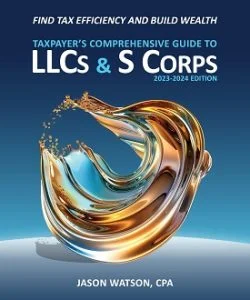 This KB article is an excerpt from our 420+ page book (some picture pages, but no scatch and sniff) which is available in paperback from Amazon, as an eBook for Kindle and as a PDF from ClickBank. We used to publish with iTunes and Nook, but keeping up with two different formats was brutal. You can cruise through these KB articles online, click on the fancy buttons below or visit our webpage which provides more information.
2027 EDITION IS CURRENTLY BEING WORKED (partial releases throughout November)
 |
 |
 |
| $49.95 | $39.95 | $29.95 |



Chat With a Tax Pro
Taxes can be tricky. Chat with a WCG human now and get questions answered.