


Formation of an LLC or S Corp
Table Of Contents
It is very easy to form an LLC and have it taxed as an S corporation. However, an S Corp is not formed by itself; another entity is created and then taxed as an S Corp. If you use a limited liability company as the underlying entity, at times people will refer to this as an LLC S Corp.
While LLC formation is easy, it is also very easy to screw it up. WCG CPAs & Advisors can assist with all the filings with the Secretary of State (for any state), and our fee is $625 plus the state filing fees ($50 to $200ish, some states are even $500). Some states such as Nevada or California require an initial report, and that will typically add $150 to our fee plus the initial report fee. As an aside, Nevada might have good corporate laws, but it is an expensive state to form a business entity in. More on the Nevada hype in a bit.
Sure, you can form an LLC on your own or through LegalZoom, but we will provide consultation and advice during the startup process. You can also use an attorney but be careful since not all attorneys are the same. If you were an idiot before law school, getting a law degree doesn’t suddenly make you smart. We have seen many things messed up by attorneys who didn’t understand their client’s needs, didn’t understand the tax code, unnecessarily complicated the heck out of an otherwise simple entity structure, so on and so forth.
Accountants and doctors are not immune. How many quack doctors are there? Plenty. Accountants? Just a bunch of nerdy, socially awkward types. Thanks to Ben Affleck, us accountants are also secret assassins. Thanks Ben, the secret is out. Way to go, wizard.
Some of the kidding aside, we have seen some attorneys do some ingenious things as well. WCG works with business law and corporate attorneys all the time. It is a great relationship since they know corporate governance and contract law, and we know taxation and businesses. Do not think you only need an attorney; you need both an attorney and sharp business consultants (like us).
For your small business formation, WCG will do the following-
- Create Articles of Organization, Formation or Incorporation (varies by state), and file with the Secretary of State
- File an initial report if required
- Check on local taxing jurisdictions for registrations (for example, San Francisco, which has its own registration form and fee in addition to the State of California)
- Obtain your Employer Identification Number (EIN) from the IRS
- Create an Operating Agreement (for single-member LLCs only, since rights are not being represented) or provide an MS Word template set of Bylaws for corporations
LLC, Professional Corporation or Corporation
For many ordinary small businesses, we will form an LLC and then consider an S Corp election when the economics make sense. However, certain states require certain professions, such as accountants, attorneys, various medical professions, and others, to practice through a professional corporation (PC) or professional LLC (PLLC). These entities can also elect S Corp taxation.
Sidebar: In California, the entity choice affects more than paperwork. A corporation’s sole shareholder officer can opt out of State Disability Insurance, but an LLC taxed as an S corporation cannot, as we covered in the California SDI section earlier in this chapter. Several states have nuances like this that LegalZoom and others might not be aware of, since they don’t process payroll and prepare tax returns.
Operating Agreements
Multi-member LLCs and partnerships need agreements between the members and partners, respectively. Yes, people swap those words all the time, but they are technically different (we covered that earlier, no need to bore you twice).
As mentioned throughout this chapter, issues such as death, divorce, incapacitation, spending limits, required distributions (so you have cash to pay taxes), valuation techniques and exit strategies need to be addressed. Don’t forget dispute resolution. These agreements are legal in nature and represent rights, so WCG cannot draft them. However, we act in a consulting capacity with attorneys all the time to ensure a quality agreement is drafted that meets the client’s needs and objectives from all aspects.
See our Operating Agreements section for more information, including deal structures and other way cooler stuff than entities alone. Please review yours for probable missing things.
Accountable Plan and Expense Reimbursements
Whether your underlying entity is an LLC or a corporation, once it elects S Corp taxation we recommend adopting a written Accountable Plan and documenting the adoption through the appropriate written consent, resolution or minutes. The plan is used for employee reimbursements (see our fun-filled chapter on operating your S Corp). Employee? Yes, as an S Corp owner, you wear both the employee and investor hats.
Deducting out-of-pocket expenses such as mileage, cell phone and home office on your individual tax return was never a good idea with S corporations, and the Tax Cuts and Jobs Act of 2017 shut the door, which the One Big Beautiful Bill Act then locked permanently. The Accountable Plan allows you to reimburse yourself as an employee, so the deduction is taken on the business tax return, which in turn reduces the net ordinary income passed through to the shareholders. We will show you how this is a slick way of pulling money out of your business in the form of employee expense reimbursements.
Corporate Minutes and Books of Record
This is a bit old school. Back in the day, you needed an attorney and a $5,000 check to create a corporation since we didn’t have the use of an LLC. The process was very formalized since larger businesses commonly used corporations, and the states used public formation and annual filings to track the comings and goings of businesses operating in their jurisdiction. Corporations also maintained formal internal records such as bylaws, minutes, resolutions and stock records for directors and shareholders.
However, if your underlying entity is a corporation, we recommend formally maintaining your Book of Record for three reasons-
- It helps maintain the integrity of the corporate veil.
- Some banks and other institutions might ask for it before allowing you, the controlling shareholder, to act on behalf of the corporation (such as buying an automobile in the business’s name).
- The IRS from time to time will ask for it during an audit. Yeah, seems silly, but they love documentation (shocker).
Corporate Minutes are generally not required for LLCs; again, because LLCs are not corporations.
Business Banking
The three typical small business formation documents (Articles of Organization and the variants, EIN and Operating Agreement) are required by most banks for a business checking account, although an Operating Agreement is not always required. Federal anti-money laundering rules, including FinCEN’s customer due diligence rule, require banks to identify who owns and controls a business account. While it might throw off the Feds, Guido’s Money Laundering LLC is a no-go for your business checking account name unless you have an EIN, which defeats the purpose if you are Guido.
So, all banks will want either an EIN or a Social Security number to open a checking account, personal or business. Your business EIN is also tied to the Social Security number of its responsible party. Follow the money, find the bad guys.
A sole proprietor can sometimes use a separate personal checking account for business activity, depending on the bank’s rules. However, if you plan on taking checks written in your business name, you’ll need a business checking account or a personal checking account with a DBA (doing business as). Direct deposits and other ACH payments usually sidestep the name issue in practice, but that is a convenience, not a fix. Once you have an LLC or corporation, we strongly prefer a dedicated business checking account titled in the entity’s name. Besides cleaner bookkeeping, it helps maintain the separation between you and the entity. If you operate under a DBA, make sure the bank has the DBA properly associated with the account.
Remember, you can also create a DBA for your entity name. Therefore, if your business is a franchise but you want a different LLC name on the checking account, you can be Big Bucks LLC dba Starbucks or Bad Coffee dba Starbucks. Remember, friends don’t let friends drink Starbucks. Please, find a decent coffee for yourself unless it is wintertime, and Starbucks’ chestnut praline latte is in season. Yum!
We pick on Starbucks, but you must admit, while they might not have the best coffee, they are prolific and consistent throughout the world. You always know what you are going to get. Oh, and they made drinking $6 lattes fashionable, $7 milkshakes as a valid breakfast option, and helped launch hundreds of thousands of small coffee shops. Wow, we really went off there.
When Should You Make the S Corp Election?
The S Corp election can wait. As mentioned throughout this book, about $60,000 of net income after expenses (profit) is often where the break-even economics start getting interesting. If income is uncertain, we can monitor the economics during the year and determine whether an S Corp election makes sense. And if the election deadline is missed, Rev. Proc. 2013-30 generally provides late-election relief for up to three years and 75 days when its requirements are met, including reasonable cause for the late filing. WCG files about 200 to 250 late S Corp elections each year, and we are batting 100% on getting them pushed through.
Therefore, get the LLC in place now and revisit the S Corp election as the year unfolds, and yes, we provide this consultation for you. Then again, if you are converting from W-2 to a 1099 independent contractor and your revenue is known, then we can form an LLC or corporation and file the S Corp election right away.
What if you are required to form a Professional Corporation (PC) because of your business activity (doctor, attorney, accountant, etc.)? Since a PC must file its own tax return and incur a tax preparation fee no matter what, which is a large chunk of the break-even analysis, an immediate S corporation election upon PC creation might be prudent especially given the double-taxation problem.
Late S Corp Election Relief
More on the late election later, but here is a spoiler-
- You could be in the middle of March 2027 thinking you’re a goner,
- Elect late S Corp status back to January 2026, and
- Reclassify distributions already paid during 2026 as officer wages through a late 2026 payroll filing or, as a fallback, report officer compensation on a one-time 1099-NEC. Boom! You just saved 8% to 10% of your net business income in taxes.
This is all legit, a pain in the butt for us, but legit and successful. Sure, there are some devils in the details in terms of your reasonable cause for the late election, and we will review those with you. We’ve been doing this for almost two decades without major hiccups. Not the ideal way in the eyes of the IRS, but then again, hate the game not the player. We are just playing within the parameters of their game.
The S Corp Break-Even Point
We mentioned this briefly just a bit ago, and we’ll expand on this here.
Not sure if you want a full-blown S corporation? Using WCG’s current service pricing and a typical payroll tax savings percentage, the practical break-even point is around $60,000 of net business income after expenses. Why? Simple cost-benefit analysis. The cost of running an S Corporation, such as payroll and the corporate tax return, equals the savings at about $60,000.
How did we calculate that? Our Vail Advisory Platform is $4,920 per year (wcginc.com/vail), and it includes your corporate tax return (Form 1120S), your individual tax return (Form 1040 and state), a payroll plan, household tax projections, two tax strategy sessions and three quick chats (about nine touch points). Add roughly $900 a year for payroll processing through Paychex, and the all-in cost is about $5,800. Divide that by a typical savings of 9% to 10%, and you land at about $60,000.
That is the conservative version, since you would pay for an individual tax return with or without the S Corp. Our advisory platforms are discussed further later in the book.
Sidebar: Are you getting crushed on state and local taxes (SALT)? Have income in a state with a pass-through entity tax (PTET) where your business pays a tax and it is credited on your state income tax return? Tilt? What the heck is the SALT workaround with PTET? Check it out- wcginc.com/ptet
Let’s say you are teetering around the $60,000 income figure and are not sure whether payroll, another tax return and all that jazz are worth it. This is exactly why we generally do not rush the S Corp election when business income is uncertain. You can form the LLC, operate under its default taxation and make the S Corp election later when the economics justify it. Once the election is made, unwinding it is not something we recommend doing casually since IRC Section 1362(g) generally prevents another S Corp election for five years without IRS consent.
If you expect to lose money the first two or three years, the S Corp election becomes a bit more complicated and more discussion is required. It is generally better to delay the S Corp election so you can avoid the costs and hassles of filing a corporate tax return. More importantly, losses on Schedule C are not limited by basis the way S Corp losses are. As an S corporation shareholder, you are both an investor and an employee, and as an investor in any business, you cannot deduct more than your investment (basis). A personal guarantee of the company’s bank loan does not count toward that basis either. Schedule C losses still face the at-risk, passive activity and excess business loss limits, but the S Corp adds one more gate.
We would be remiss, however, to not mention that for tax year 2021, S corporation tax returns had IRS examination coverage of about 0.1%, which is like a rounding error. A 1040 tax return with Schedule C activity, especially with a bunch of travel and meals, typically gives an examiner more to look at. The IRS likes pot odds.
Here are some more gee-whiz stats from tax year 2022 (the IRS is slow to release this stuff)-
| Industry | Tax Returns | Share |
| Professional, Scientific & Technical Services | 863,664 | 16.4% |
| Construction | 690,444 | 13.1% |
| Wholesale & Retail | 673,738 | 12.8% |
| Real Estate & Rental | 595,687 | 11.3% |
| Health Care & Social Assistance | 487,580 | 9.3% |
| Other Services | 353,011 | 6.7% |
| Accommodation & Food Service | 277,241 | 5.3% |
| Transportation & Warehousing | 269,711 | 5.1% |
| Administrative, Support & Waste Management | 251,863 | 4.8% |
| Finance & Insurance | 195,372 | 3.7% |
| Manufacturing | 162,216 | 3.1% |
| All Other | 446,175 | 8.5% |
| Total | 5,266,702 | 100.0% |
Source: IRS Statistics of Income, Publication 16, Table 6.1, tax year 2022. Shares may not total 100% due to rounding.
Jason Watson, CPA, is a Partner and the CEO of WCG CPAs & Advisors, a boutique yet progressive tax, accounting and business consultation firm headquartered in Colorado Springs, Colorado. With 7 partners and 110 incredible professionals across offices in Colorado, South Dakota, Wyoming and India, WCG serves small business owners, real estate investors and taxpayers worldwide.


Taxpayer’s Comprehensive Guide to LLCs and S Corps 2025 Edition
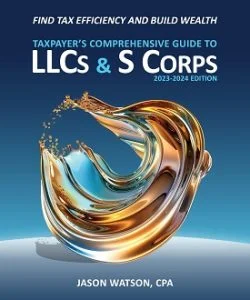 This KB article is an excerpt from our 420+ page book (some picture pages, but no scatch and sniff) which is available in paperback from Amazon, as an eBook for Kindle and as a PDF from ClickBank. We used to publish with iTunes and Nook, but keeping up with two different formats was brutal. You can cruise through these KB articles online, click on the fancy buttons below or visit our webpage which provides more information.
2027 EDITION IS CURRENTLY BEING WORKED (partial releases throughout November)
 |
 |
 |
| $49.95 | $39.95 | $29.95 |



Chat With a Tax Pro
Taxes can be tricky. Chat with a WCG human now and get questions answered.