


Parent-Child Arrangement (Income Flows “Up”)
Table Of Contents
 Can one S Corp own multiple LLCs? Yes, and it solves a common problem. You might have two business entities that you want to combine, but they are also very different. For example, you are a realtor and your spouse is an IT consultant. We could create a holding LLC called Smith Ventures which owns the realtor LLC and the IT consultant LLC. In other words, the realtor LLC and the IT consultant LLC each have a single member, and that single member is the holding LLC.
The holding LLC would then make the S Corp election, and all the LLC income (realtor and IT, using the example above) would flow into the S corporation as wholly owned subsidiaries. Remember, single-member LLCs are disregarded entities and are reported on the sole member’s tax return. In this case the sole member is a sexy and tax-efficient S corporation. Sexy and tax-efficient… probably went too far with that one. Then again, it is called an S Corp election for a reason, and not a U Corp election. Oh don’t roll your eyes, we stuck that landing.
Both spouses are shareholders of the holding S Corp, and each takes a reasonable salary for the work they do. One quick check for licensed professions: some states require commissions or professional fees to be paid to the licensee or a licensed entity, so confirm the realtor LLC can sit under a holding company your spouse co-owns.
You might be saying, “Yeah, but, why not just have two S Corps?” You can, and in some situations you must (like an attorney married to a physician, since neither can necessarily own the other’s professional entity). The downside is the additional cost in tax return preparation and payroll processing. In the arrangement above, all the payroll for the shareholders is handled out of a single S Corp, and since each single-member LLC (SMLLC) is a disregarded entity for federal income tax purposes, only one federal business income tax return is required, at the S corporation level.
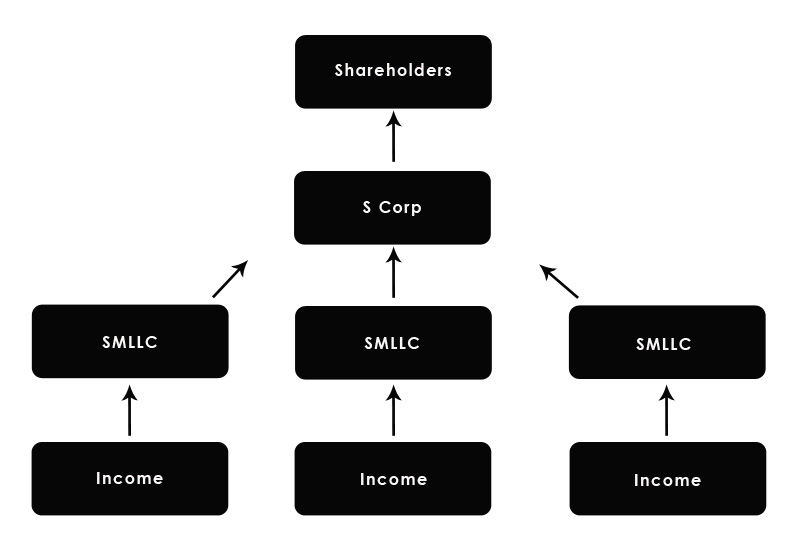 We rattled that off fairly quickly. Let’s break it down with some specifics. At WCG CPAs & Advisors, an S corporation tax return runs $1,500 to $1,800, and processing shareholder payroll through a provider (such as our preferred partner, Paychex) runs about $900 a year. Call it $2,500 to $2,700. A second S Corp adds that to your legal and professional services budget every year, perhaps unnecessarily. Then again, if a little division between you and your spouse keeps the pillow talk on the positive side, it might be the best therapy money can buy.
Another benefit is that one of these business units, subsidiaries or whatever you want to call them, can be carved away and later sold off. You could also expand ownership in one without expanding ownership in the whole structure (more on this below).
Let’s move on to the minor inconveniences. Little hiccups.
Separate everything. Each entity should have its own checking account and set of books. Common expenses such as an umbrella policy or tax preparation fees are paid at the S corporation level, while subsidiary-specific expenses such as website hosting are paid at the LLC level.
- Payroll follows the people. Payroll can also be handled at the subsidiary level when employees work exclusively for that LLC, which is often our preference for clean accounting and operational separation. However, centralized payroll through the parent S Corp is also possible with properly structured employment or employee-leasing arrangements. The structure should follow the actual employment relationships, not the other way around.
- Distributions double hop. If you want to take a distribution out of one of the subsidiaries, the S corporation receives the distribution first and then makes another distribution to you, the shareholder. A double hop, and what is referred to as a trampoline in the drug trafficking business (fire up Narcos or Snowfall… great shows!). In other words, transfer money from the SMLLC’s checking account to the S corporation’s checking account to your checking account. Please don’t take it directly from the subsidiary. The IRS sees one S Corp either way, but skipping the hop muddies the books and weakens the separation you created the subsidiaries for in the first place.
- State fees stack up. Each entity might be slapped with annual state fees in the form of filing fees, franchise taxes (like California) or both. In California, this arrangement generally costs at least $800 three times over, plus an additional LLC fee when a subsidiary has $250,000 or more of California-source total income, and the S Corp can owe more than its $800 minimum when its 1.5% franchise tax produces a higher amount. Nasty! The benefits might still outweigh the costs, but be careful.
This is a common strategy for married couples whose businesses are completely different, yet the household wants to enjoy the benefits of an S corporation.
Sidebar: Each business activity needs a legitimate profit motive under IRC Section 183. Simply tucking a money-losing activity under the “protection” of an S Corp does not magically make its expenditures deductible. The IRS looks at the economic substance and relationship of the activities, not just the LLC names on the organizational chart. Want another? The Section 199A qualified business income deduction generally requires separate calculations by trade or business, so if one SMLLC is a specified service trade or business (SSTB) and the other is not, there is some extra math in determining the deduction.
Expanding Ownership
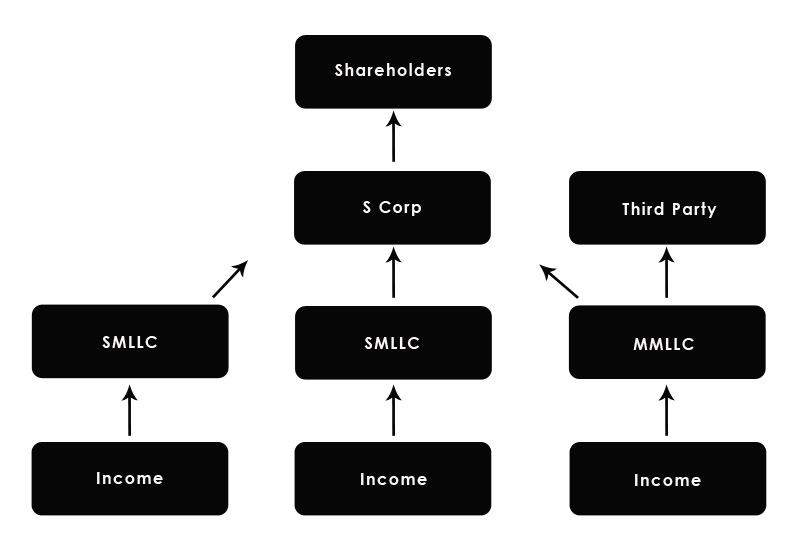
Expanding ownership will be discussed in more detail in a later chapter, but here are a few more reasons to compartmentalize multiple business units into LLCs. Say you have a home inspection business and a home remodel business. Like the real estate holding company and operating company arrangement, you might want to expand ownership in the remodeling business and not the inspection business.
For example, you add a partner to the home remodeling LLC and it becomes a multi-member LLC. This entity would have two members, your S corporation and the other guy, and the other guy could be an S corporation as well. Now you need two federal business income tax returns, a Form 1120S for the holding S Corp and a Form 1065 for the multi-member LLC. Your S Corp receives a K-1 from the multi-member LLC. The inspection business is untouched, and you never personally own the remodeling LLC. Your S Corp does.
A Twist (Separately Owned LLCs and a Shared S Corp 401k)
Now we’re going to turn the entire arrangement upside down. Instead of the S Corp owning the LLCs, each spouse personally owns an LLC, and the LLCs pay a jointly owned S Corp for services. Different ownership, different tax consequences, and a fresh batch of IRS rules to ruin the fun.
For example, one spouse owns SMLLC “A” and the other spouse owns SMLLC “B.” Each LLC pays the jointly owned S Corp a management fee for actual services performed, which could reduce each SMLLC’s taxable income to a nominal amount, perhaps $500, provided the fees are commercially supportable. The S Corp pays reasonable W-2 salaries to the working spouses and sponsors the household’s 401k, funded by that W-2 compensation.
Why not just have the S Corp own both LLCs? Because keeping the operating businesses outside the S Corp can-
- Preserve separate ownership of each business.
- Simplify future ownership changes.
- Potentially limit the management company’s multi-state tax reporting exposure.
The businesses remain separate, while the S Corp provides legitimate management services.
Of course, 401k plans have all kinds of controlled group and nondiscrimination rules, and we explore more of that in a later chapter. Because both spouses own the S Corp, the spousal attribution rules generally tie that corporation to each spouse’s individually owned LLC under IRC Section 414(c). Employees of both LLCs can therefore affect the S Corp’s retirement plan eligibility, coverage and testing.
And if the S Corp’s principal business is providing management functions to the LLCs, the affiliated service group rules under IRC Section 414(m)(5) can create an additional reason to aggregate the businesses.
If both LLCs are operated exclusively by the spouses, the retirement plan analysis is relatively straightforward. If one has a bunch of employees, your supposedly solo 401k might not be so solo anymore. This is where a retirement plan administrator or ERISA professional earns their money. If separate 401k plans are the real goal, two separate S Corps, where neither spouse owns or works in the other’s business, are usually the cleaner path, since that is where the spousal exception to the controlled group rules can hold.
One more caution. The management fees cannot simply be whatever amount drives each Schedule C down to $500. The fee needs-
- A written services agreement.
- Actual services performed by the S Corp.
- A legitimate business purpose.
- An arm’s-length price (IRC Section 482).
The tax result follows the economics, not the other way around.
Sidebar: Sound familiar? This fee for service wiring is the same machinery that powers our mothership baby S Corp construct, which we cover later in this chapter. The direction is flipped. In the twist, the operating businesses pay one shared S Corp for management. In the mothership, one shared business pays each owner’s baby S Corp for their services. Either way, the paper does the heavy lifting (services agreements, real services and a defensible fee), and the 401k usually gets tested as a group.
We discuss holding companies and management companies, and how they differ, later in this chapter.
Jason Watson, CPA, is a Partner and the CEO of WCG CPAs & Advisors, a boutique yet progressive tax, accounting and business consultation firm headquartered in Colorado Springs, Colorado. With 7 partners and 110 incredible professionals across offices in Colorado, South Dakota, Wyoming and India, WCG serves small business owners, real estate investors and taxpayers worldwide.


Taxpayer’s Comprehensive Guide to LLCs and S Corps 2025 Edition
 This KB article is an excerpt from our 420+ page book (some picture pages, but no scatch and sniff) which is available in paperback from Amazon, as an eBook for Kindle and as a PDF from ClickBank. We used to publish with iTunes and Nook, but keeping up with two different formats was brutal. You can cruise through these KB articles online, click on the fancy buttons below or visit our webpage which provides more information.
2027 EDITION IS CURRENTLY BEING WORKED (partial releases throughout November)
 |
 |
 |
| $49.95 | $39.95 | $29.95 |



Chat With a Tax Pro
Taxes can be tricky. Chat with a WCG human now and get questions answered.