


Trapped Assets (Keep Real Estate Out of Your S Corp)
Table Of Contents

As the only shareholder of an S Corp, you might think that everything the business owns you also personally own. Not true. The relationship you have with your S Corp is not a marriage where mine is mine and yours is mine too.
Moving Assets Out of an S Corp Is a Taxable Event
Can you take real estate or other property out of an S Corp tax-free? No. If you want to move assets out of an S corporation or convert them to personal use, you will trigger a taxable event. A potentially big one. When assets are distributed to the S Corp shareholders, the S Corp is treated as if it sold them at fair market value (IRC Section 311(b)). Cash is easy. An automobile is usually manageable, although one you wrote off with bonus depreciation comes out as ordinary income on whatever it is worth. But real estate can kick your butt.
WCG CPAs & Advisors once had a consultation with an S Corp owner whose business owned a hotel building. On the advice of an inexperienced CPA, he converted his S Corp-taxed LLC back to a regular LLC. Unfortunately, changing the LLC’s federal tax classification triggered a deemed liquidation (Treas. Reg. Section 301.7701-3(g)), treating the business assets as if they had been distributed at fair market value (IRC Section 336(a)). The basis in the hotel building was $400,000 and the fair market value was $2,000,000. This put a $1,600,000 gain on his K-1 and sparked roughly $320,000 in federal tax at a 20% capital gains rate, and more once depreciation and state income taxes are counted. Capital gains is a success tax, right? But when you don’t actually get the cash from the transaction, this tax could be impossible to pay. Keep appreciating assets out of an S corporation, people (or at least have eyes wide open on the risk)!
Minority interests get a little help. If your S Corp owns a minority stake in something, like a partnership interest in a law firm or accounting firm, fair market value is what a buyer would pay for that stake. Buyers generally won’t pay full price for a slice they cannot control or easily sell, so a qualified appraisal or business valuation can apply a discount for lack of control (DLOC) and a discount for lack of marketability (DLOM). A lower value means a smaller gain when the interest comes out, so DLOC and DLOM might come to the rescue. Real estate owned directly by your S Corp? No such luck. The S Corp owns the whole building, so you value the whole building, and there is no friendly valuation to be found. The IRS knows about Zillow just like you do.
Sole proprietors and garden-variety LLCs enjoy more flexibility. A sole proprietor is simply moving property from one pocket to another, and a multi-member LLC taxed as a partnership can generally distribute property to its partners without triggering gain. This is why holding companies own real estate and operating companies elect S Corp status. See our Real Estate Holding Company and Operating Company section for more information.
Sidebar: Can an F reorganization (IRC Section 368(a)(1)(F)) get real estate out of an S Corp? No. We have seen attorneys move assets into an LLC owned by the S Corp and then try some magic with the LLC. A wholly owned LLC is disregarded, so the S Corp still owns the assets for tax purposes, and distributing or selling the LLC interest is treated the same as distributing or selling the assets. An F reorganization is a great tool when you are selling the business. It is not an escape hatch for appreciated property.
No Step-Up in Basis Inside an S Corp
Assets within your S Corp can also be problematic upon death. If you own an asset at the time of death, the asset is re-valued and your heirs get a step-up in basis (cost). So, when they sell the asset their gain is lower. For example, you buy a painting for $5,000 and when you die, the painting is valued at $20,000. If your heirs sell the painting for $22,000, they will only realize a $2,000 taxable gain.
If the asset is sitting in the S Corp upon your death, your S Corp stock gets the step-up, not the underlying asset. The stock must be appraised, which is harder to demonstrate than the value of one particular asset, and the asset’s basis inside the S Corp stays right where it was. Look at it another way. S Corps don’t die, and therefore assets within the business don’t get a step-up in basis upon a shareholder’s death.
A partnership can fix this mismatch with an IRC Section 754 election, which steps up the heirs’ share of the assets inside the business. An S Corp has no such election. Heirs can sometimes unwind this mismatch through a carefully planned liquidation, where the gain recognized inside the S Corp is offset by a loss on the inherited stock. The timing and character of the gain and loss matter, and it is one more reason real estate belongs in an LLC.
We’ll acquiesce. This trapped asset problem is super rare yet so many owners love to have personal stuff owned by the S Corp.
Jason Watson, CPA, is a Partner and the CEO of WCG CPAs & Advisors, a boutique yet progressive tax, accounting and business consultation firm headquartered in Colorado Springs, Colorado. With 7 partners and 110 incredible professionals across offices in Colorado, South Dakota, Wyoming and India, WCG serves small business owners, real estate investors and taxpayers worldwide.


Taxpayer’s Comprehensive Guide to LLCs and S Corps 2025 Edition
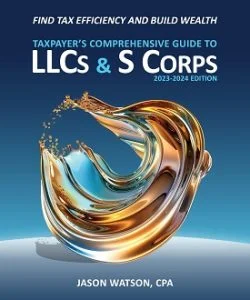 This KB article is an excerpt from our 420+ page book (some picture pages, but no scatch and sniff) which is available in paperback from Amazon, as an eBook for Kindle and as a PDF from ClickBank. We used to publish with iTunes and Nook, but keeping up with two different formats was brutal. You can cruise through these KB articles online, click on the fancy buttons below or visit our webpage which provides more information.
2027 EDITION IS CURRENTLY BEING WORKED (partial releases throughout November)
 |
 |
 |
| $49.95 | $39.95 | $29.95 |



Chat With a Tax Pro
Taxes can be tricky. Chat with a WCG human now and get questions answered.