


Single Member Limited Liability Company
Table Of Contents
 Single-member limited liability companies (what we abbreviate as SMLLC) are treated the same way as a sole proprietorship since in the eyes of most taxing agencies SMLLCs are considered a disregarded entity. Just as the name suggests, the entity is disregarded for income tax purposes and all business activities are reported on Schedule C (or Schedule E for rentals) with your Form 1040. One wrinkle: the SMLLC is not disregarded for payroll taxes. If it has employees, the LLC itself is the employer and needs its own EIN, separate from whatever you use for income tax reporting (Treas. Reg. 301.7701-2(c)(2)(iv)).
Sidebar: That payroll wrinkle has a silver lining for anyone thinking about putting their kids on payroll. Wages paid to your child under 18 by a parent-owned sole proprietorship or SMLLC are exempt from Social Security and Medicare (IRC Section 3121(b)(3)(A)), and from unemployment taxes until the child turns 21. The family employment regulations treat you, not the LLC, as the employer for this purpose (Treas. Reg. 31.3121(b)(3)-1(d)), so the exemption survives the wrinkle above. Can you pay your child from your S Corp? Yes, but the exemption disappears, since the IRS now sees a corporation paying the wages rather than Mom or Dad. This is one reason the family management LLC sometimes enters the conversation: your S corporation pays a management fee to a separate parent-owned SMLLC, and the SMLLC employs the kids. It works when the management company provides real services, charges a commercially supportable fee, maintains separate books and records, and otherwise has real substance. It draws attention when it exists only as a conduit for tax savings. We get into all of this in Chapter 11.
The disregarded entity stands in contrast to the pass-through entity (PTE), which is usually a partnership or an S corporation. Both push income down to the owners’ Form 1040, but a pass-through entity files its own tax return (Form 1065 or Form 1120S) and hands each owner a K-1, while a disregarded entity files nothing of its own.
While the IRS disregards the general SMLLC, several states have a separate form or filing-
- California uses Form 568.
- New York uses Form IT-204-LL.
- Texas has an annual franchise tax filing, and even after Texas dropped the No Tax Due Report in 2024, the Public Information Report (Form 05-102) is still required.
- Tennessee does not disregard an SMLLC owned by an individual at all. It files its own franchise and excise tax return, and the exemptions (family-owned rental entities, LLCs whose members accept personal liability) rarely fit an operating business.
We can keep going but you get the idea.
Therefore, SMLLC equals sole proprietor from a federal income taxation perspective and most states. However, keep in mind that a SMLLC enjoys some distinct benefits over a sole proprietor-
- Liability protection (with two cautions below)
- Anonymity in some states (Wyoming good, Texas bad)
- Improved transfer of ownership through its Operating Agreement
- For our purposes, a ready-made entity for the S Corp election
Two cautions on liability protection. First, most people want protection from the accident that turns into a lawsuit, and an LLC is not a tort shield. It separates your personal assets from the business’s debts and contracts, but you remain personally liable for your own negligence, LLC or not. Speeding in a school zone remains a bad idea. Second, the charging order protection that keeps a personal creditor out of a multi-member LLC is weaker for SMLLCs in several states, with Florida being the famous example. We discuss liability protection in more detail later.
Jason Watson, CPA, is a Partner and the CEO of WCG CPAs & Advisors, a boutique yet progressive tax, accounting and business consultation firm headquartered in Colorado Springs, Colorado. With 7 partners and 110 incredible professionals across offices in Colorado, South Dakota, Wyoming and India, WCG serves small business owners, real estate investors and taxpayers worldwide.


Taxpayer’s Comprehensive Guide to LLCs and S Corps 2025 Edition
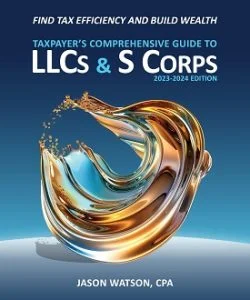 This KB article is an excerpt from our 420+ page book (some picture pages, but no scatch and sniff) which is available in paperback from Amazon, as an eBook for Kindle and as a PDF from ClickBank. We used to publish with iTunes and Nook, but keeping up with two different formats was brutal. You can cruise through these KB articles online, click on the fancy buttons below or visit our webpage which provides more information.
2027 EDITION IS CURRENTLY BEING WORKED (partial releases throughout November)
 |
 |
 |
| $49.95 | $39.95 | $29.95 |



Chat With a Tax Pro
Taxes can be tricky. Chat with a WCG human now and get questions answered.