


Posted Saturday, April 25, 2026
Table Of Contents
Tax Strategy Built Around Your Actual Situation
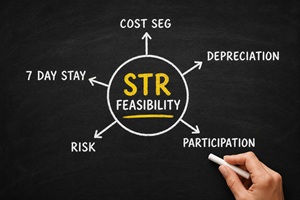
Key Takeaways
- STRs Can Work, But Only If the Facts Cooperate: The short-term rental loophole is powerful, but it only works when your income, time, and property setup align with IRS rules. Otherwise, it turns into a passive loss pumpkin at midnight (ok, well, tax time away).
- Material Participation Is the Make-or-Break Factor: Most STR strategies fail here. If you cannot realistically meet one of the IRS material participation tests, your losses likely get trapped and lose their punch. 100 hours and no one did more than you is the most common test. Acquisition, pre-opening and renovations can be problematic.
- The 7-Day Rule Drives Qualification: Average guest stay determines whether your property even qualifies as a short-term rental for tax purposes. Seems simple, but there are gotchas on mid-year conversions and late-year purchases.
- First-Year Tax Savings Must Be Modeled, Not Guessed: Cost segregation, depreciation (bonus versus Section 179), and income levels all interact. Real numbers beat online calculators every time, especially when Excess Business Loss limits enter the tax savings chart or marginal tax brackets decrease too quickly.
- Cash, Risk, and Time All Matter More Than Tax Hype: This is not just a tax play. You need capital (or willingness to take on debt), and time to operate or manage the property properly. The IRS benefit is just one piece. Short-term rentals are a real business like any other.
- Long-Term Consequences Are Just as Important as Year One: Reduced future deductions, depreciation recapture and exit strategy all matter. A strong first-year tax hit means nothing if the back-end creates regret. Does a 1031 or 721 exchange make sense?
Thinking about a short-term rental but not sure if the numbers actually work for your situation? The STR Feasibility Quick Launch is two focused 75-minute sessions designed to walk you through the loophole fundamentals, stress-test your material participation reality, and model the first-year tax impact before you write the big fat check and take on equally big fat debt (all for a potentially good cause though!).
Dare we say the STR FQL so you don’t up SOL?
STR Feasibility Quick Launch
 Thinking about a short-term rental but not sure if the numbers actually work for your situation? The STR Quick Launch is two focused 75-minute sessions designed to walk you through the loophole fundamentals, stress-test your material participation reality, and model the first-year tax impact before you write the big fat check and take on equally big fat debt (all for a potentially good cause though!).
$950
Both sessions included
2
75 minutes each
1
First-year impact model


Cost Seg, Depreciation & Tax Impact
- Understand Cost Segregation and Asset Classification
- Evaluate Bonus Depreciation vs. Section 179
- Navigate State Conformity Differences
- Plan Material Participation with a Property Manager
- Model First-Year Tax Impact
- Analyze 5 to 10 Year Horizon, Exit, and Change in Use
Add On
- Scenario Tax Planning and IRR Monitoring

Session 1: Foundation, Footprint & Ambition (75 minutes)
Most conversations around the short-term rental loophole start with excitement and a single question. Can I actually offset my W-2 income? Maybe. But only if you meet the rules. Session 1 is about separating what is possible from what is actually viable for your situation.
We walk through the mechanics of the STR loophole which feels naughty, right? So, some people say short-term rental tax advantage. Yawn. Regardless, and more importantly, we pressure-test whether you can realistically execute it. This is not about theory. It is about property selection, required cash outlay, first-year tax savings, the time you need to invest in the activity, and the risk, both financial and audit. In that order.
Session 1 is both foundational and educational on the way to feasibility.
- Wealth Ambitions First: We start by defining what winning actually looks like for your household because the tax tail should never wag the investment dog. An STR is a means to an end, not the end itself.
- The Footprint Teardown: We strip your current tax setup down to the studs to see what you are already doing to reduce taxes, what is stuck in passive loss purgatory, and whether an STR actually fills the gap or just adds complexity.
- Capital and Risk Appetite: We assess your available cash, willingness to take on debt, and true tolerance for financial and audit risk. These are the guardrails that determine whether the strategy is viable before we discuss a single property.

- The 7-Day Rule and Guest Stay Math: We break down the STR qualification rules including computing average guest stay so there is no ambiguity about whether your subject property qualifies.
- Material Participation Reality Check: We assess whether you can realistically meet one of the IRS material participation tests. This is where most strategies fail. Using a property manager does not automatically blow this up, but it changes how you must operate. Renovations? Pre-Opening duties? Check out our Material Participation Executive Summary.
- Time Log Strategy: We build a defensible approach to tracking your time including corroboration against travel records, Home Depot purchases, emails, phone calls, and third-party events. If it is not documented, it did not happen.

Before moving forward, we close the loop. WCG delivers a brief Session 1 summary outlining whether the STR loophole tax strategy is viable for you, what assumptions must hold, and what risks exist. If Session 1 does its job, you arrive at Session 2 with a clear picture of your situation and a focused set of questions worth modeling.
Session 1 Checklists
We do not show up to Session 1 cold. Before we meet, your WCG advisor has reviewed your tax returns, mapped your income profile, and identified where the STR loophole could realistically move the needle for your situation. The checklist below is what makes that preparation possible. Your job is to get us the documents and complete the questionnaire at least 48 hours before we meet. Our job is to show up with a point of view. The more complete your submission, the faster we get to the real question: does this strategy actually work for you?
Pre Session Checklist
Required Documents (at least 48 hours prior):
- Last 2 years of complete tax returns (all federal + state)
- Current year-to-date paystubs (W-2 earners)
- Expected full-year-to-date profit and loss (business owners)
- Most recent K-1s (if applicable)
- Summary of real estate holdings (address, ownership %, use, expected net profit/loss for each)
- Investment account snapshot (taxable + retirement)
 Client Questionnaire (must be completed):
- Any major life changes (marriage/divorce, new child, job change / spouse employment change, relocation)
- Any anticipated events (large bonus / equity vesting, business sale or acquisition, property purchase or sale)
- Current cash availability (rough ranges are fine) including lines of credit
- Self-identified risk tolerance (Low / Moderate / Aggressive)
Before We Meet (STR Tax Strategist):
- Review of tax returns (identify top 3 income drivers, flag missed opportunities, note AGI trend)
- Review of all current year income sources
- Review Client Questionnaire
Session Checklist
Session 1 Objectives
- Determine whether the STR loophole is viable for your situation
- Identify the key assumptions required for the strategy to work
- Eliminate scenarios that will not hold up under IRS scrutiny
Income & Tax Profile
- Review all income sources (W-2, business, investments, real estate)
- Identify marginal tax bracket and depth (reverse marginal tax bracket trap)
- Assess whether STR losses would materially impact your tax liability
Liquidity & Capital Readiness
- Assess available cash and access to financing
- Evaluate ability to acquire and operate a short-term rental
- Identify constraints that could limit execution
Passive Activity & Loss Positioning
- Understand how passive losses are created and why they get trapped
- Identify scenarios where STR losses revert to passive and become unusable against W-2 income
- Discuss how suspended losses are released including property profits, grouping elections, and disposition
STR Qualification (7-Day Rule)
- Confirm average guest stay requirements
- Evaluate whether intended use meets STR classification
- Discuss late year in-service dates including conversions to/from LTR
Material Participation Assessment
- Evaluate ability to meet IRS material participation tests
- Identify which test is most realistic for your situation
- Review acquisition, pre-opening, renovations and other phases
- Assess impact of using a property manager on material participation strategy
- Discuss grouping elections (future talk)
Time Log Strategy
- Define approach to tracking participation hours
- Identify tools or systems for documentation
- Establish corroboration standards (defensibility) including travel records, receipts, communications, and third-party events.
Session 1 Reality Filter
- Confirm whether STR strategy is generally viable
- Identify key risks (time, execution, audit exposure)
- Review guardrails and constraints that will carry into Session 2 modeling
Session 1 Next Steps
- Confirm whether to proceed to modeling
- Identify target property assumptions (purchase price, use, location)
- Review WCG STR loophole materials and material participation resources ahead of Session 2



Session 2 Checklists
Session 1 told us whether the strategy is worth pursuing. Session 2 is where we see whether the numbers actually hold up. Before we meet, your WCG advisor has reviewed your Session 1 summary, identified the key assumptions to model, and prepared the depreciation and tax impact framework for your specific property profile. Your job is to come in with a target property in mind, rough purchase price, intended use, and location. Our job is to run the real math and give you a clear answer. Not a range. Not a best case. Your numbers.
Session 2 Objectives
- Quantify the tax impact of the STR strategy
- Evaluate first-year benefit versus long-term consequences
- Determine whether the strategy works financially and operationally
 Cost Segregation and Depreciation
- Review asset classification and depreciation acceleration
- Evaluate applicability and timing of a cost segregation study
- Understand residual estimation method versus fully-engineered
Depreciation Strategy and State Conformity
- Compare bonus depreciation vs Section 179 and first-year impact
- Evaluate future-year tax positioning under each method
- Identify whether your state conforms to federal depreciation rules and quantify the difference
- Assess impact on second home conversion or change in use
Material Participation with Property Management
- Evaluate use of property manager and impact on participation strategy
- Confirm ability to maintain material participation with third-party management
- Identify operational adjustments needed to protect the deduction
First-Year Tax Impact Modeling
- Estimate first-year tax savings based on income, bracket, and depreciation profile (show me the money)
- Calculate the Cashless Tax Savings Ratio
- Calculate first-year Cash-on-Cash return including tax injection and baseline operating income
- Evaluate Excess Business Loss limitations and carryforward exposure (arguably low with a single STR)
- Stress-test against alternative income scenarios
5 to 10 Year Horizon and Exit Analysis
- Evaluate reduction in depreciation benefit after year one (pay more in taxes, paying back your cost seg)
- Estimate depreciation recapture exposure on sale
- Assess capital gains implications
- Evaluate change in use scenarios including STR to personal use or long-term rental
Strategy Decision
- Confirm whether STR strategy meets financial and operational goals
- Identify deal-breakers or constraints that prevent moving forward
- Decide to proceed or walk away with confidence
- Identify strategies set aside for now that may become viable in future years
Execution Readiness
- Discuss entity structure and ownership considerations before acquisition
- Identify cost segregation provider and optimal timing
- Confirm documentation and time tracking requirements going forward
- Align expectations for ongoing compliance and annual review
Session 2 Next Steps
- Confirm decision to move forward or not
- Identify implementation timeline and key milestones
- Review late-year material participation and average guest stay again
- Coordinate with real estate agents, lenders, or cost segregation providers as applicable







Chat With a Tax Pro
Taxes can be tricky. Chat with a WCG human now and get questions answered.





























Table Of Contents

Tax Planning Season
Tax planning season is here! Let's schedule a time to review tax reduction strategies and generate a mock tax return.

Bookkeeping Services
Tired of maintaining your own books? Seems like a chore to offload?