


Parent-Child Arrangement (Income Flows “Down”)
Table Of Contents

Can an S Corp split profits unequally? No, and that is where this arrangement comes from. It involves a multi-member LLC where you and another non-spouse partner are the members. As we covered in Chapter 1, an S corporation can have only one class of stock, so income is allocated and distribution rights follow ownership percentages. If you are 50-50 with another S Corp shareholder, income and distributions are also 50-50. However, that might not be fair or equitable.
For now, let’s back up for a moment. If this multi-member LLC was not taxed as an S corporation, the Operating Agreement could dictate a different split (we call this a special allocation under IRC Section 704(b)). For example, you and another insurance agent team up, but you want an Eat What You Kill revenue model. You could be 50-50 partners from an ownership perspective, yet split the net business income after expenses (the profit) and the eventual distributions based on the production of each insurance agent, provided those allocations reflect the underlying economics and satisfy IRC Section 704(b). Elegant. Simple.
You S Corp elect this thing, and now it blows up. Regardless of what your Operating Agreement says about production or income splitting, taxable income is allocated based on ownership percentages, and shareholders must have identical rights to distributions and liquidation proceeds. A binding agreement giving one shareholder preferential distribution rights creates a second class of stock and can terminate the S Corp election (IRC Sections 1361(b)(1)(D) and 1362(d)(2)). An occasional uneven distribution is a different matter, but you cannot use unequal distributions as a substitute for special allocations.
You could always abandon the S corporation election idea, but you are a taxpaying citizen and want the best of both worlds. You want to save on self-employment taxes as well as have a fluctuating income split. What can be done?
The first solution is to equalize with salaries. Let’s say the split based on production for the current year should be 55-45, but you are 50-50 owners. Salaries could be adjusted so that the “55% earner” obtains more of the available cash. This is an easy solution and works reasonably well when the production split closely resembles the ownership (or distribution) split.
But if the gap between production and ownership grows too much, equalizing through salaries becomes expensive. Every $10,000 of equalization bonus costs about $1,500 in payroll taxes while wages stay under the Social Security wage base of $192,300 for the 2027 tax year. Above the wage base, the cost drops to Medicare taxes. Here is an example with $200,000 of net business income after expenses, 50-50 owners, reasonable salaries of $38,000 each, and a production formula that says 40% to Batman and 60% to Robin (let’s say they are financial advisors)-
| One S Corp, Equalized | Batman | Robin |
| Production Allocation | 40% | 60% |
| Base Salary | $38,000 | $38,000 |
| Equalization Bonus | $0 | $38,252 |
| Pro Rata Distribution | $38,504 | $38,504 |
| Economic Benefit (Salary Plus Distribution) | $76,504 | $114,756 |
| Share of Economic Benefit | 40% | 60% |
| Employer Payroll Tax at 7.65% | $2,907 | $5,833 |
| Payroll Tax That Exists Only to Equalize | $5,853 | |
To get Robin to 60% of the economic benefit, the S Corp must pay Robin a $38,252 equalization bonus. The bonus is deductible by the S Corp and taxable as wages to Robin, but it also generates additional payroll taxes and can affect the Section 199A deduction. For now, we’re isolating the payroll tax difference rather than modeling everyone’s complete income tax return. That difference is $5,853, half paid by the company out of the distributable pool and half withheld from Robin’s check, and it exists only because the S Corp cannot split 40-60.
Run the same $200,000 through the arrangement below, and the two owners save approximately $5,853 in combined employer and employee payroll taxes, assuming their reasonable salaries remain the same. That is real money, although the additional entities and tax returns come with their own costs.
What’s plan B then? Easy!
We create three entities. A mothership that is a multi-member LLC (MMLLC), with each member being an S corporation. Each S corporation is owned 100% by its principal. Stay with us on this one. The following example shows three S corporations as members of the MMLLC, but just ignore one side if you are a two-person show.
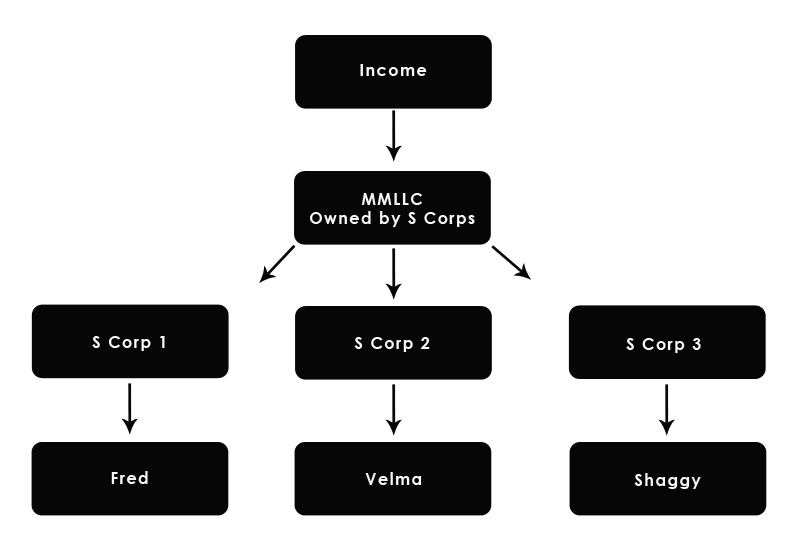
The MMLLC is really a funnel, which is why we call it the “mothership.” All revenue goes in, all common expenses are paid out (internet, copier lease if you remain stuck on paper, admin functions and so on), and an Operating Agreement dictates how the profits are split. K-1s are issued to the MMLLC’s members, which happen to be S corporations. Those S corporations then pay a reasonable salary to their respective sole shareholders and distribute the remainder.
Before we tell you about the flaw with this arrangement, let’s break this down with an example. The MMLLC earns $250,000 after expenses. S Corp 1 receives $125,000 according to the Operating Agreement (yet it remains a 1/3 owner). S Corp 1 pays a reasonable salary of $55,000, incurs about $4,200 of employer payroll taxes, and has approximately $65,800 remaining for distribution, assuming no other expenses. S Corp 2 receives $60,000 and S Corp 3 receives the balance, and both S corporations pay reasonable salaries and distribute the remainder.
There are some excellent benefits beyond the income splitting and the self-employment tax savings. Each S corporation is independent, with its own autonomy and privacy. Referencing the schematic above, there are some intangible yet valuable tax advantages-
- Fred could buy whatever business car he wants. Sure, the MMLLC could set an allowance for everyone, with anything above it paid by the member, but that gets messy real quick and loses significant tax efficiency.
- Velma could work from home and reimburse herself for a home office while others choose not to. Fred and Velma might also have different sized home offices and expenses, and handling the reimbursement at the S Corp level removes the office politics and the equalization issues.
- Shaggy could rent an office, since his place is… well… a doghouse of sorts and he needs some space to work.
Each S corporation can run expenses through as it sees fit without upsetting the other business partners. You want to attend conferences in Las Vegas. Another partner wants to add a child or spouse to payroll. Each S Corp operates independently and can do what it wants with its money (with some minor rules such as 401k plans, and the usual rules for business deductions and reimbursements). Home office? Buy a car? Your call, nobody asks.
At WCG CPAs & Advisors, we commonly see this arrangement with attorneys, medical groups (surgery groups, physicians, anesthesiologists, nurse anesthetists and so on), insurance agents and financial advisors. It is common anywhere the net business income is not shared equally, but rather on some formula or agreement. The paper matters here too. Who performs the services and who earns the income are real questions, and we dig into them later in this chapter.
401k plans in this situation can get tricky. When the baby S Corps regularly provide services to the mothership, or work together to serve clients, the entities can form an affiliated service group under IRC Section 414(m). That generally means employees across the group must be considered together for retirement plan testing. The ownership-based controlled group tests might not catch three unrelated, equal owners, but the affiliated service group rules can. More information can be found in our later chapter on retirement plans. Proceed with caution and involve your 401k plan administrator (Spoiler Alert: separate 401k plans can work if the only employees are the owners and their spouses).
Wait! Before you blast off and create the above arrangement, this version has fallen out of favor. There is another version where the MMLLC is owned by the individuals rather than the S corporations. Why? Let’s find out! Release the Mothership Baby S Corp Construct!
Jason Watson, CPA, is a Partner and the CEO of WCG CPAs & Advisors, a boutique yet progressive tax, accounting and business consultation firm headquartered in Colorado Springs, Colorado. With 7 partners and 110 incredible professionals across offices in Colorado, South Dakota, Wyoming and India, WCG serves small business owners, real estate investors and taxpayers worldwide.


Taxpayer’s Comprehensive Guide to LLCs and S Corps 2025 Edition
 This KB article is an excerpt from our 420+ page book (some picture pages, but no scatch and sniff) which is available in paperback from Amazon, as an eBook for Kindle and as a PDF from ClickBank. We used to publish with iTunes and Nook, but keeping up with two different formats was brutal. You can cruise through these KB articles online, click on the fancy buttons below or visit our webpage which provides more information.
2027 EDITION IS CURRENTLY BEING WORKED (partial releases throughout November)
 |
 |
 |
| $49.95 | $39.95 | $29.95 |



Chat With a Tax Pro
Taxes can be tricky. Chat with a WCG human now and get questions answered.