


Partnerships
Table Of Contents

Partnership entities differ mostly in who is on the hook when things go sideways-
- General Partnership (GP): every partner has unlimited personal liability for the partnership’s debts.
- Limited Partnership (LP): the general partner has unlimited liability, while the limited partners risk only what they invested.
- Limited Liability Partnership (LLP): a general partnership that registers with the state so that, in most states, each partner is shielded from the partnership’s debts and from the other partners’ mistakes (Revised Uniform Partnership Act Section 306(c)). This is the law firm and CPA firm favorite.
- Limited Liability Limited Partnership (LLLP, or triple “L” P): an LP that extends the liability shield to the general partner as well (Uniform Limited Partnership Act Section 404(c)).
Remember, this is financial exposure, not necessarily other perils such as tort liability. An LLP partner is protected from a partner’s malpractice, not their own. More about that later.
Multi-Member LLCs Replacing Limited Partnerships
We won’t discuss these entity types much either since they have fallen out of favor lately. Many attorneys are now creating two classes of members within a MMLLC to mimic the different groups that a true limited partnership would create. So, it walks and smells like an LP but it is actually a MMLLC, without the burden of complication and cumbersome ordering rules. For example, “A Members” are the old-school version of General Partners, and “B Members” are the equivalent of Limited Partners. Most of the attorneys we work with don’t create partnerships anymore, including family limited partnerships (FLPs), opting instead for the use of MMLLCs.
One recent wrinkle shows how fast this stuff moves. In January 2026, the Fifth Circuit handed taxpayers a big win in Sirius Solutions, holding that a state-law limited partner with limited liability qualified for the limited partner exception from self-employment tax, no matter how hard they worked. Then the court reconsidered.
In August 2026 it withdrew that opinion and issued a new one in the same case (the partnership had since changed its name, so it now reads K Alain, L.L.L.P. v. Commissioner), holding that a limited partner under IRC Section 1402(a)(13) is a partner who plays no significant role in managing or running the business. In September 2026 the Second Circuit reached essentially the same place in Soroban Capital Partners, holding that full-time principals exercising managerial control were not limited partners for this purpose.
So for owners who run the business, the dusty LLLP no longer has the edge it appeared to have for a few glorious months. It might still matter for a genuinely hands-off owner, since neither case resolves how LLC members are treated, and the First Circuit has a similar appeal pending. Talk to us before converting anything; as of October 2026, this fight is not over.
Partner, Member or Shareholder?
Throughout this book we might refer to members as partners. More often than not we are referring to a member of a multi-member LLC. While partner and member are technically different, and the entity type will ultimately decide member or partner, these words are often interchanged by business owners; we are doing our best to reverse the trend.
What gets really obnoxious is shareholder and member-
- A corporation has shareholders.
- An LLC has members.
- A corporation taxed as an S Corp has shareholders (that one is easy).
- An LLC taxed as an S corporation has members and shareholders.
From an entity perspective, we use members. From a tax return perspective, we use shareholders, since Form 1120S and its K-1s speak only in shareholders. Why? Historically, before the existence of LLCs, an S corporation’s underlying entity was predominantly a corporation. Wyoming invented the LLC in 1977, but LLCs did not catch on until the check-the-box regulations made them easy to tax in 1997, by which time the S Corp vocabulary was long set in stone.
Jason Watson, CPA, is a Partner and the CEO of WCG CPAs & Advisors, a boutique yet progressive tax, accounting and business consultation firm headquartered in Colorado Springs, Colorado. With 7 partners and 110 incredible professionals across offices in Colorado, South Dakota, Wyoming and India, WCG serves small business owners, real estate investors and taxpayers worldwide.


Taxpayer’s Comprehensive Guide to LLCs and S Corps 2025 Edition
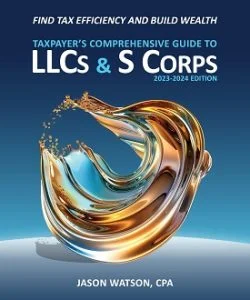 This KB article is an excerpt from our 420+ page book (some picture pages, but no scatch and sniff) which is available in paperback from Amazon, as an eBook for Kindle and as a PDF from ClickBank. We used to publish with iTunes and Nook, but keeping up with two different formats was brutal. You can cruise through these KB articles online, click on the fancy buttons below or visit our webpage which provides more information.
2027 EDITION IS CURRENTLY BEING WORKED (partial releases throughout November)
 |
 |
 |
| $49.95 | $39.95 | $29.95 |



Chat With a Tax Pro
Taxes can be tricky. Chat with a WCG human now and get questions answered.