


Pass-Through Entity Tax (PTET) and the SALT Cap Work-Around
Table Of Contents
 What is the pass-through entity tax, and why do S Corp owners care? Way back in 2017 when Ed Sheeran was topping the charts, the Tax Cuts and Jobs Act was passed with a lot of cool tax deductions like the Section 199A qualified business income deduction. But life is one big equalizer, and Congress limited the deduction for state and local taxes (SALT) to $10,000. People in South Dakota owning a $600,000 house were like “what’s the big deal?” People in Oregon owning the same house were like “WTF, over?”
So, in a classic game of cops and robbers, please a little survival instinct, states got creative. They created a state tax paid by partnerships and S corporations (pass-through entities, or PTEs if you are a cool kid), which lowers federal taxable income for the business. The tax is then credited on the owner’s state income tax return. The IRS blessed the arrangement in Notice 2020-75, and roughly three dozen states now have a version. In other words, the business pays the human’s state income tax. Cash is cash to a business owner whether it is spent by the business or the human.
The SALT Cap Today (A Sliding Scale)
The One Big Beautiful Bill Act (OBBBA) raised the SALT cap, added a sliding scale and left PTET alone. The cap is $40,804 for the 2027 tax year, the same for single and joint filers, and it rises 1% a year through the 2029 tax year. Then it snaps back to $10,000 in 2030 unless Congress acts.
Here is the catch. The cap shrinks by 30 cents for every dollar of modified adjusted gross income (MAGI) above $510,050 for the 2027 tax year, until it lands back at $10,000-
| MAGI for the 2027 Tax Year | Your SALT Cap |
| Up to $510,050 | $40,804 |
| $550,000 | $28,819 |
| $600,000 | $13,819 |
| $612,730 and above | $10,000 |
So, the higher your income, the less the new cap helps, and the more PTET matters.
How PTET Works
Here are the nuts and bolts, using a state with a 5% PTET rate and an S Corp with $200,000 of net ordinary business income after your salary-
- The business pays the state $10,000 of PTET ($200,000 x 5%).
- That $10,000 is a federal deduction on the S Corp tax return, so your K-1 shows $190,000 of income to the IRS.
- Your state generally does not let the federal PTET deduction reduce the income it taxes, so it adds the $10,000 back. Ignoring other state adjustments, your state taxable income from the business is still $200,000.
- The state then credits the $10,000 the business already paid against your state income tax on your individual tax return, like an estimated tax payment. You are not taxed twice. The business simply paid it for you.
- If none of that state tax was deductible to you personally, and you are in the 32% marginal tax bracket, you just saved about $2,560 in federal tax. If you are getting the full 20% qualified business income deduction, the math is $10,000 x 80% x 32%, since the PTET deduction trims that deduction a bit.
The state is generous enough to help you save federal tax. It is generally not generous enough to let you save state tax twice. They also cannot print money.
Bottom line is this- does it feel better to pay your state income tax with personal dollars or business dollars? It is a bit rhetorical… no need to say it out loud or call us.
Credit States Versus Exclusion States
Most states work the way we just described; add the tax back, then give you a credit. A handful of states, like Georgia, skip the credit. They tax the income at the business level, and you subtract that business income in arriving at your individual state taxable income. Same idea, different plumbing.
The plumbing matters. In an exclusion state, your personal deductions and credits only have your salary and other household income to work against, since the business income has been subtracted out. If your salary is low, which is the goal with an S Corp, some of those deductions go to waste and your state tax bill can go up. The federal savings must beat that. An exclusion state can also complicate the credit your home state gives you for taxes paid elsewhere.
Does PTET Help You? (It Depends on Your Income)
Bullet #5 above has a big “if” in it. PTET only helps to the extent your state taxes were not deductible in the first place, and with the higher cap, that is no longer everyone.
| Your Situation | Does PTET Help? |
| You take the standard deduction | Yes. Your state tax becomes a business deduction instead of nothing. |
| You itemize and your state and local taxes exceed the cap | Yes, on the excess. |
| Your MAGI is above the phase-down | Yes, and more as your cap slides toward $10,000. |
| You itemize, you are under the cap and under the phase-down | Little or none. It can even cost you a bit, since you trade a full deduction for one that trims your Section 199A deduction. |
| You live and work in a state without an income tax | No. There is nothing to work around. |
There is a bonus for those in the slide. PTET lowers your adjusted gross income, which can pull you back toward the phase-down threshold and give you more of the cap. And remember 2030. If the cap drops back to $10,000 as scheduled, PTET goes back to helping almost every business owner in a state with an income tax.
Why PTET Is an S Corp Benefit
Your garden variety single-member LLC is generally not eligible to make a PTET election. It is disregarded, and you are essentially a sole proprietor for income tax purposes. Slap an S Corp election on it and suddenly PTET might become available (you could also add another member, such as your spouse, and tax your LLC as a partnership, but then you are back to paying self-employment taxes on the whole thing). In most states, PTET is figured on the business income and not your W-2 salary, so it also plays well with a reasonable salary that is not inflated.
PTET Takes Planning (Tax Projections and Payroll)
PTET is not a set-it-and-forget-it election. The right payment depends on what the business will earn this year, where your household income lands on the SALT cap slide, and whether you will itemize. None of that is known in January, and most of it has moved by July. This is why WCG CPAs & Advisors runs a business entity tax projection alongside your household tax projection mid-year, and then adjusts the PTET payments before December 31. Pay too little and you leave federal savings on the table or eat penalties. Pay too much and your cash sits with the state.
Payroll is the other half. If the business is paying your state income tax through PTET, your paycheck should withhold far less state income tax, and perhaps none. Otherwise you pay the state twice during the year and wait for a big refund in the spring. A big state refund is not a win. It is your money coming home late. Your payroll plan gets rebuilt around the PTET election so the two work together.
Not All That Glitters (State Gotchas)
As Led Zeppelin once sang, not all that glitters is gold. Every state wrote its own PTET rules, and some of them bite. In the order you will run into them-
- Early enrollment. Some states want you enrolled early in the tax year, long before you know what the year looks like, and often through an online system that is separate from your tax returns. New York is one. Its annual election is generally due March 15. Miss the window and you wait until next year. A few states also make the election binding for more than one year.
- Required advance payments. Some states tie the election to a mid-year payment. California, for example, generally wants the greater of $1,000 or half of last year’s PTET by June 15. Starting with the 2026 tax year, a shortfall no longer kills the election, but it reduces the owner’s credit.
- Cash flow. PTET does not make the state tax disappear. It changes who pays it and often when. The business needs enough cash to make the entity-level payments while you adjust your personal withholding and estimated tax payments accordingly.
- Late payment penalties. PTET usually comes with its own estimated payment schedule, separate from yours. Miss a payment and some states charge underpayment penalties stiff enough to eat a good chunk of the federal savings. Saving $3,000 federally and paying $1,500 in penalties is technically still tax planning. It is just crummy tax planning.
- Payment timing. For a cash-basis S Corp, the federal deduction generally lands in the year the PTET payment actually goes out. December 31 matters. March might be too late for the federal deduction you wanted this year.
- Overpayments. Some states roll an overpayment forward instead of refunding it, which leaves your cash parked with the state.
- More than one state. Nonresident owners and multi-state businesses have to check whether their home state gives credit for another state’s PTET.
Not every business owner will benefit from PTET, and the planning is the hard part. More here-
Jason Watson, CPA, is a Partner and the CEO of WCG CPAs & Advisors, a boutique yet progressive tax, accounting and business consultation firm headquartered in Colorado Springs, Colorado. With 7 partners and 110 incredible professionals across offices in Colorado, South Dakota, Wyoming and India, WCG serves small business owners, real estate investors and taxpayers worldwide.


Taxpayer’s Comprehensive Guide to LLCs and S Corps 2025 Edition
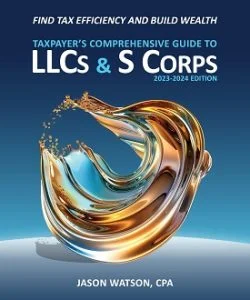 This KB article is an excerpt from our 420+ page book (some picture pages, but no scatch and sniff) which is available in paperback from Amazon, as an eBook for Kindle and as a PDF from ClickBank. We used to publish with iTunes and Nook, but keeping up with two different formats was brutal. You can cruise through these KB articles online, click on the fancy buttons below or visit our webpage which provides more information.
2027 EDITION IS CURRENTLY BEING WORKED (partial releases throughout November)
 |
 |
 |
| $49.95 | $39.95 | $29.95 |



Chat With a Tax Pro
Taxes can be tricky. Chat with a WCG human now and get questions answered.