


Posted Friday, August 8, 2025
Table Of Contents
 Ahhhh… what a cute picture. These are not business owners or two accidental sole proprietorship operators. They might be business sellers though. Sarcastically, business ownership does not mean you own a business; it means thebusiness owns you, but that can be a good thing!
Pursuing a passion and making it into a profitable enterprise is a great way of life, but certain foundational steps need to be in place for long-term success. Liability protection, self-employment taxes, tax planning and estimated tax payments, retirement savings and solo 401k plans, accountable plan reimbursements, exit strategies, business valuations, etc. are all considerations that many small business owners neglect. LLC? A good old fashioned C Corp? S Corp Formation? Keep it a sole proprietorship? Perhaps a Limited Partnership? We can help.
Business entity selection is important, but it is not cast in stone. Many businesses often start off as one entity type, and then later convert. WCG CPAs & Advisors did just that; we were an LLC until the founding partners expanded ownership to include other partners and employees. At that point it was better to convert to a corporation so that shares may be sold or paid out, versus member interest in an LLC.
First, we’ll talk about some basic business entity concepts.
Liability Protection (Fallacy)
Some sole proprietorships are concerned about being sued and therefore they create a limited liability company… an LLC… to protect their assets. Good or bad? It depends of course.
Being Sued With An LLC
Can I be sued if I form an LLC for my business activities? Yes. What about a corporation? Yes!
Not only could you be sued on a personal level, you can also lose on a personal level. While consultation with an experienced business law attorney is strongly recommended for your unique situation, as business owners ourselves, we feel the excitement of the LLC, especially the words “limited liability,” has overshadowed the reality of our litigious society. Keep in mind that a closely held business is simply a collection of people who are ultimately and personally responsible for the actions of the business.
In other words, if your careless acts, errors or omissions injure someone even though it was under the auspice of your LLC, good chances you will be personally named in the lawsuit in addition to the business, and held liable as the owner of the LLC. Remember that injury is not limited to just bodily injury; it could also mean financial injury.
 Being Sued With A Corporation
Officers and directors of corporations are routinely held liable for the actions of the corporation. This is called piercing the corporate veil. Can you say Enron? As alluded to earlier, piercing the corporate veil typically is most effective with smaller privately held business entities (close corporations) in which a) the corporation has a small number of shareholders, b) has limited assets, and c) separating the corporation from its shareholders would promote fraud or an inequitable result. Sounds like about 99% of the corporations out there, right? Right! LLCs are similar.
Being Sued With A Trust
Let’s also bring up a Trust. A lot of people set up a trust and in most cases, a revocable or living trust, where you are both grantor and trustee. This type of trust is worthless until you pass away- sure, your assets are titled in the trust and blah blah blah, but it does nothing for asset protection. A revocable trust has two primary purposes once you pass away- to avoid probate which is public record, and to “speak from the grave” in terms of how your estate is administered.
However, while you are alive, a revocable trust or living trust or family trust or the amazing Buckingham family trust dated July 4, 2025 or whatever tricked out name you want, does nothing. Absolutely nothing. Until you die- then your trust springs into action. Until then, your house that is “owned” by your trust is truly controlled by you and is inextricably connected to you, and be used to pay creditors and judgments.
The only way to shield your assets including for Medicare purposes is to use an irrevocable trust- but this is like the Hotel California. Your assets check in but never leave. Or is that a roach motel? At any rate, you, the grantor, cannot be the trustee in an irrevocable trust. Therefore, you do not control your assets and they are effectively disconnected from you.
Now What?
So, what do you do? First, securing a decent umbrella policy, both at the personal and commercial level, is our strong recommendation for liability arising from your acts, errors and omissions. Speak to your insurance agent, but typical umbrella policies are $1,000-$1,500 per year. Second, speak to a qualified business law attorney.
Third, and this is the most important, be a good person. If you are a landlord, fix that railing. If you are a truck driver, be diligent in your driving.
We’ve expanded on this LLC fallacy in our KB articles from our book, Taxpayer’s Comprehensive Guide to LLCs and S Corps.
LLC Formation
 The power of advertising, the ease and the hype have created this fervor surrounding the limited liability company. Do you know what LLC really stands for? That’s right.. Lawyer’s Likely Choice. We like to poke fun at attorneys- creating an LLC is an easy way to get your small business off the ground and it instantly moves you past the sole proprietorship. While there are significant benefits there are many things to consider.
Just like 401k’s are not IRAs, LLC’s are not corporations. The C stands for company not corporation. LLCs file Articles of Formation or Organization… not Incorporation. You don’t issue shares in an LLC nor do you have shareholders. You have members who own an interest (economic or equity, or both). Sorry to be snooty, but there are some strong technical differences.
Quick Myth Buster- As mentioned above, LLCs do NOT automagically protect you from all lawsuits- limited liability does not mean tort liability. Huge misconception! Do you really think the world would go ’round if your errors and omissions could be wiped clean through an LLC? Nope. Turn the tables for a moment. What if you were on the receiving end of a car accident and the bozo waives some formation documents and says, “You can’t sue me. This is a business car!” We doubt our justice system and our demands for equity would allow that.
You do receive some liability protection. For example, if you sign a contract with an internet provider as a member of the LLC and you are not signing as an individual, then if your business fails your personal assets should be shielded from liability for the internet contract. This is one of the fundamental differences between a sole proprietor and an LLC.
You should always seek the advice of a competent business law attorney.
S Corp Formation
 As mentioned elsewhere, an S corporation does not exist as an entity. Some other underlying entity must exist, such as an LLC or corporation, that then chooses to be taxed as an S Corp. People say “I have an S Corp” all the time… and there is nothing wrong with that, but technically you have some other recognized entity being taxed as an S corporation. You won’t see “S Corp” listed on a Secretary of State’s website. You also won’t see sole proprietorship listed on the SOS website either… and therefore you cannot S Corp elect your sole proprietorship. You need a recognized business entity.
Reducing your self-employment taxes is the main reason business owners want to be taxed as an S Corp. There are some issues such as payroll, corporate tax return requirements and passive incomes. But if you have over $50,000 in net business income after expenses, you might want to give it some serious consideration. Why? You could save about 8% to 10% of your net business income in taxes… so, if you earn $100,000 in your business after expenses, either as a sole proprietorship or LLC, you could save $8,000 to $10,000 in taxes.
Does an S Corp make sense? Here are some questions to consider-
- Does your business earn over $50,000 net income (profit) after expenses? Say yes. The break-even is basically our fee of $4,500 annually to administer your S corporation tip to tail (tax prep for you and the biz, tax planning, payroll processing, routine quick chats) divided by the savings percentage of 9%.
- Are you located in New York City or Tennessee where S corporation tax rates are egregious and suck up all the federal tax savings? Portland, Oregon? Say no. Although there might be exceptions where an S Corp election makes sense in NYC and TN in order to maximize Section 199A qualified business income deduction benefits because of the secondary W-2 wage test. Portland, Oregon is not that bad... just that your savings compared to an LLC not taxed as an S corporation is not as sexy.
- Do you have other W-2 income that exceeds or comes close to exceeding the Social Security limits of $176,100 (2024)? Say no. If you say yes, we need net business income to exceed $200,000 in #1 above so that the Medicare savings exceeds the “lost” Social Security tax paid by the S Corp (huh? read more here).
- Is this a going concern? In other words, is the business going to continue to earn the same income or more each year? Say yes.
- Do you have an LLC or some other entity in place that can be elected to be taxed as an S Corp? Say yes. If you say No, there are options, just not elegant ones, such as shelf corporations.
- Do you have other partners besides a spouse… business partners, that is? Say no. If you say yes, are you currently splitting income based on ownership percentages or some formula? If you say Formula, then we’ll need to look at a multi-entity arrangement.
- Does your entity own any appreciating assets, such as real estate? Say no. We don’t put appreciating assets into an S corporation (explained here). Holding companies own real estate, and operating companies elect S Corp status. One minor exception- if you are a partner in a law firm or accounting firm, you might elect to have your partner interest held in an S Corp (which will typically appreciate).
Are you still here? Excellent news — read on! You can also complete an online secure form of the above questions, and send them to us for review.



Taxpayer's Comprehensive Guide to LLCs and S Corps
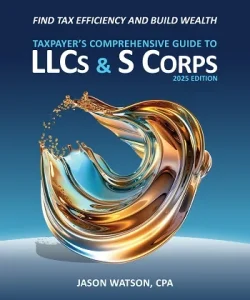 WCG CPAs & Advisors and Jason Watson, CPA, have released the 2025 Edition of Taxpayer’s Comprehensive Guide to LLCs and S Corps. Over 400 pages of pure pleasure! This edition has updated 2025 data such as IRA and 401k limits including Social Security wage limits, but it also has a bunch of new information spread out various chapters such as customized multi-entity structures, expanded reasonable shareholder salary sections, more tax reduction mechanics among various little tidbits gleaned from hundreds of small business consultations. Riveting!
It is available in paperback for $49.95 from Amazon and as an eBook for Kindle for $39.95. Our book is also available for purchase as a PDF from ClickBank for $29.95. Why do we all love 95 cents? We all know that 39.95 is really 40 bucks. At least we are not like gas stations… $39.949. Silly! Yet we digress. Apple iBook, Barnes and Noble Nook, among others are not utilized since their format is challenging to make mini updates here and there.



| Employer Identification Number (EIN) | Yes, but under your SSN |
| Bank Account | No, but you can get a separate personal checking account |
| Process Payroll | Yes, provided you have an EIN |
| 401k, SEP IRA | Yes |
| Wholesale Transfer of Ownership | Yes (provided it is an asset sale) |
| Partial Transfer of Ownership | Nearly impossible (ie, cannot add partners) |
| Financial Liability Protection | None |
| S Corp Election | No |
| Tax Rate | 15.3% + ordinary income tax (10% to 37%) |
| Ability to Deduct Expenses | Same as any other LLC, corporation, etc. |
| California Franchise Tax | No (the one benefit of a sole proprietorship) |
| Other States Franchise, Business Tax | Varies |



I Just Got A Rental, What Do I Do?
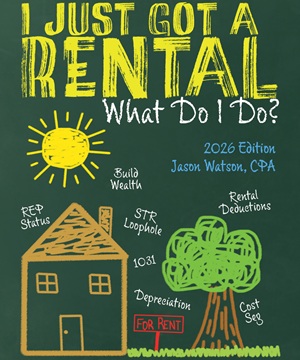 I just got a rental, what do I do? Purchasing a rental property is certainly challenging, but operating one to build wealth and find tax efficiency is equally challenging. This is our second book. Our first book, Taxpayer’s Comprehensive Guide to LLCs and S Corps, was first published in 2014 and was well-received by small business owners and tax professionals, so we thought a book on rental properties and real estate investments would be equally helpful. So, here we are with our second iteration, or the 2026 edition. We update it frequently throughout the year (last update was April 5, 2026).
Our rental property book starts with entity structures and moves into asset management such as acquisition, cost segregation, rental safe harbors, repairs versus improvements, accelerated depreciation, partial asset disposition, and 1031 like-kind exchange. From there we discuss various rental considerations like passive activity losses, short-term rental loophole, real estate professional status, and material participation including what time counts, and what time doesn’t count.
Finally, the good stuff! Rental property tax deductions such as travel, meals, automobiles, interest tracing, home office and common expenses. Fun!
It is available in paperback for $32.95 from Amazon and as an eBook for Kindle for 21.95. Our book is also available for purchase as a PDF from ClickBank for $18.95.



Chat With a Tax Pro
Taxes can be tricky. Chat with a WCG human now and get questions answered.






Aspen Tax Strategy Series
 Not every tax strategy belongs on your tax return. The Aspen Tax Strategy Series is a structured three-session engagement designed to cut through the noise, pressure-test your options, and deliver a blueprint built around your actual numbers, risk tolerance, and wealth goals.
$1,800
All three sessions
3
Foundation, exploration, blueprint
1
Execution



Math & The Blueprint
- Model 2-3 Surviving Strategies in Real-Time
- Map Capital Requirements & Cash Flow
- Analyze Cashless Tax Savings Ratio
- Calculate First-Year Cash-on-Cash (CoC) Return
- Forecast 5-10 Year Exit & Recapture Impact
- Deliver Your Execution Blueprint
Add-On
- Scenario Tax Plan & IRR Modeling

Custom Advisory Service Platforms
 At WCG CPAs & Advisors, our advisory services are built on a simple principle: start with a strong foundation, then customize where it matters.
We begin with one of three core advisory platforms: Keystone, Copper, or Breck (yes, we’re from Colorado). These platforms deliver the fundamentals of proactive tax strategy, forward-looking projections, and year-round compliance.
Once that baseline is in place, we customize the perimeter. If your situation calls for S Corp optimization, deeper strategy sessions, short-term rental planning, or managing a portfolio of K-1 investments, we simply layer those services into your engagement.
Most firms sell packages. We build systems. Yeah, OK, we might have taken that too far. At any rate, here we go-
|
Keystone
Individual Only
$2,220/yr
$185/mo
|
Copper
Business Entity Only
$2,340/yr
$195/mo
|
Breck
Individual + Business
$3,720/yr
$310/mo
|
|
Compliance & Preparation |
|||
| Individual Tax Return (Form 1040, joint filing) [more] | — | ||
| Business Entity Tax Return (Form 1065, 1120, 1120S) [more] | — | ||
| Pre-Preparation Meeting | |||
| Tax Return Review Meeting | |||
| State Income Apportionment, Nexus, Tax Filings [more] | Add-On | Add-On | Add-On |
| Expat / Foreign Income Filings (FBAR, 8938) [more] | Add-On | Add-On | Add-On |
Strategic Tax Planning |
|||
| Pre-Projection Meeting (May/Jun) | Add-On | ||
| Household Tax Projections [more] | — | ||
| Business Tax Projections (Franchise, Privilege, Receipts) | — | Add-On | Add-On |
| Business PTET Optimization [more] | — | Add-On | Add-On |
| Tax Projections Review Meeting (Jul/Aug) | Add-On | ||
| Mid-Year Tax Strategy Session [more] | |||
| Tax Advisory (strategy applied to tax projection) [more] | Add-On | Add-On | Add-On |
| Three Scheduled Periodic Quick Chats (May - Nov) | |||
| Payroll Planning, Optimization [more] | — | Vail Only | Vail Only |
| End of Year Tax Strategy Session (Oct/Nov) [more] | Add-On | Add-On | Add-On |
| Tax Resolution, Audit Defense [more] | Advanced | Advanced | Advanced |



Rental Property Platform Upgrades
 Rental properties are not just investments. They operate like businesses with unique tax considerations at every stage, from acquisition to sale. Our Rental Property Platform Upgrades layer onto your baseline advisory services to ensure your deductions, repairs versus improvements, material participation, STR loophole and REPS compliance, and reporting are handled correctly and strategically. Oh, let's not forget about pesky state issues.
Done right, they produce meaningful tax savings. Done wrong, they create long-term problems.
The following tax return preparation fees will be added to your annual advisory platform above.



STR Feasibility Quick Launch
 Thinking about a short-term rental but not sure if the numbers actually work for your situation? The STR Quick Launch is two focused 75-minute sessions designed to walk you through the loophole fundamentals, stress-test your material participation reality, and model the first-year tax impact before you write the big fat check and take on equally big fat debt (all for a potentially good cause though!).
$950
Both sessions included
2
75 minutes each
1
First-year impact model


Cost Seg, Depreciation & Tax Impact
- Understand Cost Segregation and Asset Classification
- Evaluate Bonus Depreciation vs. Section 179
- Navigate State Conformity Differences
- Plan Material Participation with a Property Manager
- Model First-Year Tax Impact
- Analyze 5 to 10 Year Horizon, Exit, and Change in Use
Add On
- Scenario Tax Planning and IRR Monitoring


Chat With a Tax Pro
Taxes can be tricky. Chat with a WCG human now and get questions answered.

The Rhythm Of The Relationship

Structured touchpoints don't just keep you informed, they prevent the scrambles that feel like emergencies in the first place. As the old adage goes, there are no accounting emergencies, only poor planning.
Here is the typical meeting cadence across our advisory platforms. Which of these are included depends on your platform, and the rest are available as add-ons.
Strategic Milestones: We Reach Out to You
These are on us. We will email, text, and call to get these on the calendar.
- Pre-Projection Meeting (May/Jun): A check-in to jump-start tax projections. We need to understand what changed from last year and where your income is headed.
- Tax Projections Review (Jul/Aug): Once we crunch the numbers, we meet to walk through the results and discuss any adjustments, estimated tax payments, withholding changes, mid-year moves.
- End of Year Tax Strategy Session (Oct/Nov): A 75-minute session to tidy up loose ends for the current year and look ahead to the next. Critical for payroll adjustments and locking in strategy before the ball drops.
On-Demand Support: You Reach Out to Us
A good engagement runs both ways. We chase you for the important ones; these are yours to schedule based on your timeline and needs.
- Tax Return Review (Feb/Apr): A comprehensive walkthrough of your tax returns before filing. One meeting is typical, two if things get interesting.
- Mid-Year Tax Strategy Session: One 75-minute session on a single strategy, with a written recap. Choose any session from our prefabricated library or bring your own questions or concerns.
- Periodic Quick Chats (May through Nov): Three 20-minute calls for whatever comes up. Buying a car? Selling a rental? Just want to vent about the IRS? That's what these are for.
Separately, Tax Advisory takes a strategy from one of your sessions and computes it into your tax projection, so you see what it does to your tax in dollars with a side by side comparison. It is a deliverable rather than a meeting, so we can walk you through it or just send it. Included on some platforms, an add-on on others.
We prefer scheduled video meetings via Teams but a phone call or in-person works too.



How We Communicate
We rely heavily on email and text, but we are not allergic to the telephone. During friendly hours (let's call it 8AM to 7PM, including weekends) we will often just call you if we have a quick question or need clarification. It is usually faster for everyone.
That said, email is a wonderful tool for sending documents, memorializing decisions, and asking simple yes or no questions. It is also a terrible tool for explaining complex tax strategy. To keep things efficient and sane, we operate under two primary communication rules.
The Deep Work Rule (Mondays and Thursdays)
To produce high-quality work, our tax team needs uninterrupted focus. As such, we generally process email on Mondays and Thursdays. Why? It allows us to stay heads-down in your data on Tuesdays, Wednesdays, and Fridays without distraction.
Need us sooner? Call us. If something is time-sensitive, a 5-minute phone call beats a 3-day email wait every time. We are committed to responding to all emails within 3 business days.
 The PB&J Rule (Efficiency)
 The PB&J Rule (Efficiency)
If your email requires more than 10 minutes to answer, we will not reply via email. Instead we will call you or send a calendar link to discuss. Why? The PB&J concept.
Everyone loves a peanut butter and jelly sandwich. But trying to explain how to make one via email takes 45 minutes. Seriously. Crunchy or smooth? Strawberry or grape? Diagonal cut or straight? Toasted?
We could trade 15 emails debating jelly, or we could have a 12-minute conversation, build the perfect sammy, come away more fulfilled, and move on with our lives.
The Recap Promise
We know conversations blur fast for busy people. After every meeting we send a recap email to memorialize the discussion. This recap also gets captured by our workflow software so your entire WCG team stays in the loop.
A Note on Exceptions
We always make room for military clients on secure bases, expats in challenging time zones, and anyone with accessibility needs who requires email as their primary channel. Just let us know and we will work around it.
 For tax preparation and advisory, you will be assigned a two-person team so there is always coverage. Teams are assigned based on your initial conversation, subject matter needs, and overall capacity. This will be your Client Manager and your Tax Accountant. Your Client Manager might be a Partner or Tax Manager.
Your core team owns the relationship and works with you throughout the year. There are some ancillary pieces as well-
- Depending on your engagement, you may also work with our Rental Expert and Tax Strategist Pod, or RETS. These are specialized advisors who step in as subject matter experts when your situation calls for deeper strategy around real estate, niche assets, or advanced tax reduction. They may communicate with you directly, while your core tax team remains involved and informed.
- If you are using our Accounting Services team for bookkeeping and analysis, you will have a dedicated accounting professional supporting that work.
- Across all of this sits our Support team including college interns, handling the day-to-day logistics that keep your engagement running smoothly behind the scenes.
So depending on your engagement, you might work with two to four people at WCG. We think that is a feature, not a bug. Specialization matters.
At the center of it all is your Client Manager. They are the conductor, coordinating your team and keeping everything aligned. You can always reach out to them directly, at any time, for anything.
If you ever find yourself thinking, “I’m not sure who to contact,” just reach out to your Client Manager. They can walk you through the batting lineup so you understand each team member’s role.
Business Formation |
|
| Articles of Organization or Incorporation, or Dissolution | $625 + state filing fee |
| Initial Report (if required) | $125 + state filing fee |
| Annual Report | $350 + state filing fee |
| Employer Identification Number (EIN) | Included |
| Single Member Operating Agreement (SMLLC) | Included |
| MS Word Templated Bylaws Agreement (Corporations) | Included |
| S Corp Election, Timely Election (made with formation) | Included |
| Accountable Plan | Included |
Onboarding Fees (one and done) |
|
| Payroll Accounts Setup or Closing | $550 to $650 depending on state |
| Payroll Quick Launch, Account Setup | $950 to $1,050 depending on state |
| Accounting Setup or Transfer (Fractional Controller) [more] | Varies |
| QuickStart, QuickBooks Setup and Support (90 days) [more] | $750 |
| S Corp Election, Timely Election (within 75 days) | $450 |
| Late S Corp Election Back to January 2024 [more] | $600, $1,200 after Jan 1 2024* |
| Examine Prior Tax Return | Included |
Business Maintenance |
|
| Entity Relocation Package (payroll closure and opening, entity move) [more] | $1,850 (some are $2,100) + state filing fees |
| Address Changes w/o Payroll (IRS, State Dept of Revenue, Secretary of State) | $250 + state filing fees |






No BS
We are not salespeople. We are not putting lipstick on a pig, and trying to convince you to love it, even if Tom Ford’s Wild Ginger looks amazing. Our job remains being professionally detached, giving you information and letting you decide.
 Moreover, many CPAs and tax professionals thrust their risk aversion onto their clients. This is bad. At WCG CPAs & Advisors we must perform our due diligence and hurdle our ethical and professional standards. However, after those gymnastics we present a risk-based analysis to the tax return and let you, the client and taxpayer, decide how to proceed. Having said that, we don’t entertain tax scammers or those who can take down the ship. Arthur Anderson anyone? No thanks.
We also see far too many crazy schemes and half-baked ideas from attorneys and wealth managers. In some cases, they are good ideas. In most cases, all the entities, layering and mixed ownership is only the illusion of precision. Just because you can complicate the crap out of your life doesn’t mean you must. Just like Chris Rock says, just because you can drive your car with your feet doesn’t make it a good idea.



Our Business And Rental Expertise
 As mentioned elsewhere we primarily focus on small business owners and real estate investors, and their unique consultation and tax preparation needs. With over 90 full-time consultation professionals including Certified Public Accountants, Enrolled Agents and Certified Financial Planners on your team, WCG CPAs & Advisors consults on custom business structures, multiple entity arrangements, S corp elections (even late S corp elections back to January), tax strategies, business coaching, industry analysis, executive benefits, retirement planning including individual 401k plans, exit strategies, business valuations, income tax planning and modeling, and tax representation.
We also work with business law attorneys for business owners who have additional needs such as drafting Operating Agreements, fee for service contracts, buying or selling a business including employee stock ownership plans and partner buy-ins. In addition, WCG coordinates with third party plan administrators create age-based profit sharing plans and cash balance (defined benefit) plans. We can run point on whatever your business needs to ensure that communication is effective and efficient allowing you to sell widgets.
Here are some additional resources you might find useful.





Various Things |
|
| Copying and returning of original tax documents | $45 |
| Significant changes or additions after a preliminary tax return is prepared- “crud, let me re-work all my numbers.” | $250 / hr |
| Tax resolution and/or audit assistance; Resolution is typically 2 hours; audit assistance is typically two 2-hour sessions | $375 / hr |
| Lender or “comfort” letters | $250 to $600 |
| Business Valuations | $5,000 – $8,000 retainer, $350 / hr |
| Divorce Analysis, Litigation Support | $250 / hr, $350 / hr for court |
| Client Support, Administrative billable rate | $150 / hr |
| Accountant billable rate | $150 / hr |
| Supervisor billable rate | $250 / hr |
| Manager billable rate | $300 / hr |
| Partner billable rate | $400 / hr |
| Managing Partner billable rate | $450 / hr |
| Senior Partner billable rate | $475 to $525 / hr |
Business Formation Frequently Asked Questions
 What is business formation and why is it important?
Business formation is the process of legally creating your business entity with the Secretary of State, which impacts taxes, compliance, liability protection, and operational flexibility. Choosing the right entity can help with tax efficiency, ownership expansion and exit strategies.
What are the different types of business entities?
Common entity types include LLCs, corporations, partnerships, and professional corporations, each with its own benefits and drawbacks. An S corporation is not a business entity type but rather an election. A sole proprietorship is also not an entity (since it is not recognized by the state as such).
What is an LLC?
An LLC, or Limited Liability Company, is a flexible business structure that provides some liability protection and pass-through taxation (or disregarded if just a single member), with owners referred to as “members” rather than shareholders. At times it is called Lawyer’s Likely Choice. It is not a corporation. It has an Operating Agreement (not Bylaws). It has members (not shareholders).
What are LLC types I should consider in business formation?
LLCs can be single-member or multi-member, and they can also be professional for certain industries depending on the state. You might also run into member-managed versus manager-managed which becomes important in multi-entity or tiered ownership arrangements. We can help.
Do LLCs protect me from lawsuits?
Not entirely. While LLCs offer liability protection for certain contractual obligations, owners can still be personally liable for their own negligence or wrongful acts.
What’s the difference between a C corporation and an S corporation?
A C corporation is taxed at the corporate level, while an S corporation passes income through to owners’ personal tax returns, avoiding double taxation.
What is S corporation taxation?
An S corporation is not a separate entity type but a tax election (didn’t we just say this) for qualifying LLCs or corporations that can reduce self-employment taxes and offer other tax advantages (Section 199A QBID limitations and PTET / SALT workaround).
When does an S Corp election make tax sense?
When net business income after expenses exceeds about $50,000, an S Corp election can save roughly 8–10% of your profits in self-employment taxes.
Can I make a late S corporation election?
Yes. WCG can often file late S corp elections retroactively to the start of the year or the entity inception avoiding lost tax savings. However, you need an entity such as an LLC in place to go retro.
How does rental property business formation services work?
Rental property entity formation involves choosing a structure like a single-member LLC, multi-member LLC, or holding company to own your rentals, based on liability, tax strategy, anonymity, and estate planning needs. The holding company strategy is where each rental property is owned by a single-member LLC and those LLCs are owned by another LLC (often with your spouse) as a holding company. This allows for more anonymity and transfer of wealth via the holding company’s Operating Agreement.
Should I use an LLC for my rental property?
Often yes, because an LLC can allow for anonymity, separate checking and banking accounts and simplify ownership transfers, but there are situations where it may not be ideal. Also, owning a rental property in an LLC does not change or improve your tax footprint.
Why might an S corporation not be good for rental properties?
S corporations are generally avoided for holding appreciating assets like real estate because if you revoke S Corp taxation, the assets are distributed to the shareholders at fair market value. This could cause a capital gain without an actual sale (and cash).
Do trusts provide protection in the formation of company planning?
A revocable (living) trust provides no asset protection while you’re alive; only an irrevocable trust disconnects you from assets, with significant control trade‑offs.
Is LegalZoom a good choice for business formation services?
While LegalZoom can appear cheaper, WCG CPAs & Advisors can often provide more tailored advice and avoid costly mistakes that DIY services can create. Oh, and we are not going to sell you a bunch of crap like “corporate seal” or the fancy leather binder for your 5 pages of formation docs.
What is the entity formation services process with WCG?
WCG handles state filings, obtains your EIN, drafts operating agreements or bylaws, and advises on tax elections, all for a flat fee plus state filing fees.
Can I change my entity type after business formation?
Yes. Businesses often start as one type, like an LLC, and later convert to another, such as a corporation, as ownership or goals change.
Can my spouse be added to my LLC?
Yes, but it changes the tax classification to a partnership, which may have pros and cons depending on your goals and your state (community property laws versus common law).
Who benefits from multi-entity arrangements among different types of business entities?
Multi-entity structures are often used by physician groups, financial advisors, insurance agents, and other production-based businesses to separate expenses and benefits. Two goals need to be accomplished- tax efficiency and flexibility, and a common solution is the Mothership Baby S Corp construct.






























Table Of Contents

Tax Planning Season
Tax planning season is here! Let's schedule a time to review tax reduction strategies and generate a mock tax return.

Bookkeeping Services
Tired of maintaining your own books? Seems like a chore to offload?