
Business Advisory Services
Everything you need to help you launch your new business entity from business entity selection to multiple-entity business structures.


Everything you need to help you launch your new business entity from business entity selection to multiple-entity business structures.

Designed for rental property owners where WCG CPAs & Advisors supports you as your real estate CPA.

Everything you need from tax return preparation for your small business to your rental to your corporation is here.

WCG’s primary objective is to help you to feel comfortable about engaging with us
Table Of Contents
 By Jason Watson, CPA
Posted Sunday, August 30, 2026
Everyone loves loopholes, right? The Hummer loophole was recently popular again with 100% bonus depreciation. The older kid on the block is the short-term rental (STR) tax loophole. What is a loophole anyway? Is it a close cousin to donut holes? Yum!
Common convention suggests that a loophole allows you to get around some inherent rule or limitation by finding an escape. According to some historians and BackThenHistory.com,
The word loophole dates to the mid-1500s. It comes from a combination of the word hole and the Middle English word loupe, which refers to the “narrow window” or “slit-opening in a wall” that archers used for protection while shooting. The figurative sense of the word loophole meaning “outlet” or “means of escape” didn’t come into usage until the 1660s.
Today, the word loophole is mostly used in legal applications, and to identify the inconsistency between parents when raising children where a child at the early age of 4 learns how to naturally manipulate. We digress.
With respects to short-term rentals, people in the real estate CPA community consider it a loophole since the tax code was written with hotel operators in mind, and not the average real estate investor operating a single-family home as a hotel. Here is the short-term rental loophole elevator spiel-
That is the version everyone knows, and it is the one you will hear on every STR podcast. But it is only one of three stay-and-service-based ways out of the rental activity classification pit of misery, and the other two get almost no attention. That is a shame, because one of them saves the deal when your rental property cannot run on 7-day turns.
Here are all three doors, and they all live in Treasury Regulations Section 1.469-1T(e)(3)(ii)–
Why does the second door matter so much? Because the 7-day average is not always yours to control. Your HOA prohibits stays under 30 days. Your city banned them. Your market simply does not book that way, such as temporary corporate housing, and 12 days is what you get. Any of those and door number one is closed before you can order the coffee maker and crock pot.
Most tax professionals stop at 7 days, shrug, and tell you your losses are passive. Sometimes that is the right answer. Often it is just an incomplete one.
Fair warning on all three. Getting out of rental activity classification is only the first hurdle. It is not the same thing as getting a deductible loss against your other income, and we will beat that material participation drum shortly.
Let’s review where this 7-day rule comes from. Treasury Regulations Section 1.469-1T(e)(3)(ii)(A) reads-
(3) Rental activity—(i) In general. Except as otherwise provided in this paragraph (e)(3), an activity is a rental activity for a taxable year if—
(A) During such taxable year, tangible property held in connection with the activity is used by customers or held for use by customers; and
(B) The gross income attributable to the conduct of the activity during such taxable year represents (or, in the case of an activity in which property is held for use by customers, the expected gross income from the conduct of the activity will represent) amounts paid or to be paid principally for the use of such tangible property (without regard to whether the use of the property by customers is pursuant to a lease or pursuant to a service contract or other arrangement that is not denominated a lease).
(ii) Exceptions. For purposes of this paragraph (e)(3), an activity involving the use of tangible property is not a rental activity for a taxable year if for such taxable year—
(A) The average period of customer use for such property is seven days or less;
(B) The average period of customer use for such property is 30 days or less, and significant personal services (within the meaning of paragraph (e)(3)(iv) of this section) are provided by or on behalf of the owner of the property in connection with making the property available for use by customers;
(C) Extraordinary personal services (within the meaning of paragraph (e)(3)(v) of this section) are provided by or on behalf of the owner of the property in connection with making such property available for use by customers (without regard to the average period of customer use);
(D) The rental of such property is treated as incidental to a nonrental activity of the taxpayer under paragraph (e)(3)(vi) of this section;
(E) The taxpayer customarily makes the property available during defined business hours for nonexclusive use by various customers; or
(F) The provision of the property for use in an activity conducted by a partnership, S corporation, or joint venture in which the taxpayer owns an interest is not a rental activity under paragraph (e)(3)(vii) of this section.
Six exceptions. Three of them matter to rental property owners, and they are stacked by how much work you do, how much you think you do, and how much work you tell your CPA you did. Kidding! But they are sorted in a natural order as you can see.
Exception (A) is the famous one. Average period of customer use of seven days or fewer, and you are out. No services required. Nobody has to make a bed or run anyone to the airport.
Exception (B) stretches your booking window from seven days to 30 days in exchange for labor. Average period of customer use of 30 days or fewer, plus significant personal services provided by or on behalf of the owner.
Exception (C) throws out the clock entirely. Extraordinary personal services, without regard to the average period of customer use. Rent the place for eight months and it still is not a rental activity, as long as the services clear a much higher bar.
Exceptions (D) through (F) show up rarely, mostly in silly books on rental properties. Rental incidental to a nonrental activity, property available during defined business hours for nonexclusive use, and property provided to a partnership or S Corp you own an interest in. File those away and move along.
Here is our gripe. Every article, podcast and cocktail party conversation about short-term rentals stops at seven days. Exception (B) sits right there in the same regulation, one semicolon later, and gets skipped entirely, which leaves a pile of rental property owners believing they have no options when their average stay lands at 12 days.
You might have options. They are just more work.
Significant personal services is not a checkbox, and it is definitely not satisfied by publishing a service menu on your listing. Treasury Regulations Section 1.469-1T(e)(3)(iv) reads in part-
In determining whether personal services provided in connection with making property available for use by customers are significant, all of the relevant facts and circumstances shall be taken into account. Relevant facts and circumstances include the frequency with which such services are provided, the type and amount of labor required to perform such services, and the value of such services relative to the amount charged for the use of the property.
Three factors. Frequency, labor, and value relative to what you charge. That third one is where the bodies are buried, and the regulation hands us a worked example. Example 4 of Treasury Regulations Section 1.469-1T(e)(3)(viii) has a taxpayer running a residential apartment hotel with average stays between eight and 30 days. The taxpayer provides daily maid and linen service at no additional charge.
Daily. At no charge. And the taxpayer loses anyway, because the cost of that maid and linen service came in under 10 percent of what was charged for occupancy. Yuck. Clean up on aisle “no tax deduction.”
Read that twice if you are sketching out a concierge-style rental on a napkin. Daily housekeeping was not enough. What sank it was the ratio. When your nightly rate is high, the services must be proportionally expensive to matter, and that is a harder problem than it looks.
And no, the regulation does not give you a magic number. Less than 10% was not enough in Example 4. In another example, services worth more than 50% of the property charge, performed frequently and requiring substantial labor, were enough. That brackets the issue, but it does not create a safe harbor. If you are building a (B) position, document the frequency, labor and value of the services relative to the rent, and expect a facts-and-circumstances argument.
The regulation also names services that get thrown out before you start counting. Treasury Regulations Section 1.469-1T(e)(3)(iv)(B) excludes-
Translated for rental property owners. Routine turnover cleaning is not the service we would build an Exception (B) position around. The stronger facts are services that go beyond simply putting the property in rentable condition and are actually provided for customers in connection with their stay. Landscaping does not help you. Replacing the water heater does not help you. Restocking the coffee and toilet paper before arrival does not help you. Ugh!
What helps you is service delivered to a guest, during the stay, performed by human beings, at a cost that means something next to your nightly rate. Mid-stay housekeeping. Breakfast. Airport transport. Guided excursions. On-site staff. A chef, even a bad one. Ski valet who fits your boots and hauls your gear to the lift.
Notice what those have in common. Somebody has to show up.
Quick reminders about flossing and material participation. Clearing (B) removes the automatic rental activity classification. It does not make your loss deductible against your W-2. You now have a trade or business, and a trade or business is passive unless you materially participate. Two gates, not one, same as the seven-day version.
Here is the squeeze, and it is worse under (B) than under (A). The more services you provide, the stronger your (B) argument gets. But if you hire a full-service management company to deliver those services precisely so you do not have to, their hours are not your hours. And, their hours still count against you when a test compares your work to everybody else’s. Only your spouse’s participation is attributed to you, under Treasury Regulations Section 1.469-5T(f)(3).
As such, every fact that gets you through the first door makes the second one heavier. You can get through both. It just means you are running a small hospitality operation, and that is a job, not an investment.
Sidebar: This conflict, pitfall, gotcha is not unique to rentals. It shows up in structured equipment leasing, aircraft leasebacks and anything else where somebody sells you a turnkey deal with a big year one deduction. Whoever does the work has the hours, and whoever has the hours has the deduction. There is no arrangement where you sit still and win.
Providing significant personal services under (B) does not automatically turn you into a hotel with a Schedule C and self-employment tax. That is a separate question under a separate regulation. Treasury Regulations Section 1.1402(a)-4(c) asks whether services are rendered for the occupant’s convenience beyond what is required to keep the space in condition for occupancy, and whether they are substantial enough that compensation can reasonably be attributed to them.
A bed and breakfast serving meals with daily housekeeping is across that line. A 12-day-average corporate rental with a mid-stay clean and an occasional airport run lands in a much grayer area. The question is whether the occupant-convenience services are substantial enough that a material portion of the payment can reasonably be attributed to them. It is a facts question, the answer changes your reporting and your tax and possibly your entity structure, and it should get modeled before you buy rather than during tax season.
Everything above concerns IRC Section 469 and whether you have a rental activity. There is another 30-day concept lurking in the depreciation rules, and it has nothing to do with passive losses. This one helps determine whether your property is residential rental property depreciated over 27.5 years or nonresidential real property depreciated over 39.0 years.
IRC Section 168 says a dwelling unit does not include a unit in a hotel, motel or other establishment where more than half of the units are used on a transient basis. Section 168 itself does not define transient, but prior regulations addressing substantially the same residential rental property definition treated a dwelling unit as transient when, for more than half of its rental days during the year, it was occupied by tenants who each stayed less than 30 days. The IRS has said that old guidance remains informative under current IRC Section 168.
Same number. Completely different test. The IRC Section 469 rule asks about average customer use and whether you have a rental activity. The depreciation rule asks about transient occupancy and whether the building gets 27.5-year or 39-year depreciation. Mix those two up and your depreciation schedule might be wrong for the next few decades. Ah, nothing that a Form 3115 can’t fix.
The 30-day thing is a bit nuanced and takes a bit of time to sort through. IRC Section 168(e)(2) reads-
(2) Residential rental or nonresidential real property
(A) Residential rental property
(i) Residential rental property
The term “residential rental property” means any building or structure if 80 percent or more of the gross rental income from such building or structure for the taxable year is rental income from dwelling units.
Ok. What is a dwelling unit? IRC Section 168(e)(2)(a)(ii)(I) reads-
(ii) Definitions. For purposes of clause (i)-
(I) the term “dwelling unit” means a house or apartment used to provide living accommodations in a building or structure, but does not include a unit in a hotel, motel, or other establishment more than one-half of the units in which are used on a transient basis
Great. What is transient basis? In Private Letter Ruling 139827-07, the IRS stated-
“Lodging facility” is defined in section 856(d)(9)(D)(ii) as a (l) hotel, (ll) motel, or (lll) other establishment more than one-half of the dwelling units in which are used on a transient basis. The term “transient” is not defined in section 856 or the regulations thereunder. However, for other purposes of the Code, a renter has generally been treated as “transient” if the rental period is less than 30 days. See section 1.48-1(h)(2)(ii) (which concerned definitions under old section 48 for purposes of the investment credit under former section 38); Shirley v. Commissioner, T.C. Memo 2004-188.
If your rental property has tenants or guests who stay 30 days or less, then they are considered transient. Subsequently, the rental property is nonresidential. However, when people toss around short-term rental or STR, they are commonly referring to the loophole or 7-day version.
Sidebar: As we discussed in our Election 1.469-9(g) section, short-term rentals with an average guest stay of 7 days or fewer, and short-term rentals where you provide significant or extraordinary personal services, are not considered rental activities and cannot be grouped with other rental activities. Yes, STRs can be grouped together just not with other rentals. This is a big deal for material participation testing.
Why did the IRS, Treasury, Congress and everyone define it this way? The original intent was to prevent real estate investors from using 27.5 years of depreciation versus 39.0 years. In other words, by calling a rental property a residential property, they were able to shrink the depreciation schedule (and increase current year depreciation deductions).
As such, if your rental property has tenants who stay 30 days or less, it is considered nonresidential and is depreciated over 39.0 years versus 27.5 years. Many rental property owners are unaware including several tax professionals.
However, we can use this spat to our advantage. How? See our section on qualified improvement property and the additional accelerated depreciation and Section 179 expensing.
We touch on personal services in other sections, but to reiterate- personal services means hotel-like services delivered to a guest during the stay. Mid-stay housekeeping, meals, access to fitness or spa amenities managed by you, concierge services, tours, airport transport. Things most rental property owners and short-term rental hosts do not provide, which is exactly why exception (B) gets overlooked.
Keep the two service standards separate. Significant personal services under exception (B) is a facts and circumstances weighing of frequency, labor and value relative to what you charge, and it comes with a hard 30-day ceiling. Extraordinary personal services under exception (C) has no duration limit but requires the guest’s use of the property to be incidental to the services, which is a much higher bar and makes you a hotel. Different standards, different consequences.
Here is a summary table-
| Avg Guest Stay | Services Provided | Rental Activity? | Path To Nonpassive |
| Over 30 days | None or excluded | Yes | REPS |
| 8 to 30 days | None or excluded | Yes | REPS |
| 7 days or fewer | None needed, (A) | Nope | Material participation |
| 8 to 30 days | Significant, (B) | Nope | Material participation |
| Any length | Extraordinary, (C) | Nope | Material participation |
Two things to be careful about here. First, the average guest stay stops mattering only under exception (C). Exception (B) still has a hard 30-day ceiling, so if your average creeps to 31 days you are a rental activity again no matter how many omelets you make.
Second, none of this excuses you from material participation. Escaping rental activity classification just moves you into a trade or business, and see the last column of the table above.
Where it all gets reported is a separate question again. A true hotel operation under (C) with meals and daily housekeeping lands on Schedule C or a business entity tax return, with self-employment tax. An exception (B) rental with mid-stay service more often stays on Schedule E. That call turns on Treasury Regulations Section 1.1402(a)-4(c), not on IRC Section 469, and we cover it in our self-employment tax discussion.
We digress… a lot.
Many cities and various municipalities are cracking down on 7-day short-term rentals. Sure, people complain about the additional cars, noise, and shenanigans associated with the inherent turnover of guests at a rental property. The hotel industry seems to enjoy this turnover since it typically means higher rents (short rent periods = higher daily rates), but they don’t like competition. As such, they leverage busy body Betty, take her complaints to local governments and influence code changes.
Some kidding aside, the other reason for these ordinance changes is a deemed housing shortage. Some governments believe that a bunch of typical homes are being pulled out of the market as a residence and re-deployed as a short-term rental (a long-term rental can be viewed as a net-zero or neutral within this argument). However, in glamorous cities such a New York City and San Francisco, short-term rentals help long-term renters with high rent costs by augmenting their household income with sporadic rental income. For example, a NYC long-term renter might sublet his Manhattan pad when they travel overseas for 10 days. Not anymore.
There is a massive point of confusion here for rental property owns and real estate investors trying to qualify for Real Estate Professional Status (REPS). Because short-term rentals are not technically rental activities under the tax code, many tax professionals and even Tax Court judges (e.g., Bailey cases, yes, plural) mistakenly assume your STR hours cannot count toward your 750-hour REPS threshold.
However, there is a very strong argument that these hours absolutely do count as a broader “real property trade or business,” and we break down exactly how to leverage this logical tax position. Please see our REPS pitfalls with short-term rentals section.
Jason Watson, CPA, is a partner and the CEO of WCG CPAs & Advisors, a boutique yet progressive tax, accounting and rental property consultation and real estate CPA firm with over 90 team members and 7 partners headquartered in Colorado serving real estate investors worldwide.


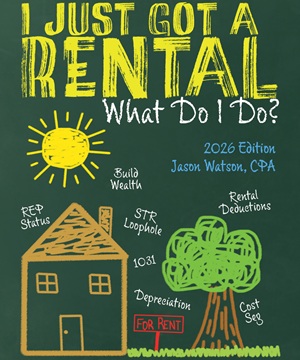 This KB article is an excerpt from our 530+ page book (yeah, thick, there are some picture pages, but no scratch and sniff) which was updated April 5, 2026, and is available in paperback from Amazon, as an eBook for Kindle and as a PDF from ClickBank. We used to publish with iTunes and Nook, but keeping up with two different formats was brutal. You can cruise through these KB articles online, click on the fancy buttons below or visit our webpage which provides more information.
 |
 |
 |
| $32.95 | $21.95 | $18.95 |

Taxes can be tricky. Chat with a WCG human now and get questions answered.

Everything you need to help you launch your new business entity from business entity selection to multiple-entity business structures.
Designed for rental property owners where WCG CPAs & Advisors supports you as your real estate CPA.
Everything you need from tax return preparation for your small business to your rental to your corporation is here.
WCG’s primary objective is to help you to feel comfortable about engaging with us