


Strategies For REPS
Table Of Contents
 By Jason Watson, CPA
Posted Sunday, August 30, 2026
Here are some common strategies for leveraging real estate professional status (REPS).
Spousal REPS Strategy
If you are married and one spouse has W-2 income, the other spouse who does not work outside the home (or stays home with the ankle biters) becomes a strong candidate for REPS. The non-W-2 spouse runs the real estate while the working spouse earns the paycheck, and if the real estate spouse also materially participates in the rental activity, the resulting rental losses are freed up against ordinary income on your joint tax return.
“Hey babe, you go out and make that big W-2, I’ll gleefully manage the rentals to create additional wealth and tax deductions.”
Now the honest part. This is a lot of work. REPS requires 750 hours in real property trades or businesses, which is roughly two full days a week, every week, all year. And 750 is only the floor. The harder test is that your real estate spouse must spend more than half of their total personal service time in real property. One or two rentals do not come close to generating that kind of hour count. There is simply not 750 hours of legitimate work in a couple of doors. Even Jim Morrison would agree and say your mojo isn’t risin’.
So the hours must come from somewhere real. That usually means an active real estate brokerage business with actual listing and buyer representation activity, a fix-and-flip or redevelopment operation, a construction or general contracting business, substantial rental management activity, or some combination of these. Your spouse cannot water the ferns two days a week and call it 750 hours.
The one nuance worth flagging: the license itself does nothing. Becoming a licensed agent only creates a path to REPS hours when you do the actual brokerage work, chasing listings and representing buyers. And you can stack. The same spouse could serve as general contractor on your next rehab for buy-rehab-rent-refinance-repeat (BRRRR) purposes, which is either a sound tax strategy or a Dr. Seuss book.
Timing Strategy
Here is the part almost nobody talks about. REPS is a switch you can flip for a single year and flip back. You are renting the status for a season, not marrying it. Say you buy three rentals and run cost segregation studies on them for that juicy first-year depreciation. That deduction is a singular shot and does not repeat. Perhaps your income is unusually high that same year. That can be the perfect time to blitz REPS, capture the tax deduction, and then hand everything to a property manager the following year.
100% legitimate. The IRS does not require a vow of eternal participation. You need to be a real estate professional in the year you want the losses to be non-passive, and no longer.
Net Investment Income Tax (NIIT)
It is also commonly forgotten that REPS can eliminate the net investment income tax (NIIT). Rental income is normally swept into net investment income under IRC Section 1411, where it can pick up an additional 3.8% once your income is high enough. But the tax code excludes rental income derived in the ordinary course of a trade or business that is not passive with respect to you. That is a two-part hurdle, and it is where people conflate things which is a fancy way of saying confusing.
The real estate professional exception in IRC Section 469(c)(7) plus your material participation makes the activity non-passive. Neat, that clears the first part. It does not automatically clear the second, because the rental still must rise to the level of a trade or business, and non-passive and trade-or-business are different questions.
The regulations give you a clean landing spot. Under Treasury Regulations 1.1411-4(g)(7), if you are a real estate professional and participate in the rental activity for more than 500 hours (in the year, or in 5 of the prior 10), the rental income is deemed to come from a trade or business and drops out of net investment income. The 1.469-9(g) aggregation election lets that 500-hour count run across the whole portfolio rather than property by property.
Here is the catch, and it is the same trap as the 750-hour floor versus the more-than-half test. The two hour counts measure different things. Your 750 REPS hours can come from brokerage, construction, or development. The 500-hour safe harbor looks only at the rental activity itself. So 650 brokerage hours plus 150 rental hours clears REPS and misses the safe harbor entirely. Most owners think of REPS purely as a way to free up losses, which is true, but the 3.8% is the tax nobody notices until the rentals turn profitable and it becomes the only REPS benefit still standing.
Jason Watson, CPA, is a partner and the CEO of WCG CPAs & Advisors, a boutique yet progressive tax, accounting and rental property consultation and real estate CPA firm with over 100 team members and 7 partners headquartered in Colorado serving real estate investors worldwide.


I Just Got A Rental, What Do I Do? 2026 Edition
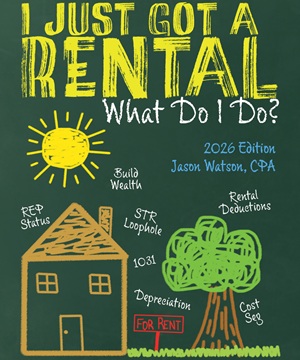 This KB article is an excerpt from our 530+ page book (yeah, thick, there are some picture pages, but no scratch and sniff) which was updated August 5, 2026, and is available in paperback from Amazon, as an eBook for Kindle and as a PDF from ClickBank. We used to publish with iTunes and Nook, but keeping up with two different formats was brutal. You can cruise through these KB articles online, click on the fancy buttons below or visit our webpage which provides more information.
 |
 |
 |
| $32.95 | $21.95 | $18.95 |






Chat With a Tax Pro
Taxes can be tricky. Chat with a WCG human now and get questions answered.