


Community Property States And Married Filing Separately
Table Of Contents
 By Jason Watson, CPA
Posted Sunday, October 11, 2026
Married filing separately (MFS) is usually a bad tax deal. IRS Publication 555 Community Property lists ten things you give up, including the student loan interest deduction and the education credits, and adds the obvious-
Ordinarily, filing a joint return will give you a greater tax advantage than filing a separate return. But, in some cases, your combined income tax on separate returns may be less than it would be on a joint return.
Neat. Um, Ok.
Sometimes MFS is the right call, or the only call. Income-driven student loan repayment plans (IDRs such as RAP, IBR and PAYE, plus the usual alphabet soup of acronyms) are the big one since your payment amount is often based on your individual income. Of course, community property states have a sense of humor. Your individual AGI on an MFS tax return might already include half of your spouse’s community wages, so the student loan math is not always as clean as “my income” versus “our income” or household income.
Why file separately? Prenuptial agreements, a spouse with tax problems, innocent spouse concerns, a pending divorce, and a spouse who will not hand over documents all show up too. As such, while MFS is rare, it happens, and when rentals are involved things get sporty. The kind of mental gymnastics that requires stretching first.
Why do you care when reading a book about rentals? Well, young grasshopper, rentals make this more complicated. Of course they do!
And No, you cannot slice every number in half on Schedule E and call it a day. If it were only that simple.
Where The Property Sits Changes The Answer
Domicile generally governs whether property and income are community or separate. Real estate is an exception.
Quick definition since we use the word a lot here. Your domicile is your permanent legal home, the one you intend to return to when you are away. You can have several homes but only one domicile, and intent is what settles it. The IRS looks at where you pay state income tax, where you vote, where your property is, your citizenship, length of residence, and your business and social ties.
Sidebar: This is not the same thing as the state tax nexus we discuss elsewhere in this chapter. Nexus determines where you file. Domicile determines whose income it is in the first place.
IRS Publication 555 defines community income to include-
Real estate that is treated as community property under the laws of the state where the property is located.
The IRS says it more directly in their Internal Revenue Manual-
Generally, the law that applies to an interest in real property will be determined by the situs of the property.
So, if you are domiciled in California and own a duplex in Tennessee, California’s community property rules do not automatically travel with the property. See IRM 25.18.1.3.6(1)(a), Determining Which State’s Laws Apply in Property Characterization for some insomnia relief.
Situs law, the geek speak technical term, is the starting point, not the finish line. That same IRM section goes on to read that in an action between the spouses, courts may apply community property principles to real property sitting in a common-law state when it was bought with community funds. And do not lean too hard on the deed either. Per IRM 25.18.1.3.20, title generally carries relatively little weight in determining whether property is separate or community. In dissolution of marriage (divorce) proceedings, this is a common theme- property tracing to determine if it is marital or separate.
Translation: pull the deed and the closing disclosure, but do not stop there. Know where the down payment came from and what has been paying the mortgage every month since. The deed tells you who is on the paper. It does not always tell you who owns, pays for and maintains the thing. Actions speak louder than titles.
Your Domicile State Changes It Too
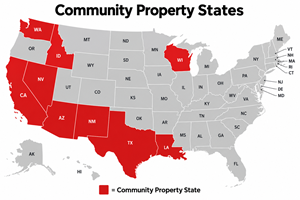
IRS Publication 555 splits the nine community property states into two camps. Income from separate property stays separate in Arizona, California, Nevada, New Mexico, and Washington. The southwest gang. In the outsiders, also known as Idaho, Louisiana, Texas, and Wisconsin, income from most separate property is community income. Yuck.
Tax Nerd Sidebar: Alaska, South Dakota, and Tennessee also have elective community property systems. Because apparently nine versions of this were not enough.
Putting The Two Rules Together
Two questions, not one. Who owns the property, and who owns the income it produces? Those are not always the same answer, which is the entire point of this section.
Here is a visual to help sew it together-
| Where You Are Domiciled | Where The Rental Sits | General Annual Schedule E Result |
| CA, AZ, NV, NM, WA | Community property state | Property is community. Rents and related deductions generally split 50/50. |
| CA, AZ, NV, NM, WA | Common law state | Property is generally separate. Rents and related deductions generally stay with the owning spouse. |
| ID, LA, TX, WI | Community property state | Property is community. Rents and related deductions generally split 50/50. |
| ID, LA, TX, WI | Common law state | Property is generally separate, but rents from most separate property are community income, so rents and related deductions generally split 50/50. |
That last row is the one nobody sees coming. You live in Texas and own a rental in Colorado. Assume the Colorado property is separate and belongs to one spouse. The rental property itself is separate, yet the rents are not. Texas treats income from most separate property as community income, so the annual rental income and related deductions generally split even though the asset itself does not.
And here is the nuance inside the wrinkle. Gains and losses on disposition such as a sale are classified based on how the property is held, not how the rental income was treated. So, in that Texas example you can split rents and deductions 50/50 for years, then have the gain on sale belong entirely to the spouse who owns the property. Two different answers on the same rental. Whoa, right?
The table is a starting point, not a substitute for the deed, the closing disclosure, the source of funds, and your state’s law. It assumes no gift, no inheritance, no marital agreement, and no separate funds mixed in. Community funds used to buy or improve separately titled property is exactly where the table stops working. Said differently, your historical actions can skew the meaning of the black and white text (as we’ve alluded to before).
Losses Follow The Same Rules As Income
While this might seem obvious it bears repeating. Per the IRS Publication 555, gains and losses are classified as separate or community depending on how the property is held. If the property and its income are separate, the depreciation, expenses, and resulting tax loss all land on the owning spouse’s tax return. No splitting. Basis, at-risk limits under IRC Section 465, and suspended passive losses under IRC Section 469 generally stay with that spouse’s interest in the activity too.
Material Participation Does Not Split At All
It is tested per person. The good news is Treasury Regulations Section 1.469-5T(f)(3), which counts your spouse’s hours toward you whether you file jointly. Read that again. Yay, right? You still get to pool your time for the 500-hour test, the 100-hour test where no other individual did more than you, and the substantially all test. We beat material participation up in Chapter 5.
The $25,000 Allowance Disappears
Ok, back to bad news. IRC Section 469(i)(5)(B) is blunt. MFS spouses who did not live apart at all times during the year get no special allowance whatsoever. Not the $12,500 half. Zero.
Barf, that was quite the section of the three dimensional handling of rentals in a married filing separate environment.
Jason Watson, CPA, is a partner and the CEO of WCG CPAs & Advisors, a boutique yet progressive tax, accounting and rental property consultation and real estate CPA firm with over 100 team members and 7 partners headquartered in Colorado serving real estate investors worldwide.


I Just Got A Rental, What Do I Do? 2026 Edition
 This KB article is an excerpt from our 530+ page book (yeah, thick, there are some picture pages, but no scratch and sniff) which was updated August 5, 2026, and is available in paperback from Amazon, as an eBook for Kindle and as a PDF from ClickBank. We used to publish with iTunes and Nook, but keeping up with two different formats was brutal. You can cruise through these KB articles online, click on the fancy buttons below or visit our webpage which provides more information.
 |
 |
 |
| $32.95 | $21.95 | $18.95 |






Chat With a Tax Pro
Taxes can be tricky. Chat with a WCG human now and get questions answered.