
Cost Segregation Pitfalls
Table Of Contents
 By Jason Watson, CPA
Posted Sunday, July 21, 2026
There are a handful of big pitfalls and a few gotchas.
Passive Activity Loss (PAL) Limits
If you are considering a cost segregation study on a rental property, and that activity is considered a passive activity, your tax deduction is limited to $25,000 (passive loss limit). If you earn over $150,000 as a household, your tax deduction might be limited to $0. Yes, you are reading that zero correctly. We discuss passive activity loss limitations later on page xx.
There are two ways to get around this. First, if you qualify as a real estate professional, then your passive activity loss limits go away. To be a real estate professional as defined by the IRS and not what you hear at the bar, an individual must spend more than half of the personal services performed in all businesses and activities during the year in real estate activities. As a reminder, this includes the following-
real property development, redevelopment, construction, reconstruction, acquisition, conversion, rental, operation, management, leasing, or brokerage trade or business.
Read this again! If you have another full-time job in which you work 40 hours a week, you will need to work more than 40 hours per week in your real estate business and related activities. Having a W-2 is a red flag, as they say, straight out of the Passive Activities Loss Audit Techniques Guide (ATG) from the IRS.
Next, your hours worked in real estate activities must be more than 750 hours. Any work performed as an investor cannot be counted. There are a bunch of other devils in the details. Yes, most real estate agents qualify, not because they are real estate agents but rather time spent on real estate activities.
Finally, you must materially participate as defined by the IRS in each rental activity. We dive deep into real estate professional or REP status or just “REPS” as the cool kids say in a later section.
The other way to get around the passive loss limits is to have the activity not be considered passive. Makes sense right? Let’s just pencil-whip this activity and add the word “non-“ in front of it all. Done!
To be a nonpassive activity, the average stay in the rental must be 7 days or less. Your typical Vrbo Airbnb situation. However, you must also materially participate (there’s that darn word again) in the activity. Alternatively, for average stays of 30 days or less, you can provide significant personal services such as changing linens during the stay or providing tours (think hunting lodge). Material participation is still required either way.
These two situations are considered nonpassive activities and losses are not limited. As a small sidebar, or perhaps a minibar, the first example is reported on Schedule E, and the second is on Schedule C possibly subject to self-employment taxes.
If PAL Limited Must Have Net Rental Income
If you can’t escape the passive activity loss limits, then you must have net rental income from the rental property or from other properties or real estate investments to absorb the accelerated depreciation expense and grab that accelerated cash flow. Self-rentals, where you own the building and lease it back to your business, do not usually absorb passive losses from other rentals. We talk about self-rentals later.
Depreciation Recapture Can Bite
Recall that depreciation is a tax deferral. When you sell the property, you have depreciation recapture which simply means you must pay back the deferred taxes. There is some tax arbitrage here, however, since recapture is limited to a 25% tax rate on Section 1250 property (remember our mini chat about this) where you might have deducted depreciation at a 37% marginal tax rate. You can also escape this gotcha with a Section 1031 Like-Kind Exchange.
Sidebar: Recall that Section 1245 property, which might be “created” with a cost segregation report, is generally recaptured at ordinary income tax rates. We stated that earlier. However, the intersection of Section 1031 and Section 1245 can be problematic. After TCJA in 2017, Section 1031 is limited to real property, and loose personal property such as furniture and appliances generally does not qualify for like-kind exchange treatment. Sticky or attached property can create a more nuanced analysis involving real-property classification, purchase-price allocation, replacement property and Section 1245 recapture. As such, you can perform a pretty Section 1031 Like-Kind Exchange and still have a tax bill because of Section 1245 recapture or personal property boot connected to the overall rental property sale. We tackle this in more detail in our Selling Your Rental Property- 1031 Like-Kind Exchange section. Apologies for the long sidebar.
Section 1245 Problems With 1031 Exchanges
Cost segregation can complicate a future Section 1031 exchange. Some assets carved out as Section 1245 property might still qualify as real property, while furniture, televisions, freestanding appliances and other movable items generally do not.
This can create ordinary income recapture or other taxable gain even when the real estate exchange under IRC Section 1031 otherwise works. The replacement property matters too since insufficient replacement Section 1245 property can cause recapture to surface.
Sidebar: This is one reason we recommend keeping these separately identifiable assets out of the cost segregation study. You do not need an engineer to tell you that a sofa is not part of the building. In turn, keeping things separated makes sales and exchanges easier to administer from a tax and deferred gains calculation perspective.
Net-net, cost segregation can accelerate depreciation today while complicating a future sale or exchange. We tackle this in detail, like lots of nauseating detail, in our Like Kind Exchange Wrinkle With Cost Segregation section.
Keep Obvious Personal Property Separate
We generally recommend keeping furniture, televisions, freestanding appliances and other separately identifiable personal property out of the cost segregation study.
You do not need an engineer to tell you that a sofa is not part of the building. More importantly, you do not want the sofa buried inside a larger Section 1245 allocation when the property is eventually sold or exchanged.
A cost segregation study often identifies several categories of Section 1245 property. Some assets are clearly personal property, while others might remain Section 1245 property for depreciation and recapture purposes but also qualify as real property under the Section 1031 rules.
Those are very different disposition problems.
At sale or exchange, you do not have to pull furniture, televisions and freestanding appliances back out of a broader cost segregation category years later. This separation also keeps the cost segregation report focused on the more difficult assets that require a separate Section 1031 real-property analysis.
Keeping the easy personal property separate allows everyone to spend their time on the assets that actually require judgment. It also reduces the risk that furniture and appliances become mixed into an allocation intended to support the treatment of wiring, plumbing, ducting and other integrated building components.
Clean records going in usually mean cleaner tax calculations coming out.
Cash Flow Juice Worth Cost Seg Squeeze
The cost of the report or cost segregation study must be significantly lower than the improved time-value of the accelerated cash flow. In other words, the juice must be worth the squeeze, including the audit risk.
Another way to look at this gotcha- accelerated depreciation is not extra depreciation. Two rentals, one with a cost segregation study and one without, will be fully depreciated at 27.5 years. As such, it is purely a time-value of money compared to fee consideration. Then again, if you take the tax savings (deferral in reality) and blast off on a fun vacation, that has value too, right?
Cost Segregation Is A One And Done Event
Another gotcha is one that is often overlooked. A cost segregation study and the subsequent big depreciation deduction is a one and done event. The following tax year, your depreciation comes down to earth and is actually less than it would normally be. Keep mind that cost segregation accelerates depreciation; it does not create new or phantom depreciation. Take a $780,000 building that would normally depreciate $20,000 per year. If you accelerate $150,000 in depreciation the first year, years 2 through 39 will be $16,600ish (versus $20,000).
The Excess Business Loss (EBL) Trap
Generating a large tax loss through cost segregation is only a victory if you can actually use it to offset income in the current year. Under IRC Section 461(l), the tax code imposes a cap on Excess Business Losses (EBL) for noncorporate taxpayers, limiting how much business loss can offset non-business income such as W-2 wages.
The EBL rule is the final gatekeeper in a long chain of loss limitations. In practical terms, your losses must first survive basis limits, the at-risk rules, and the passive activity rules before they even reach the EBL calculation. The IRS ordering rules specifically put at-risk first, passive activity loss rules next, and EBL last.
The One Big Beautiful Bill Act (OBBBA) made the EBL limitation permanent and reset the inflation adjustment base year. The statute lists a baseline threshold of $512,000 for married filing jointly ($256,000 single), but taxpayers use the inflation-adjusted amount published annually by the IRS. For example, the 2025 threshold for joint filers is $626,000, while beginning in 2026 the indexing reset pushes the limit back closer to the statutory baseline.
Confusion aside, if your combined business and rental losses exceed the annual threshold of roughly $256,000 single or $512,000 joint starting in 2026 the excess cannot offset non-business income that year.
Instead, the excess becomes a Net Operating Loss (NOL) carryforward. That loss is not lost, but it is delayed and the delay can be painful. Imagine generating a $1.5 million loss from a single cost segregation study or several smaller cost studies in one year expecting to wipe out your W-2 income, only to find a large portion locked away for future years.
And NOLs are not pure gold. They are calculated without regard to the standard deduction and generally can offset only 80% of taxable income in future years. In other words, even with a large NOL carryforward, you will likely still pay some tax.
Let’s put numbers to it. Say you own three rental properties, each purchased for $1,000,000, each with land at roughly 30%, leaving about $700,000 of depreciable building apiece. A cost segregation study on each accelerates roughly 30% of the building into short-life property, so about $210,000 per property, or about $630,000 if you fire off all three studies in the same year. Assume you can actually use the losses through the short-term rental loophole, real estate professional status, or enough passive income.
Now watch what happens if you wake up one morning and cost seg all three at once. You generate roughly a $630,000 loss. Against the $512,000 joint EBL threshold, about $118,000 is disallowed this year and shoved into next year as an NOL, where it can only offset 80% of income. You paid for three studies, took on three properties’ worth of audit exposure (yeah, sure, not a massive thing, but a thing just the same), and still had a chunk of the tax deduction delayed anyway.
The key is to plan, and the move is to unbundle. Rather than studying all five, or in this case all three, in a single year, spread the studies across multiple years (yes, a Form 3115 with an IRC Section 481(a) adjustment is likely for the ones you defer). Do one property this year, one next year, one the year after. Each roughly $210,000 study stays comfortably under the EBL threshold, each is claimed while your income is still high enough to absorb it, and you avoid manufacturing an NOL you have to sit on. Alternatively, or in addition, you can opt out of bonus depreciation for certain asset classes such as 5-year property while keeping it on 7- and 15-year property, pulling some deduction now and leaving some for later.
EBL huh? Perhaps EBK as in excessive buzz kill. Or is buzzkill one word?
The Reverse Marginal Tax Bracket Pitfall
There is a common, yet flawed, mentality that “more deduction is always better,” but smart tax planning requires looking at the value of each deducted dollar. Depreciation is a cashflow play, but as your taxable income decreases, your marginal tax bracket decreases as well from 37% to 35%, down to 32%, and possibly even into the 12% range. Good? Maybe not.
In other words, your last dollar of tax deduction has way less pizzazz than your first.
If you perform cost segregation studies on several properties in a single year, you might successfully drive your taxable income down so severely that the tax dollars you deducted at the 12% level provide significantly less bang for your buck than those at the 37% level. This can hurt the cash flow ROI of cost segregation.
Going from $2M in taxable income down to $1.5M? Sure, that makes sense. Going from $700,000 down to $200,000 might still make sense, just not as much cents.
In many cases, it is far more efficient to spread your cost segregation studies over multiple years utilizing a Form 3115 / 481(a) adjustment (as mentioned just a bit ago) when necessary to ensure you are primarily offsetting income at your highest marginal rates. Before you go all-in, let’s do some tax planning to ensure the position is impactful. It is better to save 37 cents on the dollar next year than 12 cents on the dollar today. Even in Canada.
Tangible Personal Property Reporting
This really isn’t a big gotcha or pitfall, but as we discussed in our chapter on short-term rentals, many counties want you to report and pay tax on tangible personal property. While a cost seg study’s only job is to parse property away from typical real property and relabel it as personal property, not all personal property identified in your report is suddenly tangible personal property.
Conversely, many counties are similar to Florida’s 192.001(11)(d) which reads-
“Tangible personal property” means all goods, chattels, and other articles of value (but does not include the vehicular items enumerated in s. 1(b), Art. VII of the State Constitution and elsewhere defined) capable of manual possession and whose chief value is intrinsic to the article itself.
What does this mean? It means that tangible personal property for the sake of county taxes must have value by itself and be capable of manual possession. For example, certain components might be identified as IRC Section 1245 personal property, but their value is tied to the fact they are part of a larger building system. Carpet is a good example since it typically does not have material resale value. Specialized wiring for a restaurant kitchen is likely personal property eligible for Section 179 expensing and bonus depreciation, but is unlikely to be considered capable of manual possession with intrinsic value, and therefore not be tangible personal property by a county assessor.
Jason Watson, CPA, is a partner and the CEO of WCG CPAs & Advisors, a boutique yet progressive tax, accounting and rental property consultation and real estate CPA firm with over 100 team members and 7 partners headquartered in Colorado serving real estate investors worldwide.


I Just Got A Rental, What Do I Do? 2026 Edition
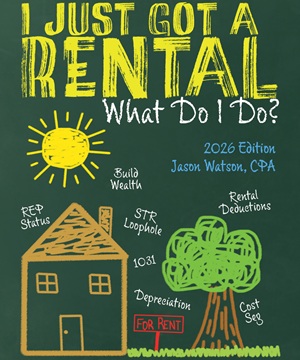 This KB article is an excerpt from our 530+ page book (yeah, thick, there are some picture pages, but no scratch and sniff) which was updated August 5, 2026, and is available in paperback from Amazon, as an eBook for Kindle and as a PDF from ClickBank. We used to publish with iTunes and Nook, but keeping up with two different formats was brutal. You can cruise through these KB articles online, click on the fancy buttons below or visit our webpage which provides more information.
 |
 |
 |
| $32.95 | $21.95 | $18.95 |






Chat With a Tax Pro
Taxes can be tricky. Chat with a WCG human now and get questions answered.