


Cost Segregation On Mid-Year Conversions
Table Of Contents
 By Jason Watson, CPA
Posted Sunday, July 12, 2026
Let’s talk about mid-year conversions. What happens if you run a short-term rental (STR) for the first four months of the year, convert it to a long-term rental (LTR) for the remaining eight months, successfully treat them as two separate IRC Section 469 activities because the facts support separate economic units under Treasury Regulations Section 1.469-4(c), and then decide to do a cost segregation study?
Do you take the massive bonus depreciation deduction and slice it up by allocating 4/12ths to the STR and 8/12ths to the LTR?
No. You do not. And understanding exactly why is the difference between a massive tax refund and a massive tax trap. Oh, let’s not forget an incorrect tax return as well.
Bonus depreciation is not allocated 4/12ths to the STR and 8/12ths to the LTR simply because the property had two uses during the year. Also, do not confuse bonus eligibility with loss usability. A long-term rental can still have bonus depreciation from cost-segregated 5-, 7-, and 15-year property.
The real question is whether the resulting loss belongs to a passive LTR activity or a nonpassive STR activity. If the STR phase is a genuine separate Section 469 activity, satisfies the 7-day average customer use rule, and you materially participate, the STR-first position can work. But if the same property changes use during the placed-in-service year, Treasury Regulations Section 1.168(i)-4 gives the IRS a primary-use argument. This is not a “bonus is gone” problem. It is an attribution and documentation problem. We belabor the heck out of this again later. Maybe even two more times.
The Placed-In-Service Rule
Generally, standard MACRS depreciation is prorated based on the applicable depreciation conventions, but bonus depreciation is an all-at-once deduction tied to the placed-in-service year, not spread over the recovery period (the life of the asset). Whether you can actually use that deduction, meaning whether the loss is nonpassive and can offset other income, is a separate question answered by the passive activity rules under IRC Section 469, which we get into below.
Therefore, the year the asset is placed in service drives the bonus depreciation question, and IRC Section 469 decides where the resulting loss can land. We talk about the tension between IRC Section 168 and IRC Section 469 in a bit.
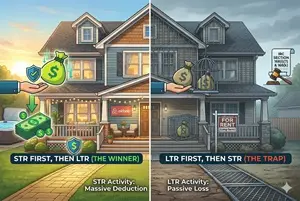
STR First, Then LTR (The Winner, Maybe, Kinda)
Let’s say you place the rental property in service as an STR in January. You materially participate, satisfy the 7-day average customer use rule, and do all the right things.
In May, you get tired of the turnover, or perhaps ski season is closing out, and lease it to a long-term tenant. Because it was genuinely placed in service as an STR, the STR activity generally claims the bonus depreciation tied to the initial placed-in-service event. Assuming you materially participated, this creates a massive nonpassive loss that can offset your W-2 or business income (which is one of the primary objectives for high W-2 earners, right?).
When the property converts to an LTR in May, it inherits the remaining, much lower adjusted basis. The LTR activity simply claims the standard, prorated MACRS depreciation on the leftovers for the remaining portion of the year.
Mechanically, there are a couple of things to keep in mind. First, if the facts support treating the STR phase and LTR phase as truly separate IRC Section 469 activities, you will show two activities on the tax return: one for the STR activity and another for the LTR activity involving the same actual real estate asset.
Said differently, yes, you might have two separate IRC Section 469 activities. Bonus depreciation is available either way, so this is not about whether you get bonus. It is also not about whether the later LTR conversion automatically makes the STR passive. It does not. If the STR phase is a genuine separate activity, satisfies the 7-day average customer use rule, and you materially participate, IRC Section 469 can still treat the STR loss as nonpassive.
Sidebar: More of a warning. Treasury Regulations Section 1.168(i)-4 addresses a change in use of MACRS property, including a change during the placed-in-service year, which paragraph (e) resolves by primary use across the year. That rule does not automatically override your IRC Section 469 separate-activity position. However, it gives the IRS something to point to if they want to argue, “You are calling these two separate activities, but for depreciation purposes this looks like one asset with a same-year change in use.” Said differently, IRC Section 168 does not decide passive versus nonpassive treatment, but it can make your attribution story harder if your facts and records are sloppy. You would then tell the IRS they are confusing 168 with 469. They love free lessons by taxpayers. Just love ‘em.
Next, the fixed asset records must preserve the single asset history. Most tax software will show this as two depreciation schedules or two fixed asset entries because each activity has its own reporting life. That is fine. The STR version of the asset goes out of service when the STR use ends, and the LTR version of the asset goes into service when the LTR use begins.
But do not confuse tax software mechanics with economic reality. You are not creating two buildings, two original basis amounts, or two chances at bonus depreciation. The LTR activity picks up the property’s adjusted basis after depreciation, including bonus depreciation and Section 179 expensing, already claimed during the STR phase. Said differently, the software schedules might look duplicated at a quick glance. The tax basis should not be.
Sidebar: This is not for the faint of heart, or perhaps better said, not for the lousy recordkeeper. To demonstrate true separate activities, you will need excellent documentation proving these are two separate and distinct activities. Candidly, the bar is quite high. Whether the phases fall in the same tax year or across two, the burden is the same: your records must show two genuinely separate and distinct activities, not one asset with a change in use. Doable? Perhaps. Casual? Nope.
LTR First, Then STR (The Trap)
Now, let’s flip it. You place the property in service as an LTR in January. In May, the tenant moves out, and you decide to turn it into an Airbnb to hit the juicy summer travel traffic. You do a cost segregation study, thinking, “Great, now it is an STR and I can deduct the losses against my big W-2 income.”
Because it was genuinely placed in service as an LTR, the LTR activity generally claims the bonus depreciation tied to the initial placed-in-service event. Unless you are a qualifying Real Estate Professional (REPS) or have other passive income, that massive cost segregation and subsequent depreciation loss drops straight into the passive loss world and gets trapped. Yuck.
When you convert to an STR in May, you might materially participate and run a great hospitality business, but the depreciation damage is done. Just like our other example, the STR activity only inherits the remaining adjusted basis and gets a tiny sliver of standard MACRS depreciation. The giant STR loss bomb you were hoping to trigger was already detonated behind the passive loss wall. Ok, that was a bit over the top, but whatever.
Do Not Conflate IRC Section 168 And IRC Section 469
Remember that free lesson you were about to give to the IRS? Here are the speaker notes.
These two code sections answer completely different questions, and mixing them up is the single most common way people talk themselves into a wrong answer on cost segregation.
IRC Section 168 governs the deduction itself. Is bonus depreciation available on this property, and what is the recovery period? Bonus rides on the 5, 7 and 15-year property a cost segregation study breaks out, and it does not care whether the building is a short-term rental or a long-term rental. You can take bonus depreciation on either. Perhaps Section 179 as well.
IRC Section 469 governs whether you can use the deduction. Is the resulting loss passive or non-passive? Can it offset your W-2 or other income, or is it trapped behind the passive loss wall? This turns on the activity and your participation in it, not on the recovery period.
So when you hear someone say a long-term rental “cannot get bonus” or a short-term rental “unlocks bonus,” they are smashing the two ideas together. The bonus is an IRC Section 168 matter and it is available either way. What the short-term rental changes is the IRC Section 469 answer, whether that bonus-driven loss is non-passive and therefore usable against ordinary income. Keep the two questions on separate shelves. IRC Section 168 says how big the deduction is and when it is earned. IRC Section 469 says whether you get to use it this year.
The Takeaway
If you are treating a mid-year conversion as two separate activities, there is no magic rule that lets you assign the resulting loss to the activity you prefer. Bonus depreciation is available either way, but the loss follows the activity that placed the asset in service, which is strongly dictated by the placed-in-service date.
If your strategic intent is to use the STR loophole to offset ordinary income, the property must be placed in service as an STR first. Flipping an LTR to an STR mid-year mechanically works the same way, but strategically, it traps your best tax deductions behind the passive loss wall. Timing isn’t just everything; it is the only thing.
The Reboot Myth And The Entity Shuffle
Some clever real estate investor is inevitably going to ask: “Wait, if an STR is a totally different business than an LTR, why can’t I just take the LTR out of service, and then ‘re-place’ it into service a week later as a brand-new STR to grab the bonus depreciation again? Or better yet, what if I sell it to a new multi-member LLC I own with my spouse so a ‘new taxpayer’ buys it?”
Nice try, but the IRS saw you coming a mile away. You cannot unplug your rental property and plug it in somewhere else and reboot your tax deductions. Here is why the tax code crushes both of these maneuvers:
Under IRC Section 168(k), bonus depreciation is strictly a “first placed in service” deduction. For that specific asset, the IRS generally cares about the first time you made it ready for an income-producing use. Transitioning from an LTR to an STR is classified as a “Change in Use” under Treasury Regulations Section 1.168(i)-4. It may change how the property is classified for depreciation purposes, but it does not reset the original placed-in-service date.
Sidebar: The one exception? Brand-new assets you buy specifically for the STR, like a hot tub or new furniture. Those get their own fresh placed-in-service date and their own bonus depreciation. Yeah, this doesn’t make you feel any better.
If you try to outsmart the system by dropping the property into a new LLC with your spouse or your S Corp, you hit two brick walls:
- If you simply contribute the property to the new LLC, the entity “steps into your shoes” as suggested by IRC Section 168(i)(7). It inherits your exact depreciation schedule, remaining basis, and original placed-in-service date.
- If you actually sell the property to the LLC to claim bonus depreciation on “new to the LLC” property, you trigger related party transaction rules. Because you, your spouse, or your controlled entities own more than 50% of the new entity, the IRS disallows the bonus depreciation entirely, and you just triggered a taxable sale for absolutely no reason.
Here is the exact language of IRC Section 168(i)(7) which will completely put you to sleep:
(7) Treatment of certain transferees
(A) In general
In the case of any property transferred in a transaction described in subparagraph (B), the transferee shall be treated as the transferor for purposes of computing the depreciation deduction determined under this section with respect to so much of the basis in the hands of the transferee as does not exceed the adjusted basis in the hands of the transferor.
The house always wins. The asset keeps its original history, and the bonus depreciation clock does not reset.
Jason Watson, CPA, is a partner and the CEO of WCG CPAs & Advisors, a boutique yet progressive tax, accounting and rental property consultation and real estate CPA firm with over 100 team members and 7 partners headquartered in Colorado serving real estate investors worldwide.


I Just Got A Rental, What Do I Do? 2026 Edition
 This KB article is an excerpt from our 530+ page book (yeah, thick, there are some picture pages, but no scratch and sniff) which was updated August 5, 2026, and is available in paperback from Amazon, as an eBook for Kindle and as a PDF from ClickBank. We used to publish with iTunes and Nook, but keeping up with two different formats was brutal. You can cruise through these KB articles online, click on the fancy buttons below or visit our webpage which provides more information.
 |
 |
 |
| $32.95 | $21.95 | $18.95 |






Chat With a Tax Pro
Taxes can be tricky. Chat with a WCG human now and get questions answered.