


Reducing Taxes
Table Of Contents
 By Jason Watson, CPA
Posted Sunday, October 11, 2026
One of our primary focuses at WCG CPAs & Advisors is ensuring you are paying the least amount of taxes allowed by law through tax reduction strategies. Some of our other primary focuses are helping you build wealth and leverage the most of your financial worlds for you and your family. However, these focuses or objectives are not isolated; they are very much related to each other and intertwined.
Before we run through several tax reduction and tax avoidance ideas, let’s talk about some basic concepts-
There is not a secret tax deduction club that only a few people know about. If there were, it would be like fight club, right? But trust us when we say no one is intentionally not talking about a tax deduction club.
Most people are interested in saving cash when they say they want to reduce or avoid taxes, but saving cash and reducing taxes are not necessarily the same.
Two households, making the exact same income, might have wildly different tax liabilities based on the myriad of variables such as children, mortgage interest, charitable donations, available tax credits, and, Yes, the proficiency of the tax professionals involved. So, just because your neighbor or produce clerk pays x does not mean you will too.
As household incomes travel through the ranges, a lot of things happen. The first $100,000 in income for most households is well-sheltered with itemized deductions and low tax brackets. The next $100,000 in income sees certain tax credits go away, higher tax brackets and fewer available tax deductions such as IRAs and other things (what we call income phase-outs).
In other words, if you go from $100,000 to $200,000 in household income, you will pay way more than double in taxes (you could easily see 2.5 to 3.0 times more). Yuck! The next $100,000 and beyond is completely naked, and is generally purely taxable (unless some tax reduction tactics are deployed). Super yuck!
Tax deductions and tax deferrals are not the same. Tax deferrals are tax bombs later in life; little IOU’s to the IRS and they will eventually call in the chit. But if you use the immediate tax savings to build wealth, then a tax deferral is worth it. Deferring taxes to pay for a cruise vacation might not always be the best approach (then again, live a little!).
You want to match the highest tax deduction to the high income. Let’s say it’s December and you are considering buying a piece of equipment. If next year’s income is going to be significantly higher, wouldn’t it make sense to wait until January to complete the purchase? Probably.
Alternatively, you received a huge bonus and your W-2 income skyrocketed this year. It might be a good year to buy some short-term rentals, crank up the depreciation with a cost segregation report, and then chill the following year with a property manager.
Tax deductions commonly need separation with cash. For example, you can save $2,500 (for example) in taxes right now if you write a check for $10,000 to a charity. That might not make sense if you are more interested in cash than taxes, right? Tax deferrals commonly need separation with cash as well, but at least you get it back. IRA’s and 401k plans (among others) come to mind.
Ok, here we go on those tax reduction and tax avoidance headlines. Some of this might not make sense purely based on the headline.
General Tax Strategy (Yawn)
- Wash Sale Rules / Tax-Loss Harvesting
- Borrowing Against Appreciated Stock (access capital)
- State Income Tax Deferral (mostly avoidance)
- 401k / IRA Contributions
- Roth vs. Pre-Tax 401k Contributions
- Health Savings Account (HSA)
- Roth Conversions
- Charitable Giving / Donor Advised Funds (DAF)
- Qualified Charitable Distributions (QCDs)
Business Owners
- Budget Review, Business Connection
- S Corporation Salary QBID Optimization
- Pass Through Entity Tax (PTET)
- SEP IRA / Solo 401k including Cash Balance / Defined Benefit Plans
- Accountable Plan Reimbursements
- Health Reimbursement Arrangement (HRA)
- Business Expense Prepayment
- Depreciation Timing With Section 179 / Bonus
- Automobile Deductions / Heavy Vehicle Rules
- Switching to Accrual Accounting
- Adding Kids and / or Spouse to Payroll
- Consider Yourself a Passive Business Owner
- Augusta Rule
- Medical C Corp
Real Estate Investors
- Short-Term Rental Loophole
- Cost Segregation Study
- Real Estate Professional Status (the spouse play)
- 721 and 1031 Exchanges, Lazy 1031 Exchange
- Business Rents Your Short-Term Rental or Long-Term Rental
- Paying Your Kids From The Rental
Advanced Tax Strategy
- Structured Equipment Leasing (airplane, boat, yacht, heavy equipment)
- Leasing Equipment With Solar Credit
- Real Estate Syndicate / REPS
- Working Interest in Oil and Gas
- Niche Assets (gas stations, car washes, mobile home parks, self-storage)
Exotic Strategy
- Captive Insurance Companies
- Permanent Life Insurance Plans
- Conservation Easements (mostly dead)
- Family Limited Partnerships (FLP) and LLCs
- GRATs, GRITs, and Private Annuities
- Discounted Roth Conversions
- Deferred Sales Trusts (DSTs)
- Monetized Installment Sales (MIS)
- Charitable Remainder Trusts (CRTs)
If you want to know about these bulleted items, please visit the WCG Tax Strategy Center.
Jason Watson, CPA, is a partner and the CEO of WCG CPAs & Advisors, a boutique yet progressive tax, accounting and rental property consultation and real estate CPA firm with over 100 team members and 7 partners headquartered in Colorado serving real estate investors worldwide.


I Just Got A Rental, What Do I Do? 2026 Edition
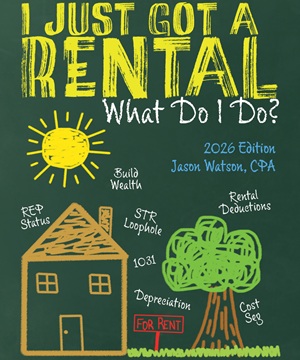 This KB article is an excerpt from our 530+ page book (yeah, thick, there are some picture pages, but no scratch and sniff) which was updated August 5, 2026, and is available in paperback from Amazon, as an eBook for Kindle and as a PDF from ClickBank. We used to publish with iTunes and Nook, but keeping up with two different formats was brutal. You can cruise through these KB articles online, click on the fancy buttons below or visit our webpage which provides more information.
 |
 |
 |
| $32.95 | $21.95 | $18.95 |






Chat With a Tax Pro
Taxes can be tricky. Chat with a WCG human now and get questions answered.