


Posted Friday, October 16, 2026
Table Of Contents
Multi-Entity Quick Launch Strategy Session
 Multi-entity business structures can create tax benefits, but more importantly they create flexibility, tax efficiency and long-term options. Unlike some attorneys and wealth managers, WCG does not automatically recommend complicated structures. Far too often we see half-baked ideas and unnecessary complication in pursuit of precision. We call it the illusion of precision. Color-coded arrows everywhere, this owns 2% of that, the whole thing owned by 27 LLCs, and blah blah blah.
Granted, there are times when complication is required, and complication can be elegant when it is done correctly. This session walks every arrangement we use, from the operating company that leases its own building to the mothership baby S Corp construct in all three of its versions to the holding company versus management company question for the owner with their hands in a lot of pots. Most of them will not apply to you. We quickly walk them anyway since life is long, and what might not apply today might be the perfect solution next year, or the next venture.
And then we price it. You leave with the cost, what it saves, and a recommendation, including the possible recommendation to leave things exactly as they are, which we give more often than you would think.
$475
One session included
1
75 minutes
1
A visual schematic
and written recap
The Arrangements at 30,000 Feet
This material comes from Chapter 2 of our book, Taxpayer’s Comprehensive Guide to LLCs and S Corps, and the session walks all of it. Here is the quick version so you can see which rows are yours before we get into the checklist.
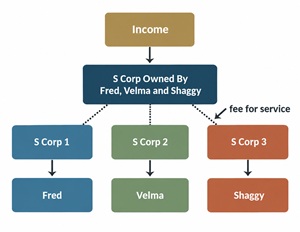 Mothership Baby S Corp, Fee for Service, and the Cali Twist
Two or more non-spouse owners want an eat what you kill profit split and the tax efficiency of an S Corp, which an S Corp alone cannot give them. So revenue pours into a mothership that you own directly, as humans, and each owner runs a baby S Corp. The S Corps provide services to the mothership and invoice the mothership for fees in the amount of the agreed split, driving the mothership down to zero or something nominal like $500. Each owner then runs their own tax world inside their own S Corp: cars, home office, spouse and / or kids on payroll, and nobody asking. Super popular with physician groups, financial advisors, insurance agents and any production-based gaggle of business owners. In California the mothership is taxed as an S Corp so it pays the $800 minimum rather than an LLC fee on gross receipts. We call that the Cali Twist.
 Parent-Child Structures 1 and 2
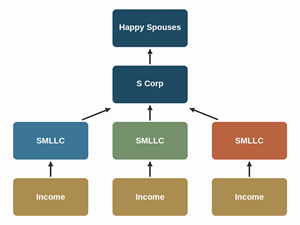 Parent-Child Structures 1 and 2
A married couple with two very different businesses, say a realtor and an IT consultant. A holding LLC owns each spouse’s LLC and makes the S Corp election, so both businesses roll up onto one S Corp tax return with one payroll. Three checking accounts, three EINs, everything separated, then consolidated for tax reporting purposes.
Structure 2 is the same picture with outside ownership in one subsidiary. You’re an IT consultant like above, and your spouse runs a yoga studio. All flowing into the S Corp. Next, your spouse the yoga instructor joins forces with another instructor, leases a gym and goes crazy with mats and pants. Your S Corp owns a piece of that multi-member LLC rather than your spouse personally, and the rest of the household is untouched. Sidebar: They also sell way more yoga pants than yoga mats. And why call it a studio? Is that fancy speak for gymnasium?
Operating Company and Self-Rental
Your operating company leases its building, warehouse, land or equipment from a separate holding LLC that you own. Rent is a deduction to the operating company, which reduces the earned income exposed to payroll taxes, and lands on the other side as rental income that normally is not. The building can have different owners than the business, which keeps the father-in-law out of operations and the key employee out of the real estate. The Treasury Regulations 1.469-4 grouping election can let self-rental losses offset operating company profits, with conditions. Mostly a flexibility play with disparate ownership structures. We have a sister page for real estate as it pertains to multi-entity and tiered-entity structures.
Holding Company versus Management Company
One owner, several pots a.k.a. revenue streams. A holding company owns the underlying entities and consolidates everything, which is simple and drags liability, state footprint and lender questions along with it. A management company owns nothing, bills each entity a fee for services, and pumps the income into one S Corp while every venture stays encapsulated. They are not the same thing, and which one fits depends on what you want out of the structure: one bag to carry everything, or straight lines between the pots. Typically, management company for operation type stuff and holding company for real estate stuff. Either way, we explore.
Tiered Rental Property Structure (HoldCo, PropCo, Rental)
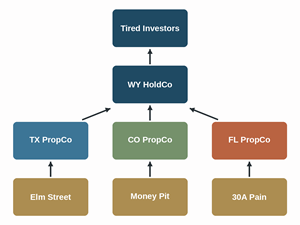 Tiered Rental Property Structure (HoldCo, PropCo, Rental)
Rental properties in Montana, Colorado and Texas, each in its own LLC, all owned by a Wyoming holding LLC for anonymity and low annual cost, and managed in a way that keeps the Wyoming parent from doing business in the property states. HoldCo owns a series of PropCo’s, and each PropCo LLC owns a rental property. Flexible for estate planning and financing, and complexity costs money, so it has to be meaningful. We mention it here because the question comes up in the same breath as everything above. We build it in our Multi-Entity Structuring session for real estate.
Session Checklists
This session produces an entity map and a recommendation an attorney can draft from (if necessary), so we want the ownership picture in advance.
Pre-Session Checklist, Due 48 Hours Prior
- Last two years of complete tax returns, federal and state, for every entity and every owner
- Current year income estimate, which can be a profit and loss, a production report, or a number
- The WCG Multi-Entity worksheet (or you can answer the questions below in an email)
What the Worksheet Asks For
Everyone answers these.
- Each business entity, its tax election, who owns it, and who is on payroll where
- The states where revenue is earned and where you live
- Whether your profession is regulated and by whom
- Your existing 401k plan, health insurance arrangement and professional liability policy (if applicable)
- Whether the business owns or wants to own its building
- Any planned expansion of ownership, carve-out or sale
- If you are married and both of you run a business, whether you want one S Corp or two, and whether separate 401k plans matter to you
- If you are a solo owner with several ventures, what each one does and why you want them separate
 If there is more than one owner outside your marriage, add these.
- Every owner by name, state of residence and ownership percentage
- How profit is actually split today versus how you want it split, and the formula if there is one
- Each owner’s appetite for cars, home office, family payroll, travel and audit risk
- Whether a new partner is coming in slowly, on an economic interest first or similar arrangement
- For financial advisors, who is named on the broker-dealer or RIA contract
- Who holds the group’s 401k plan, health insurance and liability policy today, and whether anyone wants that to change
What We Cover in the Session
- Every arrangement on the checklist below, with the ones that do not apply to you closed quickly
- The arrangement that fits, in detail: who owns what, how money flows, what gets signed
- For married couples, one S Corp or two, and whether separate 401k plans are worth the twist
- For the building, the lease, the rent appraisal and the grouping election, with the real estate side routed to its own session
- For the owner with several ventures, holding company or management company and why they are not the same thing
- For partners, why the S Corp election makes your profit split rigid, whether salaries alone fix it, and the three versions of the mothership construct
- Licensing and regulator questions wherever a license is involved, including Fleischer if you are a financial advisor
- What stays shared: 401k plans, health insurance, professional liability
- State footprint and apportionment, and what each arrangement does and does not change
- The cost of the arrangement against what it saves and enables

Every Entity Arrangement We Walk Through
Here is the checklist. We read every row with you, close the ones that do not fit in a sentence, and spend the time on the ones that do.
| Arrangement | Who It Fits | What It Buys | What to Watch |
| One S Corp, Salary Equalization | Owners whose split sits near ownership | Simplicity. One tax return, one payroll | Payroll tax on every equalization dollar under the wage base |
| Operating Company and Self-Rental | An owner buying the building | Rent converts earned income into rental income; the building can have different owners | Market rent and a lease; grouping has its own test |
| Holding S Corp With Subsidiary LLCs | Spouses with different businesses | One S Corp tax return, one payroll; a unit can be sold off | A hobby cannot hide under it; $800 per entity in California |
| Separate LLCs, One Management Fee | Spouses who want separate 401k plans | Separate plans where the spousal exception holds | The management company rule can still group the plans |
| Partnership of S Corps | Legacy, rarely recommended now | Eat what you kill | K-1s plant a state footprint; appreciation trapped in the S Corp |
| Fee for Service to Baby S Corps | Physicians, attorneys, financial advisors, insurance agents, production-based groups | Eat what you kill plus your own tax world | The paper that proves the S Corp earned the income; 401k tested as a group |
| California S Corp Mothership | The same group, in California | Kills the LLC fee on gross receipts | $800 at every layer; 1.5% on what remains |
| C Corp Mothership | Groups with employee shareholders or retained working capital | No partnership Section 707 question, no K-1, 21% on retained capital, stock to employees | Double tax on anything distributed |
| Management Company | A solo owner with several ventures | One S Corp collects fees while each venture stays separate | Business purpose and a services contract |
| Holding Company | An owner who wants one bag to carry everything | Consolidated reporting; easy transfer of the whole | Liability creep; a state footprint you cannot shape; lenders want tax returns that do not exist |
| Economic Interest Plus Baby S Corp | Bringing in a partner slowly | Owner-like pay without giving away equity | Legal documents; pair it with fee for service |
| Pure Holding LLC | Co-owners of an airplane, boat or collection | Transfer by membership interest; no tax return | Not an operating arrangement |
| Tiered Rental Property (HoldCo > PropCo > Rental) | Rental owners across several states | One holding entity, anonymity, estate planning | Built in the real estate session |
Operating Company and Self-Rental
This is the most common two-entity arrangement there is. Your operating company, usually an LLC taxed as an S Corp, leases its office, warehouse or land from a separate LLC that owns it. Rent is a deduction to the operating company, so earned income subject to payroll taxes goes down, and the rent lands on the other side as rental income that is not subject to Social Security and Medicare. We call this changing the color of money where you go from earned income to passive income (in a traditional sense, although a self-rental profit is non-passive).
It is also flexible. Your father-in-law can own the building without owning a piece of your business, and your key employee can become a partner in operations without a stake in the real estate (since one day you might sell the company but keep the real estate).
One caution comes with that elegance.
Tax grouping is a separate question. Under Treasury Regulations 1.469-4, the rental and operating business must form an appropriate economic unit. They must also satisfy one of three alternatives: the rental is insubstantial compared with the business, the business is insubstantial compared with the rental, or the business owners hold matching ownership percentages in the rental. Different ownership percentages therefore do not automatically prevent grouping. A valid grouping, together with material participation in the combined activity, can allow rental losses to offset nonpassive income, subject to the other loss limitations. We check the facts before promising the result.
 The rent has to be market, with a written lease, and a rent appraisal is cheap insurance that also keeps the peace as partners come in. Jason and Tina Watson own the building WCG leases, and as WCG has added partners the rent has had to be above reproach. Hence the appraisal.
One caution on the payroll tax side. Rent lowers the operating company’s profit, and profitability is a legitimate factor in setting your reasonable shareholder salary, but you still have to be paid reasonably for the work you do, and rent cannot be salary wearing a different hat. Market rent has to be supportable on the property. Reasonable compensation has to be supportable on the services. Both numbers stand on their own. See our Reasonable Salary Quick Check tax strategy.
And keep it honest. A self-rental is mostly a flexibility and wealth-building play rather than a tax reduction strategy. The building, its depreciation, cost segregation and the eventual exit are a real estate question, and we cover that in our Multi-Entity Structuring session for real estate. Here we tease it. There we build it. Sorry not sorry.
Holding Company versus Management Company
Different client, different question. You are one owner with your hands in several pots. Ok, we have used that analogy before. How about this: you are an owner with a bunch of irons in the fire, and you want multiple LLCs, one per venture, for liability, regulation, a future sale, or because you like straight lines and clean garages. Do the entities get owned by a holding company, or do you keep them personally and have a management company bill them? They are not the same thing. One owns underlying businesses. The other sells services for a fee and owns nothing. Sure, the income tax effect is likely the same, but that is it, and it is important to understand the nuances.
A holding company owns each underlying LLC, so each one is disregarded and the holding company absorbs all the revenue and expenses. Simple, and yet it opens some cans of worms. A lawsuit against one underlying entity can drag the holding company and everything it owns into the mess. The holding company inherits a multi-state footprint from every activity and cannot shape the narrative. Lenders underwriting one underlying entity ask for its tax return, and a disregarded LLC does not have one, which confuses the lender’s sales prevention team a.k.a. underwriting. It works well for rentals, and it is Santa with a big bag of stuff when you want everything to move together as one.
 A management company leaves each entity owned by you personally, and each one pays the management company a fee. That pumps the income into one entity taxed as an S Corp for tax efficiency and cocktail party bragging rights. You dictate the fee, every underlying activity stays encapsulated, and the state picture is more controlled. The warts: the underlying LLCs land on Schedule C, which gets examined at a higher rate than an S Corp, and a Schedule C that drives its income to a nominal amount through a Management Fee line is a Schedule C the IRS reads like the Pink Panther. If you love audits, call it Meals. Better year, call it Entertainment. Kidding aside, this risk is low, but certainly remains.
The fix is often to make the underlying entities partnerships or S Corps, and the fee needs a real services contract and a business purpose either way. Why? Audit rates on partnerships (Form 1065) and S Corps (Form 1120S) are very low such as less than 0.2%. The problem is professional fees for additional tax return preparation.
| Consideration | Schedule C (Single Member LLC) | Partnership (Multi-Member LLC) | S Corp |
| Tax Return | None. It lands on Schedule C of your Form 1040 | Form 1065 at $1,500 to $1,800 | Form 1120S at $1,500 to $1,800 |
| Examination Profile | Highest of the three, and a Schedule C driven to nominal income by a Management Fee line gets read | Low, under 0.2% | Low, under 0.2% |
| Payroll | None | None at the entity, but residual income is self-employment income to active members | Shareholder salary only if income is material; nominal income can usually skip it |
| Second Owner | Not needed | Required. A spouse works. Using the management company itself as the member reopens the Section 707 question | Not needed |
| Lenders | See a Schedule C | See an entity tax return | See an entity tax return |
| Best For | Small ventures where the fee is modest and the profile is tolerable | Ventures with a real second owner, or a household who wants a lower audit profile | Ventures with meaningful revenue, a California address, or an owner who wants the lowest audit profile |
In all versions the money double hops. Each subsidiary keeps its own checking account and pays its own expenses, leftover cash moves up as a distribution or a fee, and owner salary and distributions come out of the top entity. Never straight from an underlying entity to you.
Your Own Tax World
A multi-entity arrangement does not automatically buy income tax savings, and we say that first because the internet or your bartender might say otherwise. Three owners inside one S Corp save the same payroll tax as three owners each running their own baby S Corp fed by a mothership. The election did the tax work. The arrangement does something else.
 It buys your own tax world. Inside one S Corp every fringe benefit is a negotiation. Fred wants a Ford-a-saurus and Velma wants an economy sedan, so the partners set a vehicle allowance that Velma never uses and Fred always exceeds, and then they argue about the maintenance, the financing and the registration. Velma works from a 250 square foot home office in a house with a mortgage and Shaggy works from a rented apartment, so how do you reimburse that equitably? You do not. You set a not-to-exceed limit and hose whoever has more expenses. One partner wants to put a spouse on payroll and take them to the Vegas conference, with margaritas at Cabo Wabo, and now has to explain that line item at the partner meeting.
Inside your own baby S Corp none of that is anyone else’s business. You buy the car you want and depreciate it. You reimburse your home office at your square footage and your mortgage. You put your spouse on payroll, or not. Kids, or not. You set your own reasonable shareholder salary and defend your own number. You make your own pass-through entity tax (PTET) election in your own state. Your partner does the same in theirs, and nobody asks. Each S Corp operates independently and can do what it wants with its money, with some minor rules such as 401k plans.
It also buys ownership that can expand in one unit without expanding in the whole, a unit that can be carved away and sold without touching the rest, and some control over what each state gets to see. A multi-entity structure does not solve office politics, but it takes away most of the sting, since you can spend what you want and get the full tax benefit without being crimped by your partner. We know because we live it. WCG is a C corporation that pays a fee for service to each partner’s S Corp.
The Mothership Baby S Corp Construct
We made the name up, and it stuck. It is three entities (or more depending on the number of owners who participate in the arrangement). A mothership that all the revenue pours into and all the common expenses come out of, and a baby S Corp for each owner that does what an S Corp does best: pays its owner a reasonable salary and distributes the rest.
The original version made each baby S Corp a member of the mothership. The mothership earns, say, $250,000 after expenses. S Corp 1 receives $125,000 under the Operating Agreement while remaining a one-third owner, pays its owner a $55,000 salary and distributes $70,000. S Corp 2 receives $60,000, S Corp 3 the balance, and each does the same. Eat what you kill, with S Corp efficiency at every baby S Corp, and each owner gets autonomy and privacy.
We no longer lead with that version, for reasons that only show up later.
- State Footprint: A K-1 from a California mothership to an Illinois S Corp plants a visible footprint in California, and the recipient does not control the narrative.
- State Apportionment: A K-1 is not sales but rather investment income. As such, the S Corp is receiving investment income from another state that does not have a sales threshold escape hatch connected to it. Your baby S Corp gets dragged through state filings the arrangement was supposed to spare it.
- Appreciation Trapped in the S Corp: The S Corp holds an appreciating partnership interest, so revoking the election or shutting it down one day distributes that interest at fair market value and creates gain without a sale.
- Step-Up at Death: The step-up in basis lands on the S Corp stock rather than the underlying interest, which means valuing an enterprise rather than a slice. Your heirs would have to sell the S Corp itself to avoid capital gains on the underlying asset appreciation. Yeah, that is messy.
- No S Corp Election at the Top: A mothership owned by S Corps can never itself elect S Corp status, since an S Corp cannot have a corporation as a shareholder, which closes off the California fix below before it starts.
Those are not small things.



The C Corp Mothership
 A C corporation mothership makes sense when IRC Section 707 keeps someone up at night, when you have employees who should own shares but are not partners, or when the business needs to retain working capital. This is the version WCG runs.
IRC Section 707(a) governs transactions between a partnership and its partners, and there is a line of authority asking whether a partner who gets paid for services within the partnership’s own business is really acting as something other than a partner. Who wants some tax code? IRC Section 707(a)(1):
If a partner engages in a transaction with a partnership other than in his capacity as a member of such partnership, the transaction shall, except as otherwise provided in this section, be considered as occurring between the partnership and one who is not a partner.
What does this mean? A partner can wear two hats. When you deal with your own partnership the way a stranger would, selling it a building, lending it money, or providing a service it could have hired anyone to do, the tax law treats you as that stranger, and the payment is an ordinary vendor payment rather than a share of partnership profit. The fight is always over which hat you were wearing, and a fee tied to your own production under a written agreement looks a lot more like a vendor than a fee that is just whatever is left at year end.
We think the fee for service construct holds up with the right paper, and we say so below. A C corporation makes that partnership question go away, because a corporation paying its shareholders’ S Corps for services is not a partnership transaction at all. It does not make the other questions go away. Who earned the income, and whether the fee is commercially supportable, apply to a C Corp mothership exactly as they do to a partnership.
A C Corp also issues no K-1s, which shrinks what a state like California gets to snoop at when an owner lives in Texas. It retains working capital at 21% rather than pushing phantom K-1 income to the owners at marginal income tax rates up to 37%. And it can issue stock to key employees without the K-1 mess of an LLC interest, which is exactly why WCG is a C corporation with employee shareholders who are not partners.
Two cautions. Anything left in the C Corp and later distributed is taxed twice, so the construct keeps profit near zero through the fees. And the qualified small business stock exclusion gets mentioned with every C Corp conversation, then qualified immediately, because IRC Section 1202(e)(3) excludes health, law, accounting, consulting, financial services, brokerage and insurance, which is most of the people reading this page.
State Tax Footprint and Narrative Control
A multi-entity structure does not reduce state taxes. It reduces scrutiny, which is different and still worth something.
Say you and your partner live in Minnesota and North Carolina. Wherever the entity is domiciled, it registers as a foreign entity in the other state, and once it trips nexus it apportions its income between the two states by formula. Each of you files where you must. None of that is avoidable. What is avoidable is the experience of reporting everything to Minnesota and then convincing a revenue agent that a big chunk of it belongs to North Carolina, while they peer into your entire business to check your work like Ms. Betty in junior high.
 The construct’s answer is a mothership in a tax-inert state, usually Wyoming, with a baby S Corp in each owner’s resident state. Revenue pours into the mothership and goes out as fees for services. Does that let the Minnesota owner avoid North Carolina taxes? No. Income is still apportioned and tax is still paid to every state with nexus. What it does is let each of you show each state only the cards that are pertinent to that state. We are not advocating avoiding apportionment. We are controlling the narrative rather than inviting a state to build its own, which they love to do with wild assumptions.
It also sidesteps a K-1 problem. An out-of-state S Corp that is a partner in a California LLC gets a K-1, and California may argue all of that income is California income because the LLC sits there, or that K-1 income is not revenue at all and therefore cannot be apportioned anywhere else. A fee for service is revenue to your baby S Corp, sourced under your baby S Corp’s rules. Each baby S Corp also makes its own pass-through entity tax election in its own state, which is a related tax strategy session.
What Stays Shared No Matter How You Draw It
Autonomy has limits, and we name them so nobody is surprised at the partner meeting.
- The 401k Plan: The mothership and the baby S Corps are an affiliated service group under IRC Section 414(m), which means every employee of every entity is counted together for plan testing. This is the most overlooked problem in the construct, partly because the controlled group tests most people know run on ownership percentages and three equal owners fail them. The affiliated service group test runs on the service relationship instead, and it catches you. The usual design is one plan at the mothership that each baby S Corp adopts, with each owner’s contribution following their own salary. Separate plans are possible and usually not worth the testing. The exception is a group with no employees other than the owners and their spouses, where separate solo plans work.
- Health Insurance: Ask your broker before assuming your current setup is cast in stone. Usually the mothership holds the group policy and each baby S Corp reimburses the premiums for its owner. Where a PEO handles payroll and benefits, each owner might need a small salary or guaranteed payment at the mothership to stay eligible, which trims the fee paid to that baby S Corp by the same amount.
- Professional Liability: The policy stays at the mothership, each owner is named as a principal, and the baby S Corps are named as additional insureds. Our errors and omissions policy works exactly that way, and the carrier had seen it before.
The mom and pop arrangements have it easier. Under a holding S Corp the subsidiaries are disregarded, so there is one employer, one plan and one set of policies. A management company and the entities it bills are under common control, so one plan covers the group. A self-rental landlord LLC with no employees is not in the plan at all, though it needs its own premises liability policy and a lease that says who insures what.
What It Costs and Whether It Clears
 It depends on the arrangement, and the mothership baby S Corp construct is the expensive one. The comparison is incremental: what you pay today against what the arrangement costs, with one-time legal and formation costs stated separately from the recurring ones. Here are the general shapes, and we run your version live.
- Spouses, Holding S Corp With Subsidiary LLCs: Nothing beyond the one S Corp tax return you already have, since the subsidiaries are disregarded. However, since we need to prepare multiple sets of books to ensure limitations and adjustments are handled on the subsidiary level, there is usually a $150 to $500 per subsidiary fee. Conversely, running two S Corps instead adds a second tax return and a second payroll, call it $2,500 to $2,700 a year.
- Operating Company and Self-Rental: One more tax return if the holding LLC is a partnership, or a Schedule E on your Form 1040 if it is single member, which is about $250. No payroll.
- Mothership and Baby S Corps: Each owner adds a Vail Advisory Platform at $4,920 per year, which covers the S Corp tax return, your Form 1040, the payroll plan, tax projections and strategy sessions, plus payroll processing of about $900 with Paychex. Since your Form 1040 moves inside Vail, the net increase is roughly $5,000 per owner, less where you already pay for projections and planning. The mothership keeps filing its own tax return (Form 1065 or 1120S) at about $1,500 to $1,700 depending on owners and states, as it did before the construct, paid by the mothership as a common expense before the fees go out rather than on anyone’s personal tab.
- Management Company: One S Corp for the management company plus a tax return or Schedule C for each underlying venture. A second payroll only where an underlying S Corp needs one. This would be the typical S Corp fee of $1,500 to $1,700, plus $150 to $500 per Schedule C activity.
- Holding Company, One Owner: One tax return, since the subsidiaries are disregarded. The cost is liability creep and state footprint rather than fees. Having said that, and similar to the holding S Corp above, we need to prepare multiple sets of books to ensure limitations and adjustments are handled on the subsidiary level, so there is usually a $150 to $500 per subsidiary fee.
- Tiered Rental Property: One tax return for the parent entity, usually a partnership on Form 1065, plus our typical rental property preparation fees.
Your own Form 1040 is part of the arithmetic too, and it moves independently of the entity count. Every rental, every K-1 and every state beyond your resident state increases your tax footprint and the preparation fee that comes with it. A mothership construct hands each owner two K-1s, and a baby S Corp in each owner’s state can create state filings on top of whatever the mothership apportions. Our Personal Tax Prep page shows how rentals, K-1s and states add up, and our State Income Apportionment page covers the state side and its fees.
Outside the recurring fees sit the one-time items: formation, S Corp election, payroll setup fees, your attorney’s drafting of the agreements, and registration with your licensing body where it applies.
What has to clear it is the payroll tax you stop paying on equalization bonuses, the value of the car, the home office and the spouse on payroll you would otherwise have negotiated down, and the things that resist a price tag: office politics that do not happen, privacy, the state narrative, and the option to expand or sell one unit cleanly. An equalization bonus of $30,000 a year under the wage base costs about $4,600 in payroll tax by itself, which covers most of the mothership delta before anything else is counted.
Bottom line: We will provide a quote for your unique situation.
The mothership baby S Corp entity arrangement is as common for two owners as it is for eight owners. It all depends on the value assessed to the squishy and intangible things.







Chat With a Tax Pro
Taxes can be tricky. Chat with a WCG human now and get questions answered.































Table Of Contents

Tax Planning Season
Tax planning season is here! Let's schedule a time to review tax reduction strategies and generate a mock tax return.

Bookkeeping Services
Tired of maintaining your own books? Seems like a chore to offload?