


When a Home Becomes a Rental
Table Of Contents
When a Home Becomes a Rental

Lessons from Smith v. Commissioner and Best Practices for Conversion
Converting a primary residence into a rental property can be an effective wealth-building strategy, but the tax details demand some care. A recent Tax Court decision, Sherman Derell Smith v. Commissioner, T.C. Memo. 2025-24 (Mar. 24, 2025), illustrates how insufficient documentation can dismantle an otherwise legitimate deduction. The case serves as a reminder that turning a home into a rental is not simply a financial decision — it is a tax event requiring careful recordkeeping and valuation.
The Smith Case: What Happened and Why It Matters
In Smith, the taxpayer converted a former personal residence into a rental property and later claimed depreciation deductions. The property’s ownership history was complex, involving transfers within the family. When the IRS challenged his return, the only issue remaining was whether the taxpayer could substantiate his depreciable basis.
Under long-standing rules, when a property changes from personal to income-producing use, its depreciable basis is the lower of (1) its adjusted basis (original cost plus improvements, minus prior adjustments) or (2) its fair market value (FMV) at the time of conversion. Treasury Regulation § 1.167(g) and § 1.168(i)-4(b) codify this “lesser-of” principle.
The taxpayer in Smith failed on both fronts. He did not provide reliable evidence of either FMV or adjusted basis. His own estimate of FMV was unsupported, and he could not reconstruct the property’s cost history. The Court described his valuation as a “guestimate” that fell short of the precision required for depreciation deductions. Without proof of basis, the tax deduction was denied in full.
The lesson is straightforward: “basis drives depreciation,” and basis must be proven, not assumed.
Why Homeowners Convert — and Where the Risks Begin
Many homeowners choose to convert a primary residence into a rental property for various reasons-
- Preserving a historically low mortgage interest rate.
- Deferring capital gain recognition in a high-income year.
- Maintaining ownership during a temporary relocation.
- Positioning for future appreciation before an eventual sale (tax planning!).
While these motivations are logical, the conversion process carries hidden tax consequences. From a compliance perspective, a conversion triggers a change in use, which means a new basis calculation, a new depreciation schedule, and new reporting responsibilities. A failure to document that transition properly can mess up an otherwise perfectly good depreciation tax deduction, as seen in Smith.
Establishing Depreciable Basis at Conversion
The foundation of successful conversion planning is establishing a defensible depreciable basis. To reiterate, Treasury Regulation § 1.168(i)-4(b) dictates that the depreciable basis is the lower of adjusted basis or FMV on the date of conversion. This rule prevents taxpayers from depreciating unrealized appreciation that accrued while the property was used personally. Bummer, right?
For example:
- If a home was purchased for $300,000 and is worth $450,000 at conversion, depreciation must be based on $300,000 (the lower amount).
- If the home has declined in value to $250,000, the depreciable basis is $250,000, not the higher historical cost.
Easy math.
Documentation and Timing: The Practical Side of Compliance
The Smith decision demonstrates how the absence of documentation can unravel a taxpayer’s case. Several tax court cases hinge on recordkeeping and documentation- “your argument and tax position are sound, but your records are garbage.” The court usually finds a way to soften this.
An appraisal or broker opinion prepared contemporaneously (in real time) with the conversion is essential. In addition, records of purchase price, closing statements, and detailed lists of improvements must be maintained to support the adjusted basis calculation.
A structured conversion process might include:
- Professional Valuation – Obtain a dated appraisal or written market analysis at the time of conversion. Expensive, but a lock.
- Basis Reconciliation – Summarize purchase price, improvement costs, and prior depreciation (if any) in a basis schedule.
- Conversion Evidence – Retain proof that the property was made available for rent, such as listing records, lease agreements, or communications with property managers.
- Renovation Timing – Ideally, complete major renovations after the property is placed in service, so those costs can be capitalized into the depreciable basis.
- Formal Recordkeeping – Treat the conversion as a business event; maintain memos, appraisals, and correspondence for future substantiation.
Can a Zillow screenshot serve as a professional valuation? Unlikely. The courts have routinely considered the following to the gold standard-
- A licensed real estate appraiser’s report, dated close to the conversion date.
- A written broker price opinion (BPO) or comparative market analysis (CMA) prepared contemporaneously by a local real estate agent, ideally with MLS comps attached.
- County assessor data or certified appraisal records if contemporaneous and supported by comparables. This can be a challenge since assessment data is not fair market value.



I Just Got A Rental, What Do I Do?
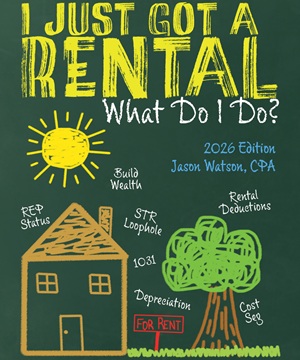 I just got a rental, what do I do? Purchasing a rental property is certainly challenging, but operating one to build wealth and find tax efficiency is equally challenging. This is our second book. Our first book, Taxpayer’s Comprehensive Guide to LLCs and S Corps, was first published in 2014 and was well-received by small business owners and tax professionals, so we thought a book on rental properties and real estate investments would be equally helpful. So, here we are with our second iteration, or the 2026 edition. We update it frequently throughout the year (last update was April 5, 2026).
Our rental property book starts with entity structures and moves into asset management such as acquisition, cost segregation, rental safe harbors, repairs versus improvements, accelerated depreciation, partial asset disposition, and 1031 like-kind exchange. From there we discuss various rental considerations like passive activity losses, short-term rental loophole, real estate professional status, and material participation including what time counts, and what time doesn’t count.
Finally, the good stuff! Rental property tax deductions such as travel, meals, automobiles, interest tracing, home office and common expenses. Fun!
It is available in paperback for $32.95 from Amazon and as an eBook for Kindle for 21.95. Our book is also available for purchase as a PDF from ClickBank for $18.95.




Related Blogs

One Email Address. Same People.

One Team, One Heartbeat: WCG Engagements Requires A 7216 Consent

The Two-Gate Trap: Why “Not a Rental Activity” Does Not Mean Nonpassive

Book Updates for Rental Property Owners: Cost Seg Mechanics Etc

DepreciMax Study: Ranking STR Markets by Bonus Depreciation

AI Tax Prep in 2026: Not Quite There Yet
Table Of Contents

Tax Planning Season
Tax planning season is here! Let's schedule a time to review tax reduction strategies and generate a mock tax return.

Bookkeeping Services
Tired of maintaining your own books? Seems like a chore to offload?