


Book Updates for Rental Property Owners: Cost Seg Mechanics Etc
Table Of Contents
Book Updates for Rental Property Owners: Cost Seg Mechanics Etc

 We just finished a deep revision pass on the cost segregation chapter of our rental property book, “I Just Got a Rental What Do I Do?” and this one went well beyond a light edit. This was not “move a comma, fix a typo, grab coffee.” We chopped a lot of wood.
Cost segregation remains one of the most powerful and most misunderstood tools in real estate tax planning. With restored 100% bonus depreciation, Revenue Procedure 2025-23, mid-year STR-to-LTR conversion questions, Form 3115 look-back opportunities, Excess Business Loss traps and Section 1031 like-kind exchange wrinkles, several sections needed to be rebuilt instead of lightly massaged.
Here is a plain-English tour of what changed and why it matters.
We Separated Two Ideas People Constantly Smash Together: Section 168 and Section 469
The single most common way rental property owners talk themselves into a wrong answer on cost segregation is by blending IRC Section 168 and IRC Section 469.
We added a dedicated section drawing a hard line between them.
Section 168 governs the depreciation deduction itself. Is bonus depreciation available? What is the recovery period? Is the property 5-year, 7-year, 15-year, 27.5-year or 39-year property? Bonus depreciation rides on the 5-, 7- and 15-year property a cost segregation study breaks out, and it does not care whether the building is being operated as a short-term rental or a long-term rental. You can have bonus depreciation in either case.
Section 469 governs whether you can actually use the resulting loss. Is the loss passive or nonpassive? Can it offset W-2 income, business income or portfolio income, or is it trapped behind the [passive activity loss] wall? That turns on the activity and your participation, not on the recovery period.
So when someone says an LTR “cannot get bonus depreciation” or an STR “unlocks bonus depreciation,” they are conflating the two rules. Is anyone tired of the word “unlock?” We are.
Mid-Year STR-to-LTR Conversions Got a Full Rewrite
Our old example placed a property in service as an STR in January and converted it to an LTR in May, all in the same year. Sounds clever, right?
Maybe. Maybe not.
This issue forced us to separate two different questions. First, can the STR phase and LTR phase be treated as two separate activities under IRC Section 469? Maybe. If the facts support separate economic units under Treasury Regulations Section 1.469-4, the STR and LTR periods might be treated as separate activities. Different customers, different operations, different pricing, different services, different records and different business models all help that argument.
But that does not end the discussion. After digging into Treasury Regulations Section 1.168(i)-4, we rebuilt the section around the placed-in-service year because that is where things get touchy. Even if you have two separate Section 469 activities, the IRS might still argue that for Section 168 depreciation purposes, you have one MACRS asset with a same-year change in use.
In other words, the IRS might try to use one part of the tax code to muddy up another. Does that automatically work? No. Can it still make your life miserable if your facts and records are sloppy? You bet.
The change-in-use regulation has a special rule for property that changes use in the same taxable year it is placed in service. Paragraph (e) generally looks to the property’s primary use for that year, and the examples measure that use in full months. Four months as an STR against eight months as an LTR gives the IRS an obvious LTR-year argument.
That does not automatically make the STR activity passive. Section 168 does not decide passive versus nonpassive treatment. Section 469 does that. But it does give the IRS something to point to if your position is, “This was placed in service as an STR, so all the first-year depreciation belongs to the STR activity,” while the same asset spent more of the placed-in-service year as an LTR.
Said differently, the taxpayer might say, “These are separate economic units under Section 469.” The IRS might respond, “Maybe, but Section 168 still sees one asset with a same-year change in use.” That is the conflict. Two code sections. Two conversations. One headache.
This is why a same-year STR-to-LTR conversion is the fragile version of the strategy.
The cleaner approach separates the years. Place the property in service in December as a genuine STR. That placed-in-service year is a pure STR year, so paragraph (e) never fires. Run it as an STR into the next year, then convert to an LTR later. That later conversion falls under the subsequent-year change-in-use rules, which generally adjust depreciation on the remaining basis going forward and do not disturb the already-claimed bonus depreciation.
Yeah, sure, facts rarely line up the way you want them to.
The good news is that there is no bonus depreciation clawback merely because of the later conversion. Yay, kinda.
The Form 3115 Timing Play
We expanded the retroactive and look-back discussion around a genuine planning lever. This one is fun since it allows for some strategy.
You do not always have to claim a cost segregation study on the placed-in-service year tax return. A look-back cost segregation study can often be reported using Form 3115 with an IRC Section 481(a) adjustment, allowing missed depreciation to be caught up in the year of change.
That matters for two reasons.
First, the Section 481(a) adjustment is generally deducted in the year of change. Its passive or nonpassive character follows the activity’s status in that year under Section 469.
 That is wonderful news, and it is the heart of the passive-to-nonpassive arbitrage. A rental property that was a passive LTR for years can later convert to a qualifying STR. If the STR activity is nonpassive in the year of change, a look-back study filed for that year can allow the entire catch-up deduction to ride through the current-year activity status.
Second, timing matters because income is not the same every year. A rental owner might have a large W-2 year, a business sale, a large Roth conversion, a big K-1, a stock compensation event or some other income spike. Filing the look-back study in that higher-income year can make the deduction more valuable than taking it earlier against lower-bracket income or against income that would have been limited anyway.
Boom! You can time cost segregation on an existing rental property to align with a spike in income. Same property. Same missed depreciation. Better landing zone.
We Tightened the DIY Versus Engineered Study Discussion
This was one of the biggest revisions in the chapter. We walked through how a cost segregation study is actually prepared, from fully engineered cost segregation studies with a site visit, measurements and construction analysis, to residual estimation methods that start with the depreciable basis and carve out the short-life property, to the hybrids in between. We explained where each method is strongest, and we added break-even math on when a fully engineered study is worth the higher fee versus a residual estimation report.
We also detailed what the report itself must do, because a study is only as good as its support. A defensible cost segregation report starts with total depreciable basis, removes land, identifies components, assigns supportable values, classifies the assets into their recovery periods, and reconciles everything back to the purchase price or actual project costs. If the report starts with $300,000 of basis, the asset classes must total $300,000. We see plenty of reports that do not reconcile, which is often the fingerprint of a low-quality automated product.
On the DIY question specifically, we clarified that a ‘do-it-yourself’ report is usually not a separate methodology at all. In many cases it is a residual estimation report delivered through software, a portal, a questionnaire or some other technology-assisted workflow. The delivery feels DIY. The underlying methodology is often residual estimation, modeling, prior study data, cost databases and user-provided inputs. That distinction matters.
Land Allocation and the Nielsen Case
We cleaned up the land-versus-building allocation discussion. The county assessor ratio method remains a reasonable starting point. If the assessor says the property is 20% land and 80% improvements, that ratio can be useful when allocating the purchase price between nondepreciable land and depreciable building basis.
But it is not a magic wand.
Nielsen offers a helpful example where assessor data carried the day, though it is a summary opinion with no precedential value. We also noted that in Nielsen, an independent appraisal lined up with the assessor result. That is a useful reminder that assessor data and an appraisal can reinforce each other instead of competing.
The practical point: county assessor data can be a reasonable starting point, but if you are pushing land value down aggressively, you need support. Otherwise, “because I wanted more depreciation” is not the best courtroom strategy.
Unbundling, the EBL Trap and the Reverse Bracket
We added a worked example showing why bundling multiple cost segregation studies into one year can backfire.
Suppose you have three rentals at $1,000,000 each. Assume roughly 30% land, leaving about $700,000 of depreciable building basis per property. If each study accelerates about 30% of the building basis, you might generate roughly $210,000 of accelerated depreciation per property, or $630,000 across all three.
That sounds amazing until it runs into the Excess Business Loss limitation under IRC Section 461(l).
Against the statutory $512,000 joint Excess Business Loss threshold, part of that loss can be disallowed and pushed into a Net Operating Loss carryforward. Then the NOL rules decide how much of it you can use in later years. Yay, another limitation stack.
Bundling also walks your own deduction down the bracket ladder. The first dollars might offset income taxed at 37%. The last dollars might offset income taxed at 24%, 22% or even 12%. Same deduction. Different value.
That is the reverse bracket problem. More deduction is not always better if the last chunk of deduction is worth a lot less than the first chunk.
The fix is to model and, where appropriate, unbundle. Unlike Flo and Progessive who’s first child is likely called Bundle, you might want to spread studies across multiple years using Form 3115 where needed. Consider whether to opt out of bonus on one class of property while keeping bonus on another. It might be better to save 37 cents on the dollar across three good years than 12 cents today and wait on the rest.
 Tax planning is not just “make number big.” It is “make number useful.” Useful today and tomorrow. We know, waiting sucks.
1031 Exchanges and Recapture
Finally, we cleaned up the cost segregation and Section 1031 like-kind exchange workflow. This one is messy. Complicated. Nauseating. All those things.
After TCJA, Section 1031 is generally limited to real property. That sounds simple until cost segregation enters the chat.
A cost segregation study can create several depreciation buckets. Some assets are true personal property. Some are Section 1250 land improvements. Some are Section 1245 property for depreciation and recapture purposes but might still qualify as real property under the special Section 1031 definition. Read that again. All of it.
The Form 8824 instructions specifically acknowledge that Section 1245 property can be real property for Section 1031 like-kind exchange treatment. This is good news when you are [avoiding depreciation recapture] with a 1031 like-kind exchange.
That is why we rebuilt the section around three different concepts:
- Section 1245 property for depreciation recapture purposes.
- Real property for Section 1031 purposes.
- True personal property that is not eligible for Section 1031 treatment.
Those three buckets can overlap, but they are not the same thing.
We also cleaned up the 15% incidental personal property rule. That rule can help protect the qualified-intermediary safe harbor when a relatively small amount of personal property is received with replacement real estate. It does not magically convert personal property into real property, and it does not independently eliminate gain or Section 1245 recapture.
Incidental does not mean tax-free. It just means incidental. Sounds so innocent.
The Bottom Line
Cost segregation is a powerful tool, but it is still a tool.
Used well, it improves cash flow, creates tax planning opportunities and gives rental property owners more control over timing. Used blindly, it creates deductions you cannot use, passive loss problems, EBL surprises, reverse-bracket waste and reporting headaches when you sell or exchange the property.
Cost segregation is a cash-flow tool, not a magic wand. If you own rentals and want to know whether cost segregation, a mid-year conversion or a look-back study fits your situation, that is exactly the kind of rental property tax planning conversation worth having before you go all in.
I Just Got A Rental, What Do I Do?
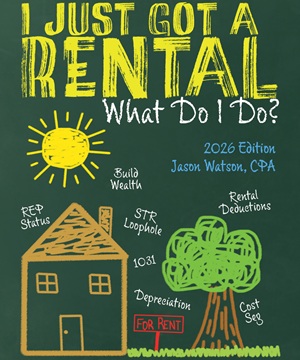 I just got a rental, what do I do? Purchasing a rental property is certainly challenging, but operating one to build wealth and find tax efficiency is equally challenging. This is our second book. Our first book, Taxpayer’s Comprehensive Guide to LLCs and S Corps, was first published in 2014 and was well-received by small business owners and tax professionals, so we thought a book on rental properties and real estate investments would be equally helpful. So, here we are with our second iteration, or the 2026 edition. We update it frequently throughout the year (last update was April 5, 2026).
Our rental property book starts with entity structures and moves into asset management such as acquisition, cost segregation, rental safe harbors, repairs versus improvements, accelerated depreciation, partial asset disposition, and 1031 like-kind exchange. From there we discuss various rental considerations like passive activity losses, short-term rental loophole, real estate professional status, and material participation including what time counts, and what time doesn’t count.
Finally, the good stuff! Rental property tax deductions such as travel, meals, automobiles, interest tracing, home office and common expenses. Fun!
It is available in paperback for $32.95 from Amazon and as an eBook for Kindle for 21.95. Our book is also available for purchase as a PDF from ClickBank for $18.95.




Related Blogs

One Email Address. Same People.

One Team, One Heartbeat: WCG Engagements Requires A 7216 Consent

The Two-Gate Trap: Why “Not a Rental Activity” Does Not Mean Nonpassive

DepreciMax Study: Ranking STR Markets by Bonus Depreciation

AI Tax Prep in 2026: Not Quite There Yet

AI Tax Preparation and Automation: What It Means for You
Table Of Contents

Tax Planning Season
Tax planning season is here! Let's schedule a time to review tax reduction strategies and generate a mock tax return.

Bookkeeping Services
Tired of maintaining your own books? Seems like a chore to offload?