
Business Advisory Services
Everything you need to help you launch your new business entity from business entity selection to multiple-entity business structures.


Everything you need to help you launch your new business entity from business entity selection to multiple-entity business structures.

Designed for rental property owners where WCG CPAs & Advisors supports you as your real estate CPA.

Everything you need from tax return preparation for your small business to your rental to your corporation is here.

WCG’s primary objective is to help you to feel comfortable about engaging with us
Table Of Contents
 By Jason Watson, CPA
Posted Sunday, July 12, 2026
When you buy real estate for business or rental use, you generally depreciate the purchase price, minus the land value, over 27.5 years or 39.0 years depending on the designated use. Residential rental property is generally 27.5-year property. Nonresidential / commercial property is generally 39.0-year property. As we discussed previously, short-term rentals can also fall into 39.0-year property because of the way the tax rules classify certain transient use property.
This can feel like forever. Not just forever, but forever and ever.
For example, let’s say you purchase a $400,000 single-family rental property and $100,000 is attributed to land. Since land is not depreciable, unless you are four beers into your tax return, you are left with $300,000 of depreciable building value. Under normal residential rental depreciation, you deduct that $300,000 over 27.5 years, or about $10,909 per year. This is 3.64% of the $300,000 value attributed to the building.
At a mid-range 24% marginal tax rate, that annual depreciation deduction puts about $2,618 into your pocket. Not shabby. But also not exactly a money cannon.
What if you could front-load some of that depreciation? What if, instead of waiting 27.5 years, you could deduct $60,000 in the first year? Using the same 24% tax rate, that creates a first-year tax benefit of about $14,400. Accelerated cash flow is always nice. Time value of money. Dollars today are better than dollars when your knees hurt. Yay!
That is the basic idea behind a cost segregation study.
A cost segregation study breaks a rental property into different asset classes for depreciation purposes. Instead of treating the entire building as one big 27.5-year or 39.0-year blob, the study identifies components that can be depreciated over shorter periods, such as 5 years, 7 years or 15 years. Some of those shorter-life components might also qualify for bonus depreciation or Section 179 expensing where available.
Sidebar: We mention this in various spots of our book, but many (most) states decouple from federal bonus depreciation and severely limit Section 179 expensing. See our State Problems With Your Rental Property section.
Said differently, the study takes the building apart for tax purposes. The report looks at the property and asks, “What is really part of the building, and what is something else?” The building structure itself, such as walls, roof, framing, plumbing systems, and core electrical systems, usually stays in the 27.5-year or 39.0-year bucket. But other items might be personal property, land improvements, decorative components or shorter-life assets.
Examples might include-
The exact answer depends on the facts, the asset, how it is attached, how it is used, and whether it relates to the operation and maintenance of the building itself. This is why cost segregation is not just throwing darts at a depreciation chart or the template your bartender shared. A proper study needs methodology, documentation and support.
How did we get here? The short version is that courts and the IRS eventually recognized that not everything inside or around a building should automatically be depreciated over the same life as the building itself.
Recall that one of the fundamentals of depreciation is to expense the asset over its useful life. However, carpeting, lighting, heating or cooling systems, cabinets, landscaping, and land improvements might not last as long as the building itself. That distinction matters because shorter recovery periods can create larger deductions sooner and front-load your cash flow.
A major case in this area was Hospital Corporation of America v. Commissioner, 109 Tax Court 21 (1997), where the Tax Court determined that many disputed building-related assets were IRC Section 1245 property rather than IRC Section 1250 structural components. The IRS later issued an Action on Decision (AOD) 1999-008 and, while not loving every part of the court’s asset-by-asset determinations, accepted that the older tangible personal property analysis still had relevance under ACRS and MACRS. We dig a bit further into this later.
We’ll discuss Section 1245 property, Section 1250 property, structural components, tangible personal property and all the other tax gobbledygook later. For now, the big takeaway is this: cost segregation is based on the idea that a rental property is not just one asset. It is a collection of assets all blending together and pretending to be one building.
Whether a cost segregation study helps you depends on your tax situation. The biggest winners are usually taxpayers who can actually use the accelerated depreciation, such as-
Or, some combination of the above. So, should every rental property owner order a cost segregation study? Nope.
Cost segregation is a tool. A powerful tool, but still a tool. Used correctly, it can improve cash flow and create excellent tax planning opportunities. Used blindly, it can create deductions you cannot use and unnecessary reporting complexity.
That is where we are headed next so please buckle up.
Jason Watson, CPA, is a partner and the CEO of WCG CPAs & Advisors, a boutique yet progressive tax, accounting and rental property consultation and real estate CPA firm with over 90 team members and 7 partners headquartered in Colorado serving real estate investors worldwide.


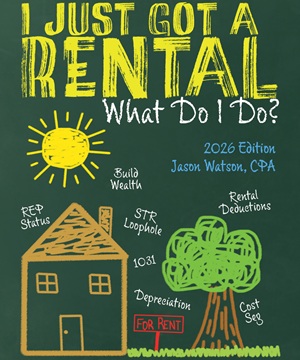 This KB article is an excerpt from our 530+ page book (yeah, thick, there are some picture pages, but no scratch and sniff) which was updated April 5, 2026, and is available in paperback from Amazon, as an eBook for Kindle and as a PDF from ClickBank. We used to publish with iTunes and Nook, but keeping up with two different formats was brutal. You can cruise through these KB articles online, click on the fancy buttons below or visit our webpage which provides more information.
 |
 |
 |
| $32.95 | $21.95 | $18.95 |

Taxes can be tricky. Chat with a WCG human now and get questions answered.

Everything you need to help you launch your new business entity from business entity selection to multiple-entity business structures.
Designed for rental property owners where WCG CPAs & Advisors supports you as your real estate CPA.
Everything you need from tax return preparation for your small business to your rental to your corporation is here.
WCG’s primary objective is to help you to feel comfortable about engaging with us