
Business Advisory Services
Everything you need to help you launch your new business entity from business entity selection to multiple-entity business structures.


Everything you need to help you launch your new business entity from business entity selection to multiple-entity business structures.

Designed for rental property owners where WCG CPAs & Advisors supports you as your real estate CPA.
Everything you need from tax return preparation for your small business to your rental to your corporation is here.

WCG’s primary objective is to help you to feel comfortable about engaging with us
Table Of Contents
 By Jason Watson, CPA
Posted Tuesday, July 7, 2026
Ok, who wants some easy stuff? After all that start-up expenditure nonsense, we all do, right?
All the kitchen wares, linens, and supplies such as paper towels, coffee pods, soap, and other guest goodies are generally deductible right away provided they are $2,500 or less per item or invoice, assuming the de minimis safe harbor applies. See our rental property safe harbors section.
Furnishings will likely qualify as well, unless you spring for an expensive sectional or a fancy dining table. A nightstand? Probably fine. A $2,500-or-less hot tub? We’d be wary of that one. Bonus depreciation and Section 179 expensing are your backup options should some of your furnishings not be eligible for the de minimis safe harbor.
Before we get to the timing trap, two quick comments on booking furniture purchases as rental property assets.
First, if these furnishings were purchased after the rental property was officially placed in service, they might be immediately deducted as operating expenses using the de minimis safe harbor. Therefore, no bonus depreciation or Section 179 expensing is necessary. We see many tax practitioners mess this up. They see $40,000 in total furnishings and instantly think “CapEx,” completely forgetting to apply the safe harbor item-by-item.
Second, why does this matter? While booking the asset and using bonus depreciation or Section 179 expensing might arrive at the exact same tax deduction today, you now have a lingering asset on the books that must be resolved when you eventually sell the rental property. We agree that deducting your furnishings as an operating expense and later selling them technically causes the same disposition grief. However, having a formal asset permanently listed on your tax return’s depreciation schedule makes this recapture process a bit more “front and center” with a giant IRS spotlight on it.
Avoid the discussion and keep it off the books if you legally can.
Now for the timing wrinkle. Everything above assumes the rental activity already exists or the property is already placed in service. Pre-opening purchases get trickier, and this is where the December furniture purchase can ruin the tax deduction party.
Here is where timing will make or break your accounting strategy. Are pre-opening furniture purchases considered IRC Section 195 start-up costs? Possibly, but not because tangible property magically becomes deductible before the rental activity begins.
IRC Section 195 generally applies to expenditures paid or incurred before an active trade or business begins if those same costs would have been deductible had they been paid or incurred after the business was already operating. Huh? That’s a long sentence, right? Let’s just say the line is blurry.
That is where the de minimis safe harbor can matter. If an operating rental business could deduct a qualifying $900 nightstand, $1,200 sofa or $600 set of kitchen supplies under the de minimis safe harbor, then there is a solid argument that the same cost, when incurred before the rental activity begins, can be treated as a Section 195 start-up expenditure.
To understand the trap, or pitfall, or otherwise bad thing, you must look under the hood at how the tax code connects the dots. The de minimis safe harbor is a nice gift from the IRS, found in Treasury Regulation Section 1.263(a)-1(f). It acts as a tax bridge: it takes a tangible asset that you would normally be forced to capitalize and depreciate under IRC Section 263, and magically transports it over to IRC Section 162 to be immediately deducted as a routine operating expense.
Hang in there… because here is the catch. And then the fight. But the catch first.
Once the safe harbor pushes that expenditure into IRC Section 162 territory, you must play by Section 162 rules. Here is the exact text straight from IRC Section 162(a)–
(a) In general
There shall be allowed as a deduction all the ordinary and necessary expenses paid or incurred during the taxable year in carrying on any trade or business,
If you buy $40,000 worth of furniture in December, but the rental property does not officially become ready and available for rent (placed in service) until January 1, your rental activity has not technically begun in December. You are not yet carrying on a rental trade or business when the expenditure is paid.
One view says you have a timing problem. IRC Section 162 generally requires an existing trade or business, and the de minimis safe harbor rides on that same concept. No active rental business yet? Sorry, Charlie. Under this view, the furniture does not get immediately deducted in December, and you are pushed back into the capitalization rules of IRC Section 263.
Sidebar: Some might argue that these furniture purchases were made “in anticipation of a business,” which is IRC Section 195 language. That argument is not silly. If the item would have been deductible in an existing rental business under the de minimis safe harbor or supplies rules, then Section 195 might control the timing before the rental activity begins. But Section 195 does not save true capital assets, acquisition costs, or improvements. Those stay in the normal depreciation world.
Under this capitalization-first view, you would book that $40,000 as a capitalized asset on your depreciation schedule. You cannot use the safe harbor retroactively once the calendar flips and the business, in this case the rental, is open for customers. Instead, you must rely on bonus depreciation or Section 179 to deduct the expenditure once the rental is finally placed in service in January.
The critical timing rule for tangible property is not the purchase date- it is the placed-in-service date. The tax treatment follows the timeline of when the asset begins performing its intended income-producing function, not when the money left your checking account.
Different phases. Different handling.
However, that does not mean you deduct the item immediately before the rental is in service. If the rental activity has not begun, Section 195 controls the timing. As stated earlier, you may deduct up to $5,000 of total start-up expenditures in the year the rental activity begins, reduced dollar-for-dollar once total start-up expenditures exceed $50,000. The remaining start-up expenditures are amortized over 180 months beginning with the month the rental activity begins.
In other words, the de minimis safe harbor helps determine whether the cost would have been deductible in an existing rental activity. Section 195 then controls when that pre-opening cost is deducted. If the cost is instead a true capital asset, acquisition cost or improvement, Section 195 does not apply. You are back to the normal depreciation world, including bonus depreciation or Section 179 expensing where available.
A visual reference-
| Phase | Handling |
| Exploratory, investigation | Start-up expenditure |
| Specific property acquisition | Acquisition costs, but only for costs that facilitate the purchase |
| Pre-closing rental launch purchases | Start-up expenses or capital assets, depending on the item |
| Launching rental after closing | Start-up expenses or operating expenses, depending on placed-in-service date |
| Pre-opening furnishings and supplies | Possibly Section 195 if de minimis applies, otherwise capital assets* |
| Pre-opening carrying costs | Depends on the cost, facts and timing |
| Ready and available for intended use | Operating expenses |
| Improvements and renovations | Capital expenditures |
* Capital assets are not bad. Most freestanding furniture, appliances and equipment are Section 1245 property, and once placed in service, they might be eligible for bonus depreciation or Section 179 expensing.
Who wants to belabor the heck out of this some more? Of course you do!
Here’s the order of operations:
This is tricky stuff. Ok, having said all this, we must present an alternative approach.
Put two tax professionals in a room to discuss this December furniture purchase, and you will get an argument. Why?
The safe harbor regulations explicitly state you must claim the deduction in the taxable year the amount is paid (December/Year 1). But to take a Section 162 deduction, you must be actively carrying on a trade or business as we’ve stated previously. Because the rental isn’t placed in service until January, the rental business doesn’t exist in Year 1. We all agree. Good. Now the fight.
Opinion A (The Capitalization Purist): Because you fail the active business test in Year 1, the safe harbor bridge collapses. You are thrown back into the capitalization rules. You must book the $40,000 as an asset, carry it into Year 2, and rely on bonus depreciation or Section 179 to deduct it once the property goes live in January.
Opinion B (The Capital Recovery Pragmatist): Other practitioners argue that the expenditure simply sits in tax purgatory until the property is placed in service in January. At that exact moment, the safe harbor wakes up, the business is now active, and you can expense it directly under de minimis.
Opinion C (The Section 195 Bridge): A third view is that the de minimis safe harbor answers the “would this have been deductible in an existing business?” question, and Section 195 then controls timing because the rental activity had not yet begun. Under this view, qualifying pre-opening furnishings and supplies become start-up expenditures, subject to the $5,000 limit, $50,000 phaseout, and 180-month amortization, and blah blah blah.
Which opinion is right? The annoying answer is that the code, regulations and timing rules do not line up as cleanly as we would like. The approaches can also produce different answers if total start-up expenditures exceed the Section 195 limits, so this is not always just academic.
However, WCG CPAs & Advisors typically believes Opinion A is the cleaner mechanical route when the amounts are large and the year changes. A de minimis safe harbor election is generally tied to amounts paid during the taxable year, and trying to drag that treatment into the next year can get messy. By capitalizing the furniture and using Section 179 or bonus depreciation in Year 2, you align the deduction with the moment the asset begins performing its intended income-producing function. Cleaner. Easier to defend. Less weird.
Jason Watson, CPA, is a partner and the CEO of WCG CPAs & Advisors, a boutique yet progressive tax, accounting and rental property consultation and real estate CPA firm with over 90 team members and 7 partners headquartered in Colorado serving real estate investors worldwide.


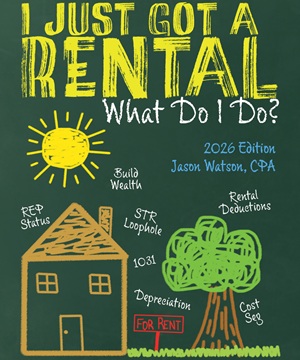 This KB article is an excerpt from our 530+ page book (yeah, thick, there are some picture pages, but no scratch and sniff) which was updated April 5, 2026, and is available in paperback from Amazon, as an eBook for Kindle and as a PDF from ClickBank. We used to publish with iTunes and Nook, but keeping up with two different formats was brutal. You can cruise through these KB articles online, click on the fancy buttons below or visit our webpage which provides more information.
 |
 |
 |
| $32.95 | $21.95 | $18.95 |

Taxes can be tricky. Chat with a WCG human now and get questions answered.

Everything you need to help you launch your new business entity from business entity selection to multiple-entity business structures.
Designed for rental property owners where WCG CPAs & Advisors supports you as your real estate CPA.
Everything you need from tax return preparation for your small business to your rental to your corporation is here.
WCG’s primary objective is to help you to feel comfortable about engaging with us