
Business Advisory Services
Everything you need to help you launch your new business entity from business entity selection to multiple-entity business structures.


Everything you need to help you launch your new business entity from business entity selection to multiple-entity business structures.

Designed for rental property owners where WCG CPAs & Advisors supports you as your real estate CPA.

Everything you need from tax return preparation for your small business to your rental to your corporation is here.
Table Of Contents
 By Jason Watson, CPA
Posted Monday, March 30, 2026
Part 5 of our miniseries focuses on the “Bank of You.” In a real estate market occasionally (and perhaps stubbornly) defined by high interest rates and tight lending standards, seller financing (sometimes called carryback financing) always makes a comeback. Instead of the buyer going to a traditional bank for a mortgage, they come to you. You accept a down payment and a promissory note for the balance.
The appeal is obvious. You can sell a property that might otherwise sit stagnant on the market, and you earn interest income that is often higher than a standard savings account. More importantly, you get tax deferral. Instead of paying all your capital gains tax in year one, you pay it slowly over the 10, 20, or 30 years you receive payments.
Sidebar: In any installment sale scenario, we recommend a 5-year balloon or perhaps a 10-year. Let banks be banks. Your installment generosity was mostly to grease the skids and get this deal closed. Long-term financing brings long-term risk.
It sounds like the perfect plan, right? But there are massive traps buried inside IRC Section 453 that can leave you cash-flow negative or heavily tax-exposed.
This is the rule that leaves unsuspecting sellers frustrated like the Monopoly guy with empty pockets. Depreciation recapture is entirely ineligible for installment sale reporting. Wait! What? Yeah, you read it correctly.
The general rule of installment sales is that you recognize gain pro-rata as you receive cash. Simple. If you receive 10% of the sale price, you pay tax on 10% of the gain. However, the IRS makes a glaring exception for our old friend, depreciation recapture.
Who wants some code? Let’s look at IRC Section 453(i)(1), specifically dealing with the recognition of recapture income in the year of disposition:
(1) In general
In the case of any installment sale of property to which subsection (a) applies—
(A) notwithstanding subsection (a), any recapture income shall be recognized in the year of the disposition, and (B) any gain in excess of the recapture income shall be taken into account under the installment method.
See that phrase “recognized in the year of the disposition”? That means certain depreciation-related gains must be recognized immediately in the year of sale, even if you receive very little cash. This typically includes depreciation from personal property, cost segregation components, Section 179 expensing, or other accelerated depreciation. Because these amounts are treated as ordinary recapture income, they cannot be reported using the installment method.
Sidebar: Recapture vs. Unrecaptured Gain True IRC Section 1250 recapture, which is uncommon for modern residential rentals depreciated using straight-line methods, also cannot use the installment method. This is very different from unrecaptured Section 1250 gain, which is the standard 25% tax bucket common in rental real estate. Unrecaptured Section 1250 gain can follow the installment method for gain recognition, allowing you to defer those taxes over the life of the note. Yawn.
Consider this nightmare scenario:
If we assume a 25% combined state and federal tax on that $200,000 recapture, your tax bill is $50,000. If you also have $60,000 in selling costs and commissions, you have a massive problem. You received $50,000 in cash from the buyer, but you wrote checks for $110,000 (tax on recapture and selling costs). You are negative $60,000 on the deal. You handed over the keys to your building and had to write a check to the IRS for the privilege. Yuck!
Ok, to be fair this is an extreme example especially considering the super low down payment above. However, there is still a cash crunch created by all depreciation recapture coming in on year 1.
Many sellers mistakenly believe that the monthly check they receive is fully taxable. Others think it is tax-free until they recover their original cost basis. Both are wrong. Every payment you receive is split into distinct buckets for tax purposes.
To determine the exact split of that principal payment, you must calculate your Gross Profit Ratio. IRC Section 453(c) defines the installment method perfectly:
(c) Installment method defined For purposes of this title, the term “installment method” means a method under which the income recognized for any taxable year from a disposition is that proportion of the payments received in that year which the gross profit (realized or to be realized when payment is completed) bears to the total contract price.
As such, if you bought a property for $100,000 and sold it for $300,000, your gross profit is $200,000. Your gross profit percentage is 66.67%. Therefore, for every $1,000 of principal you receive, about $333 is tax-free return of basis and about $667 is taxable gain. Does $334 and $666 sound better?
Also, beware the high interest mirage. Earning 8% interest on a carryback note sounds fantastic, but remember that interest is ordinary income. It does not enjoy capital gains tax rates. If you are a high earner, your after-tax yield on that 8% note might be significantly lower than you anticipate. Then again, 8% in our example, is not too far off most people’s cost of equity (9 to 11% for most taxpayers).
Sometimes, a seller tries to be nice to a buyer (often a child or family member) by charging 0% interest or a drastically below-market rate. They structure the deal entirely as principal payments to avoid ordinary income tax on the interest.
The IRS hates interest free loans since there is no such thing as a free lunch, and anyone offering something for free is making it up elsewhere. Under the imputed interest rules, the IRS can recharacterize part of your deferred payments as interest if the note does not provide for adequate stated interest. This minimum rate is known as the Applicable Federal Rate, or AFR.
IRC Section 483(a) reads-
(a) Amount constituting interest For purposes of this title, in the case of any contract for the sale or exchange of property there shall be treated as interest that portion of the total unstated interest under such contract which, as determined in a manner consistent with the method of computing interest under section 1272(a), is properly allocable to such payment.
When the IRS imputes interest, they forcibly reclassify a portion of your principal payments as interest. You are required to pay ordinary income tax on money you thought was capital gains (or tax-free basis), even though you didn’t actually charge the buyer a lick of interest.
Finally, what happens if the buyer defaults? You get the property back. That sounds okay, right? You keep the down payment and get the building back.
Under IRC Section 1038, repossessing real property can trigger taxable gain, even though the seller generally does not recognize a loss. While you generally don’t recognize loss, you must recognize gain to the extent of the cash payments you already received prior to the repossession that haven’t already been taxed as gain. Huh?
The real sting? You do not get a refund for the taxes you paid on the sale in year one (like that massive recapture tax). That money is gone. You now own the property again, but your bank account is lighter by the amount of tax you paid to the IRS.
Want some good news? Your basis in the property resets. Under IRC Section 1038, your new basis becomes the basis of the defaulted note, plus the gain you just recognized on repossession, plus your legal fees to get the property back (think acquisition costs). Because you already paid that massive recapture tax and recognized gain on the cash received, your starting basis is stepped up. If you redeploy the property as a rental, you get to start depreciating it all over again based on this new, higher number.
That heading alone can make you drool. But the warning remains- if the property you are selling still has a mortgage loan, the installment method can behave strangely. If the buyer assumes your mortgage, the IRS does not automatically treat that debt relief as cash unless that debt exceeds your adjusted basis in the property. If your mortgage is higher than your basis (often due to cash-out refinances or heavy depreciation), the IRS treats that excess amount as cash received in the year of sale. In extreme cases, sellers can owe a massive tax bill in year one despite receiving almost no actual money at closing.
Seller financing is a powerful tool to free up equity in a frozen market. But it turns you into a bank, and banks have complex accounting departments for a reason. Calculate your recapture first, respect the AFR, and heavily vet your buyer.
Jason Watson, CPA, is a partner and the CEO of WCG CPAs & Advisors, a boutique yet progressive tax, accounting and rental property consultation firm with over 90 team members headquartered in Colorado serving real estate investors worldwide.


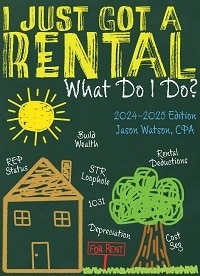 This KB article is an excerpt from our 480+ page book (some picture pages, but no scratch and sniff) which was updated October 6, 2025, and is available in paperback from Amazon, as an eBook for Kindle and as a PDF from ClickBank. We used to publish with iTunes and Nook, but keeping up with two different formats was brutal. You can cruise through these KB articles online, click on the fancy buttons below or visit our webpage which provides more information.
 |  |  |
| $19.95 | $15.95 | $12.95 |

Taxes can be tricky. Chat with a WCG human now and get questions answered.

Everything you need to help you launch your new business entity from business entity selection to multiple-entity business structures.
Designed for rental property owners where WCG CPAs & Advisors supports you as your real estate CPA.
Everything you need from tax return preparation for your small business to your rental to your corporation is here.