
Business Advisory Services
Everything you need to help you launch your new business entity from business entity selection to multiple-entity business structures.


Everything you need to help you launch your new business entity from business entity selection to multiple-entity business structures.

Designed for rental property owners where WCG CPAs & Advisors supports you as your real estate CPA.

Everything you need from tax return preparation for your small business to your rental to your corporation is here.
Table Of Contents
 By Jason Watson, CPA
Posted Sunday, March 22, 2026
While bonus depreciation usually grabs the headlines, IRC Section 179 is the workhorse of small-to-mid-sized real estate. For rental properties under $5M, cost segregation typically identifies 20% to 40% of the basis as eligible property (5-, 7-, or 15-year assets). Since the Section 179 limit is $2,560,000 for the 2026 tax year, it effectively covers the entire amount of property eligible for acceleration (and perhaps even higher than a $5M purchase).
The critical distinction is intent:
This is where Section 179 shines. Most states are decoupled from bonus depreciation- meaning if you take a $500,000 bonus deduction on that massive cost segregation study on that equally massive rental property, your state makes you add it back (literally or figuratively depending on your state) and pay state tax on it today. However, a significant majority of states conform to federal Section 179 limits.
Sidebar: As of the 2026 tax year, these states generally roll with the federal Section 179 limits as of the 2026 tax year- AL, AZ, CO, DE, GA, ID, IA, IL, KS, LA, MA, ME, MI, MS, MO, MT, NE, NM, ND, NY, OK, OR, RI, SC, UT, VT, VA, WV. There are some developments with AZ.
Sidebar #2: Some states have detachment anxiety but eventually compromise. California is the poster child—capping Section 179 at $25,000 and forcing a second depreciation schedule. Other states such as Arkansas, Hawaii, Indiana, Kentucky, New Jersey, and Pennsylvania also limit or modify Section 179 in various ways rather than fully conforming. Ohio allows Section 179 but requires adjustments that effectively spread the benefit over time. Maryland also imposes limits with additional modifications. Translation: same concept, different flavors of pain.
By using Section 179 instead of bonus depreciation, you achieve tax nirvana: a massive deduction that works for both federal and state tax returns simultaneously. Without 179, you might save 37% federally but still get nickeled and dimed by a 5% to 9% state tax on that same income. More like beaten with the dollars whip- forget about nickels and dimes!
Despite its state-level benefits, Section 179 has a locking mechanism when used inside a pass-through entity such as a multi-member LLC (MMLLC) taxed as a partnership. While the partnership allocates Section 179 deductions through the K-1, the deduction is first limited at the entity level based on the partnership’s business income. It is then subject to additional limitations at the partner level under IRC Section 179(b)(3), along with basis, at-risk, and passive activity rules.
If the partnership does not have sufficient income, a portion of the Section 179 deduction never makes it to your personal tax return in the first place. And if it doesn’t land on your Form 1040, it cannot offset anything including your W-2 income. Yeah, read that again. Buzzkill for sure.
As a result, even if the partnership generates a large Section 179 deduction, a partner with limited income might find the deduction effectively trapped, either at the entity level or on their personal return, and carried forward to future years. Possibly a lot of future years.
Sidebar: Think you can avoid a partnership return by assigning your LLC interests to a joint revocable trust? Think again. In common law states, the IRS disregards the trust and sees two distinct owners (the spouses) under IRC Sections 671–679, mandating a Form 1065 partnership filing per Treasury Regulations Section 301.7701-3. Unless you are in a community property state, you cannot bypass the partnership layer or report this activity directly on your Form 1040.
Bonus depreciation asks, “Did you place it in service?” Section 179 asks, “Do you have enough income to deserve it?” Yeah, Ok, animals can’t talk, we get it, but play along please.
Section 179 carries a “predominant use” sting that bonus depreciation (for non-listed property) largely avoids.
Granted, this is crystal ball type stuff. Then again, if 3-4 years go by, and then you want to take the short-term rental out of service and make it a second home, the decision you made way back when could haunt you.
The OBBBA introduced a specific hurdle for bonus depreciation- the “Acquired after January 19, 2025” rule. To qualify for 100% bonus depreciation, you must have acquired the property after that date.
If you bought a home in 2024 as a primary residence and are converting it to a rental in 2026, it was acquired prior to the OBBBA deadline. In this specific “primary-to-rental” conversion, bonus depreciation will be subject to pre-OBBBA rules or in this case 40%. Section 179 does not have this same “acquired” restriction, making it the primary viable path for a massive year-one deduction on older properties newly placed into service as rentals.
Section 179 is the Swiss army knife of depreciation- it’s the best way to get a state-level deduction and the only way to handle properties acquired before the OBBBA. Its only real downsides are its inability to create a paper loss at the entity level and the aggressive recapture rules if you decide to move in.
Said differently- the question isn’t which deduction is bigger but rather which one survives all the limitations and rules, today and tomorrow. Yeah, Ok, that probably didn’t help much.
Jason Watson, CPA, is a partner and the CEO of WCG CPAs & Advisors, a boutique yet progressive tax, accounting and rental property consultation and real estate CPA firm with over 90 team members and 7 partners headquartered in Colorado serving real estate investors worldwide.


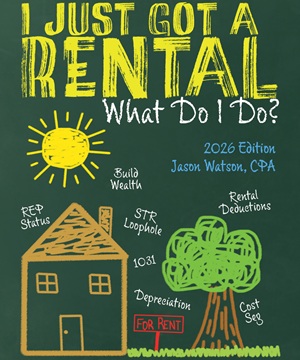 This KB article is an excerpt from our 530+ page book (yeah, thick, there are some picture pages, but no scratch and sniff) which was updated April 5, 2026, and is available in paperback from Amazon, as an eBook for Kindle and as a PDF from ClickBank. We used to publish with iTunes and Nook, but keeping up with two different formats was brutal. You can cruise through these KB articles online, click on the fancy buttons below or visit our webpage which provides more information.
 |  |  |
| $32.95 | $21.95 | $18.95 |

Taxes can be tricky. Chat with a WCG human now and get questions answered.

Everything you need to help you launch your new business entity from business entity selection to multiple-entity business structures.
Designed for rental property owners where WCG CPAs & Advisors supports you as your real estate CPA.
Everything you need from tax return preparation for your small business to your rental to your corporation is here.