
Business Advisory Services
Everything you need to help you launch your new business entity from business entity selection to multiple-entity business structures.


Everything you need to help you launch your new business entity from business entity selection to multiple-entity business structures.

Designed for rental property owners where WCG CPAs & Advisors supports you as your real estate CPA.
Everything you need from tax return preparation for your small business to your rental to your corporation is here.
Table Of Contents
 The next part of our material participation miniseries brings us to travel time. Once the rental property is running, you will inevitably spend time driving to check on it, grabbing supplies, or meeting contractors.
Does the drive count toward your hours?
The answer is incredibly squishy. Nailing Jello to the wall sort of thing. It largely comes down to the distinction between a personal commute and travel that is integral to performing services for the activity.
You might look at Treasury Regulation Section 1.469-5T(f) and think you are safe-
(f) Participation-
(1) In general.
Except as otherwise provided in this paragraph (f), any work done by an individual (without regard to the capacity in which the individual does the work) in connection with an activity in which the individual owns an interest at the time the work is done shall be treated for purposes of this section as participation of the individual in the activity.
It plainly states that “any work done by an individual… in connection with an activity” counts as participation. However, Treasury Regulations Section 1.469-9(b)(4) throws a wet blanket on the party like your spouse looking at their watch and then giving you “the look,” by stating that personal services do not include work performed in an investor capacity.
(4) Personal services.
Personal services means any work performed by an individual in connection with a trade or business. However, personal services do not include any work performed by an individual in the individual’s capacity as an investor as described in § 1.469-5T(f)(2)(ii).
So, is travel a valid personal service or just an investor checking on their asset? The IRS Passive Activity Loss Audit Techniques Guide gives away their playbook:
Travel time generally should not be considered in computing the hourly tests for material participation, particularly if other factors indicate the taxpayer is not participating in the activity on a regular, continuous and substantial basis. Legislative history provides that ‘services must be integral to operations.’ It is somewhat difficult to construe that travel constitutes ‘services’ or ‘participation’… travel is not integral to operations in most cases.
Read that last line again. Yuck. Immediate skepticism, right? In other words, the IRS inherently assumes your drive to the rental property is just a personal commute. And just like driving from your home to your W-2 job is a non-deductible commute, the IRS views driving from your home to your rental property the exact same way. Admittedly, this mixes deductible expense concepts with material participation hours, but the analogy helps illustrate the IRS position.
Need more? The IRS position on travel time is not just an audit preference. Rather, it traces back to the legislative history of the passive activity rules. The Joint Committee explanation (JCS-10-87, May 1987) of the Tax Reform Act of 1986 states that services counted toward material participation must be integral to the operations of the activity. The committee report notes that merely traveling to or from an activity generally does not qualify as participation because the services must be tied directly to the operational functions of the business.
When this goes to Tax Court, the results are a mixed bag.
There is case law saying No. In Truskowsky v. Commissioner, Tax Court Summary 2003-130, the court stated that unless a taxpayer can prove day-to-day managerial involvement, travel time is considered commuting, which is personal in nature, and therefore does not qualify. To be fair, Truskowsky’s travel was a bit self-serving since it was not solely for business since they mixed in some pleasure by visiting family.
There is also case law saying Yes. In Leyh v. Commissioner, Tax Court Summary Opinion 2015-27, the taxpayer had only 632.5 hours on her time log but explained during the audit that she had failed to record the time spent traveling among her 12 rental properties. The IRS countered that her log was already inclusive of travel time. Based on her testimony, the Tax Court found she had not included it, and surprisingly allowed her to restate the time log to add the travel hours. The Tax Court was certainly having a nice day and being taxpayer-friendly. Perhaps Leyh brought chocolate.
As you can see, the IRS starts from the assumption that travel is personal unless the taxpayer can demonstrate that the travel itself was integral to performing services for the activity.
While your mileage might vary (pun intended), a reasonable, audit-defensible tax position starts with proving you are traveling between two business locations.
In Truskowsky v. Commissioner, Tax Court Summary 2003-130, the taxpayer successfully asserted that travel time counts if you are also claiming a home office that is used regularly and exclusively for your real estate activities. In that case, the drive may be characterized as travel between business locations rather than a personal commute. That counts.
How many rental properties do you need to assert a home office? Three? Five? Who knows! Facts and circumstances, chocolate and luck. In other words, it is situational. Some rentals are a pain in the butt; others run like clockwork. In our opinion, day-to-day participation is a higher standard than regular, continuous and substantial.
Even without a home office, driving from rental A to rental B is business travel. Driving from the bank (a business task) to Home Depot, and then to the rental is business travel. Don’t just log “driving.” Log “Travel to Main Street to collect rent.” And if you do not have a qualified home office, be very careful about counting the drive from your personal driveway to the rental property.
Sidebar: Personal service is scattered throughout this section and is one of the pillars of testing your participation. How much personal service is being performed on your real estate investments while sitting on an airplane? Perhaps a lot if you are reviewing contracts and balancing your rental property checkbook. How much personal service is being done driving a car for three hours? Perhaps a lot if you are on the phone chatting about your partnership tax returns and 1031 like-kind exchange concerns with your real estate CPA at WCG CPAs & Advisors. Be reasonable but don’t skimp.
You might be looking at the IRS rules versus the Tax Court cases and thinking, “This is entirely contradictory. The IRS says travel doesn’t count unless I’m performing a service, but the court in Leyh allowed it anyway. What gives?”
And you all wonder why CPAs drink.
The secret lies in volume and context. It is the difference between a commute and a route. If you have a W-2 job and own one or two rentals, driving to check on them looks exactly like a personal commute to an investment. The IRS will almost always throw those hours out unless you have a strict home office or are actively conducting business on the phone during the drive (and tread lightly how often you claim business calls during your drives).
However, if you manage 12 or 20 properties full-time like the taxpayers in our favorable tax court cases such as Leyh and Hailstock, the script flips. You are no longer commuting; you are running a daily route. Just like a pool cleaner or a FedEx driver, the travel between your scattered properties is the connective tissue of your day-to-day operations. The court recognizes that at a high volume, transit is an integral part of managing the business.
We need to revisit a painful truth we discussed earlier: just because an expense is deductible does not mean the time associated with it counts toward material participation.
Many investors assume that if they can deduct the 50 miles they drove to their rental, or the airfare to fly across the country to check on a property, then the time spent traveling automatically counts toward their hourly threshold.
Let us burst that bubble right now. Time spent in connection with mileage and its eventual deduction does not equal material participation. Airfare does not equal material participation. Trains and boats?
You might legally and perfectly deduct a $500 flight to Florida as an ordinary and necessary business expense under IRC Section 162. But the four hours you spent sitting in coach eating Biscoff cookies and watching a movie? The IRS generally does not consider that “work in connection with an activity.” As we mentioned in our multitasking sidebar, unless you are actively balancing the books or reviewing leases on that flight, the travel time itself is just… travel time.
Sidebar: $500 for coach? Live a little. Remember, if you don’t fly first class, your kids will.
Passing the test to deduct the cost of the trip does not automatically grant you the hours for the trip. One does not get you the other.
Let’s also throw a dash of common sense into the mix. The IRS and Tax Court judges are human beings, and they have a pretty good radar for nonsense.
If you log 24 hours of round-trip driving to spend 45 minutes painting a single accent wall, that just doesn’t make sense. The travel time must be proportional to the actual work being performed. There isn’t a rule or a safe harbor or a ratio or anything mathematic- just a smell test.
If your travel hours vastly outweigh your operational hours, the IRS and court might argue that your trip was personal in nature. Don’t confuse personal with pleasure- personal is just a nice way of saying “no time, no deduction, no nothing nothing” in perfect English prose.
Be reasonable. If the juice isn’t worth the squeeze for the actual property, it certainly isn’t worth the squeeze for material participation.
Here’s some gray water to swim in- you could fly the family to your short-term rental for 3 days of maintenance and 1 day of personal use. The trip is predominantly business. Kids’ air fare is likely not deductible unless they do actual work. Travel time as material participation?
What is this section really telling us? Unlike other areas of the tax code, there are no bright lines here. There are no safe harbors where you can neatly dock your material participation boat. Counting travel time toward material participation is a pure “facts and circumstances” test.
It relies entirely on the specifics of your situation, the proportionality of your driving versus working, the strength of your home office position, and frankly whether the human being auditing your return or hearing your Tax Court case is having a good day.
Track your time meticulously, lean on the home office or “cluster” defense if you can, pass the smell test, and always remember to bring chocolate to the audit.
Jason Watson, CPA, is a partner and the CEO of WCG CPAs & Advisors, a boutique yet progressive tax, accounting and rental property consultation and real estate CPA firm with over 90 team members and 7 partners headquartered in Colorado serving real estate investors worldwide.


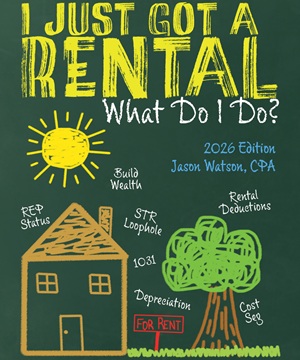 This KB article is an excerpt from our 530+ page book (yeah, thick, there are some picture pages, but no scratch and sniff) which was updated April 5, 2026, and is available in paperback from Amazon, as an eBook for Kindle and as a PDF from ClickBank. We used to publish with iTunes and Nook, but keeping up with two different formats was brutal. You can cruise through these KB articles online, click on the fancy buttons below or visit our webpage which provides more information.
 |  |  |
| $32.95 | $21.95 | $18.95 |

Taxes can be tricky. Chat with a WCG human now and get questions answered.

Everything you need to help you launch your new business entity from business entity selection to multiple-entity business structures.
Designed for rental property owners where WCG CPAs & Advisors supports you as your real estate CPA.
Everything you need from tax return preparation for your small business to your rental to your corporation is here.