
Business Advisory Services
Everything you need to help you launch your new business entity from business entity selection to multiple-entity business structures.


Everything you need to help you launch your new business entity from business entity selection to multiple-entity business structures.

Designed for rental property owners where WCG CPAs & Advisors supports you as your real estate CPA.

Everything you need from tax return preparation for your small business to your rental to your corporation is here.
Table Of Contents
 But there is a wrinkle when we apply these acquisition rules to short-term rentals. Short-term rentals with an average guest stay of 7 days or less are not treated as “rental activities” under the passive activity rules. They are treated like hotels. Why does this matter? Please see our chapter on short-term rentals.
Because the passive activity rules treat very short-term rentals more like hotels than traditional rental properties, the operational side of the business begins to resemble a service business rather than a passive investment.
Let’s go to the regulations. Treasury Regulations Section 1.469-4 primarily deals with how activities are grouped under the passive activity rules. However, courts often rely on this regulation because it is one of the few places in the IRC Section 469 regulations that explains what an “activity” actually is. In doing so, the regulation notes that an activity can include work performed “in anticipation of the commencement of a trade or business.”
This means you are considered to have an activity by the mere anticipation of starting a trade or business that is not a traditional rental. This opens the door to an argument that certain operational setup activities for a short-term rental may occur within an existing trade or business activity even before the property is fully operational.
Think about selling used copiers as a new business, as we discussed in a previous section. The moment you start procuring inventory, negotiating contracts, creating marketing materials, buying office furniture, and deploying an accounting system, you are materially participating in your used copier activity.
Setting up your STR by signing up with a management company, launching a listing, and shopping for linens starts to look a lot like building the operational framework of a small hospitality business, right?
Here is the massive catch: The chicken or the egg.
To use this anticipation rule, your STR cannot be classified as a rental activity. To avoid being classified as a rental activity, the property must ultimately meet the exception requiring an average guest stay of 7 days or less.
But how do you prove an average guest stay of 7 days or less if the property hasn’t opened for business yet?
If you buy a property in November, spend December furnishing it, and don’t host your first guest until January, you have a Year 1 tax problem. The IRS can easily argue that because you had zero guests in Year 1, you cannot prove the 7-day exception. If you can’t prove the exception, the property defaults to a standard rental activity for that year. The moment it becomes a standard rental activity, the anticipation rule vanishes, and your setup hours are thrown out as pre-opening rental time.
As such, if you want to count your operational setup time (buying linens, building listings) under the anticipation rule, you desperately need to get that property placed in service and host actual guests in the same tax year. You need that 7-day average data on the books to prove the activity is a trade or business, and not a typical rental activity.
Even with the STR anticipation rule, we must still be mindful of the investor time trap. Setting up operations counts, but purely looking for an asset does not. The following items likely will never (yeah, sure, a bit dramatic) count for material participation, even for an STR:
Ah, the beauty of our tax code!
Sidebar: While this trade or business classification creates a frustrating Year 1 material participation hurdle, it can be a benefit for the 750-hour REPS test. Because your STR is a trade or business using real property, your operational hours drop right into your 750-hour bucket to help your overall tax strategy. See our REPS pitfalls with short-term rentals section.
Jason Watson, CPA, is a partner and the CEO of WCG CPAs & Advisors, a boutique yet progressive tax, accounting and rental property consultation and real estate CPA firm with over 90 team members and 7 partners headquartered in Colorado serving real estate investors worldwide.


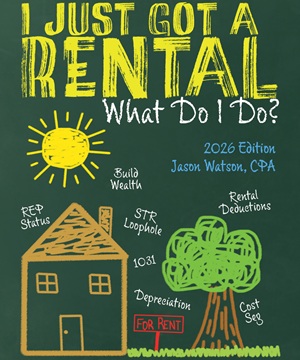 This KB article is an excerpt from our 530+ page book (yeah, thick, there are some picture pages, but no scratch and sniff) which was updated April 5, 2026, and is available in paperback from Amazon, as an eBook for Kindle and as a PDF from ClickBank. We used to publish with iTunes and Nook, but keeping up with two different formats was brutal. You can cruise through these KB articles online, click on the fancy buttons below or visit our webpage which provides more information.
 |  |  |
| $32.95 | $21.95 | $18.95 |

Taxes can be tricky. Chat with a WCG human now and get questions answered.

Everything you need to help you launch your new business entity from business entity selection to multiple-entity business structures.
Designed for rental property owners where WCG CPAs & Advisors supports you as your real estate CPA.
Everything you need from tax return preparation for your small business to your rental to your corporation is here.