
Business Advisory Services
Everything you need to help you launch your new business entity from business entity selection to multiple-entity business structures.


Everything you need to help you launch your new business entity from business entity selection to multiple-entity business structures.

Designed for rental property owners where WCG CPAs & Advisors supports you as your real estate CPA.

Everything you need from tax return preparation for your small business to your rental to your corporation is here.
Table Of Contents
 By Jason Watson, CPA
Posted Sunday, April 5, 2026
Owning rental property in another state creates more than just cash flow- it creates tax jurisdiction. Great, what does that mean? It means that even if your rental activity shows little or no taxable income (i.e., a tax loss), that state, and more correctly, that taxing jurisdiction, generally has the right to inspect your books and records to validate your net tax effect and, just as importantly, to revisit it later. Woah, that’s a long sentence.
The real question, then, is not always whether you owe tax today, but whether you should be filing anyway. In many cases, the answer is yes. Not because of the current year’s result, but because of what the state tax return filing does for you over time.
When you own income-producing real estate in a state or even a city, you are generally considered to have nexus there simply based on the asset’s physical presence. Filing a non-resident state tax return acknowledges that relationship and establishes a clean, defensible reporting position. If you don’t file, you are not avoiding attention- you are simply leaving the state to fill in the blanks later, and states tend to fill in blanks.
Sidebar: As with any missing information in life, others will substitute their own assumptions. They are usually wrong, and usually in their favor. And why not? You’d probably do the same thing
There is also a practical consideration that often gets overlooked: in most states, the statute of limitations does not begin until a tax return is filed. No filing can mean no time limit on audit exposure, which is rarely a position you want to be in.
Beyond audit posture and narrative position, the more technical reason to file comes down to how states diverge from federal tax law. As you might have learned from a previous section, many states do not follow federal rules on bonus depreciation, Section 179, or even certain passive activity concepts.
California is the most commonly cited example, but it is far from alone. When a state decouples from federal rules, you are no longer working with a single set of numbers. You now have a federal depreciation schedule and a separate state depreciation schedule, whether you realize it or not, along with potentially different passive loss carryforwards. Filing annually allows those differences to be tracked cleanly as they occur. Without that annual reporting, you are left trying to reconstruct years of adjustments later, which is both time-consuming and prone to error.
And it doesn’t stop there, oh no sir, depreciation (basis) and loss carryforwards add another layer.
This leads to one of the most important and most overlooked issues: basis tracking for future sale. Because many states limit or disallow accelerated depreciation, your state basis is often higher than your federal basis. That difference works in your favor. A lower federal basis typically results in a higher federal gain, while a higher state basis results in a lower state gain. This makes sense, but is often missed or skipped during rental property dispositions. Especially when no state filing history exists to support the difference.
In other words, you may end up paying less tax to the state when the property is sold. But that benefit only exists if you can support it. If you have not been filing state income tax returns, your state-specific depreciation adjustments might not be properly documented.
Why is this a big deal? Many states require that the federal tax return is filed alongside the state tax return, or at least pertinent portions of it. This gives visibility into the calculated gain on your rental sale from your federal tax return as compared to your state tax return. If you suddenly show a discrepancy without building that history over the years, the state tends to take issue with it. The result is that you could actually overpay state tax on the sale simply because the history was never established.
Passive activity loss carryforwards present a similar issue. Even when rental losses are clear at the federal level, states often require filed returns to establish and preserve those losses on their terms using their forms. Also, going back to the issue about books and records, states that accept your losses through consistent filings have less room to challenge them later when those suspended losses are released upon sale.
All in all, and without a filing history, suspended losses may be limited, delayed, or challenged outright. What appears to be a simple “paper loss” today can become a contested issue later if it was never properly reported at the state level.
There are also practical, administrative considerations that come into play over time. State-level withholding requirements, particularly upon disposition, can create mismatches if prior filings do not exist. What are we talking about here?
Many states require title companies to withhold state income taxes often based on the gross sale amount. This in turn requires you to file a non-resident tax return just to get your tax refund. This too can present challenges from the state if your historical data doesn’t align.
To be fair, and equal opportunity provider, there are situations where filing a non-resident tax return may not be necessary. Minimal income, clear statutory exemptions, or situations where the administrative burden truly outweighs the benefit can justify a different approach. But that should be a conscious decision, not a default assumption.
Everyone? Awesome. Consider a simple example. You own a rental property in California while living in another state. Federally, you take bonus depreciation and generate a large loss. California does not allow bonus depreciation and Section 179 didn’t make sense either, so your California loss is smaller and your depreciation is spread out over a longer period.
Over time, your federal basis declines faster than your California basis. When you eventually sell the property, the federal gain is larger, and the California gain is smaller.
Moreover, California does not conform to federal real estate professional status (REPS) and losses allowed under IRC Section 469 (as we discussed in our state problems with your rental property section on page 138). As such, not only is your basis different, your passive losses that are carried forward are different as well, and in some cases, California’s will be much higher.
Said differently, you could have a small gain simply because of depreciation allowance and even a smaller gain because of higher passive losses that are released upon sale.
The bottom line is that filing a non-resident return for a rental property is rarely about the current-year tax bill. It is about establishing a record, tracking state-specific differences, preserving your basis, and protecting future outcomes. That is literally on California’s 540NR. Kidding.
Jason Watson, CPA, is a partner and the CEO of WCG CPAs & Advisors, a boutique yet progressive tax, accounting and rental property consultation and real estate CPA firm with over 90 team members and 7 partners headquartered in Colorado serving real estate investors worldwide.


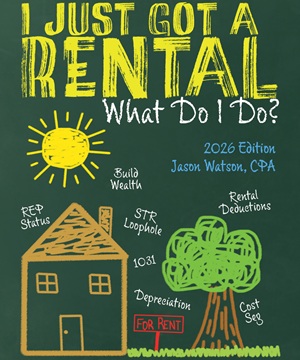 This KB article is an excerpt from our 530+ page book (yeah, thick, there are some picture pages, but no scratch and sniff) which was updated April 5, 2026, and is available in paperback from Amazon, as an eBook for Kindle and as a PDF from ClickBank. We used to publish with iTunes and Nook, but keeping up with two different formats was brutal. You can cruise through these KB articles online, click on the fancy buttons below or visit our webpage which provides more information.
 |  |  |
| $19.95 | $15.95 | $12.95 |

Taxes can be tricky. Chat with a WCG human now and get questions answered.

Everything you need to help you launch your new business entity from business entity selection to multiple-entity business structures.
Designed for rental property owners where WCG CPAs & Advisors supports you as your real estate CPA.
Everything you need from tax return preparation for your small business to your rental to your corporation is here.