
Business Advisory Services
Everything you need to help you launch your new business entity from business entity selection to multiple-entity business structures.


Everything you need to help you launch your new business entity from business entity selection to multiple-entity business structures.

Designed for rental property owners where WCG CPAs & Advisors supports you as your real estate CPA.

Everything you need from tax return preparation for your small business to your rental to your corporation is here.

WCG’s primary objective is to help you to feel comfortable about engaging with us
Table Of Contents
 By Jason Watson, CPA
Posted Sunday, March 22, 2026
Short-term rentals with average guest stays of 7 days or less create an odd technical problem for the 750-hour test because the regulations state they are not considered rental activities. Wait, what? It’s true! But there is an escape hatch at the end. Stay with us for a bit.
Treasury Regulations Section 1.469-1T(e)(3) reads “an activity involving the use of tangible property is not a rental activity for a taxable year if for such taxable year the average period of customer use for such property is seven days or less.”
Sidebar: Don’t confuse tangible property with personal property. Real property is tangible property since you can touch it, paint it, etc. Technically, tangible property has physical substance.
Read those last two sentences again. Are we telling you that a short-term rental with an average guest stay of 7 days or less is not considered a rental activity? Not even a real property trade or business for purposes of the passive activity rules? No, but the regulations are.
Oh, and so are the courts.
In Bailey v. Commissioner, Tax Court Memo. 2001-296, and again in Bailey v. Commissioner, Tax Court Summary Opinion 2011-22, which are different people with different facts but the same problem- the court used a literal interpretation of “the average period of customer use for such property is seven days or less” and stated that the activity was not a rental activity, and therefore the taxpayers could not rely on those hours to establish material participation.
The reasoning in both Tax Court decisions has been criticized because the analysis relied heavily on the formal election under Treasury Regulations Section 1.469-9(g) to group all rental activities into one activity for the primary purpose of demonstrating material participation. However, grouping activities for the 750 hours test does not rely on the formal election to group rental activities. We are getting a bit into the weeds.
The bad news is that courts have sometimes refused to count hours from short-term rentals with average stays of 7 days or less toward the 750-hour requirement. The good news is that these short-term rentals are typically not treated as rental activities and sidestep passive loss limitations. However, if you have a mixed bag of real estate investments, this potentially flawed Tax Court logic could become problematic.
Sidebar: Keep this 7 days or less thing in mind. Also, keep in mind that rental properties are presumed to be passive. The foundation of the short-term rental ‘loophole’ is that the activity is not classified as a rental activity because of the 7 days or less average guest stay. More on that in our short-term rentals section.
If you cannot get enough, here is a contradicting blurb from Chief Counsel Advice 201427016–
whether a taxpayer is a qualifying taxpayer within the meaning of section 469(c)(7)(B) and Treas. Reg. § 1.469-9(b)(6) depends upon the rules for determining a taxpayer’s real property trades or businesses under Treas. Reg. § 1.469-9(d), and is not affected by an election under Treas. Reg. § 1.469-9(g). Instead, the election under Treas. Reg. § 1.469-9(g) is relevant only after the determination of whether the taxpayer is a qualifying taxpayer.
Let’s break this down. IRC Section 469(c)(7)(B) refers to the 750 hours requirement. The Treasury Regulations 1.469-9(g) refer to the formal election to group all your rental activities together as a single activity for material participation testing. The Chief Counsel Advice suggests a different analytical approach than the one used in the Bailey decisions. Nice!
In other words, the IRS clarified their version of chicken and egg sequencing problem. The formal election under Treasury Regulations 1.469-9(g) to group rental activities together is typically considered after qualifying as a real estate professional. If you cannot or choose not to elect your rental properties under the 1.469-9(g) regulations, it should not be used as a wedge to unravel your grouping of all real property trade or businesses for the sake of the 750 hours test.
Tilt!
Could you make a reasonable argument that you are relying on Chief Counsel Advice 201427016? Perhaps, but this area remains unsettled.
How about this angle?
Treasury Regulations Section 1.469-1T(e)(3) merely states that short-term rentals with an average guest stay of 7 days or less are not considered rental activities. Got it. Beat up. Can’t forget. Like ever.
However, IRC Section 469(c)(7)(C) defines a real property trade or business much more broadly to include development, construction, acquisition, operation, management, leasing, and brokerage. Focus on operation and management for a minute.
In other words, an activity can fail the definition of a rental activity and still potentially qualify as a real property trade or business. As such, some practitioners, and WCG CPAs & Advisors tends to agree, argue that time spent operating or managing a short-term rental could still count toward the 750-hour requirement, even though the activity itself is not treated as a rental activity.
Essentially, the accounting industry, courts, and the IRS at times treat real estate professional status as if it applies only to rental real estate, when the statute actually refers more broadly to real property trades or businesses. A hotel is not rental real estate, we can all agree. However, a hotel is certainly a trade or business using real property.
Finding cracks and splitting hairs.
Jason Watson, CPA, is a partner and the CEO of WCG CPAs & Advisors, a boutique yet progressive tax, accounting and rental property consultation and real estate CPA firm with over 90 team members and 7 partners headquartered in Colorado serving real estate investors worldwide.


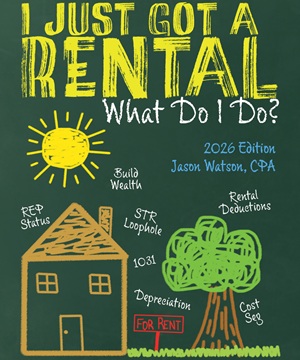 This KB article is an excerpt from our 530+ page book (yeah, thick, there are some picture pages, but no scratch and sniff) which was updated April 5, 2026, and is available in paperback from Amazon, as an eBook for Kindle and as a PDF from ClickBank. We used to publish with iTunes and Nook, but keeping up with two different formats was brutal. You can cruise through these KB articles online, click on the fancy buttons below or visit our webpage which provides more information.
 |
 |
 |
| $32.95 | $21.95 | $18.95 |

Taxes can be tricky. Chat with a WCG human now and get questions answered.

Everything you need to help you launch your new business entity from business entity selection to multiple-entity business structures.
Designed for rental property owners where WCG CPAs & Advisors supports you as your real estate CPA.
Everything you need from tax return preparation for your small business to your rental to your corporation is here.
WCG’s primary objective is to help you to feel comfortable about engaging with us