
Business Advisory Services
Everything you need to help you launch your new business entity from business entity selection to multiple-entity business structures.


Everything you need to help you launch your new business entity from business entity selection to multiple-entity business structures.

Designed for rental property owners where WCG CPAs & Advisors supports you as your real estate CPA.

Everything you need from tax return preparation for your small business to your rental to your corporation is here.

WCG’s primary objective is to help you to feel comfortable about engaging with us
Table Of Contents
 Here is a classic scenario. You close on October 1. You spend the entire month of October painting walls, assembling IKEA furniture until your fingers bleed, and staging the perfect living room. After long debates with your spouse over the rug, you finally list it for rent on November 1.
Can you count the 100 hours you spent sweating in October toward material participation?
The answer: Generally, no.
And the hours arguing over the rug? Still No.
You might hear from your bartender, your brother-in-law, or a highly confident person on the internet that because short-term rentals are technically treated as a trade or business rather than a rental activity, the business magically starts the day you buy the property. They might even use the used copier business analogy we discussed earlier, arguing that the moment you buy the asset, you are in business and the clock starts.
Proceed with extreme caution.
The courts have long held that a business does not begin until it functions as a going concern. For a rental property, that means the asset must be ready and available for customers.
In Richmond Television Corp. v. United States, 345 F.2d 901, the court established what is widely known as the “pre-opening doctrine.” The ruling states:
The court explained that a taxpayer has not “engaged in carrying on any trade or business” within the intent of section 162(a) until such time as the business has begun to function as a going concern and performed those activities for which it was organized.
Courts often describe this as the moment the business becomes a going concern, meaning the activity is capable of serving customers and generating revenue. What does this mean for your timesheet in plain English?
Yes, we feel the “yeah, but” from over here. Give us a minute.
Your participation clock starts when the rental property is placed in service. Period. Full stop.
Do not rely on pre-opening hours to save your tax return or help you hit your minimum hour thresholds. Get the property listed and available for rent as quickly as humanly possible, and then worry about sourcing the perfect throw pillows.
Ok, here is your “yeah, but.”
“Wait a minute,” you might be saying. “Didn’t you just tell me in the STR Acquisition Wrinkle section that I could count my operational setup time because of the ‘anticipation of a trade or business’ rule?”
Yes, we did. And this is where the tax code gets incredibly bifurcated. Confusing. Stupid. Conflicted. D, all the above.
The hard line of the Richmond doctrine (where zero hours count before the property is placed in service) applies flawlessly to traditional long-term rentals. Why? Because traditional rentals are legally classified as “rental activities.” They do not get the benefit of the Treasury Regulations Section 1.469-4 “anticipation” rule because that rule specifically applies to trade or business activities, not rental activities.
Short-term rentals (STRs), however, may be treated as trade or business activities under the passive activity rules. Therefore, they get to use the “anticipation” rule. For an STR, the logic effectively becomes, “Your business hasn’t officially opened under Section 162, but for the sake of tracking your material participation hours, we will let you count the time you spend anticipating the opening.”
But do not let this give you a false sense of security. Remember the Chicken or the Egg problem we discussed earlier.
If you try to use the STR anticipation rule to count your October furniture-assembly hours, you must get that property placed in service and host enough guests by December 31st to prove your average stay is 7 days or less.
If you fail to get guests in Year 1, your property defaults to a traditional rental activity. The moment it defaults to a traditional rental, the “anticipation” loophole slams shut, the Richmond doctrine drops like a hammer, and every single hour you spent working on the property including the rug argument before November 1st gets wiped off your timesheet.
The ultimate takeaway remains the same- whether it is a long-term rental or an STR, racing to get the property placed in service is the only way to bulletproof your tax return.
Sidebar: Scrambling to place a rental property in service with a one-day, bare-bones guest stay feels less like a marketing strategy and more like a hack check a box. To survive scrutiny, you need to show regular and continuous efforts, and not an engineered, form-over-substance game. Ok, a bit dramatic, but see our rental property in service defined section on page 96 anyway.
Jason Watson, CPA, is a partner and the CEO of WCG CPAs & Advisors, a boutique yet progressive tax, accounting and rental property consultation and real estate CPA firm with over 90 team members and 7 partners headquartered in Colorado serving real estate investors worldwide.


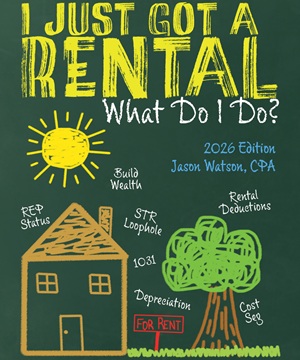 This KB article is an excerpt from our 530+ page book (yeah, thick, there are some picture pages, but no scratch and sniff) which was updated April 5, 2026, and is available in paperback from Amazon, as an eBook for Kindle and as a PDF from ClickBank. We used to publish with iTunes and Nook, but keeping up with two different formats was brutal. You can cruise through these KB articles online, click on the fancy buttons below or visit our webpage which provides more information.
 |
 |
 |
| $32.95 | $21.95 | $18.95 |

Taxes can be tricky. Chat with a WCG human now and get questions answered.

Everything you need to help you launch your new business entity from business entity selection to multiple-entity business structures.
Designed for rental property owners where WCG CPAs & Advisors supports you as your real estate CPA.
Everything you need from tax return preparation for your small business to your rental to your corporation is here.
WCG’s primary objective is to help you to feel comfortable about engaging with us