
Business Advisory Services
Everything you need to help you launch your new business entity from business entity selection to multiple-entity business structures.


Everything you need to help you launch your new business entity from business entity selection to multiple-entity business structures.

Designed for rental property owners where WCG CPAs & Advisors supports you as your real estate CPA.

Everything you need from tax return preparation for your small business to your rental to your corporation is here.

WCG’s primary objective is to help you to feel comfortable about engaging with us
Table Of Contents
 By Jason Watson, CPA
Posted Sunday, August 30, 2026
The good news is you finally get to use those old suspended losses to wipe out income. Flip the coin over, and you might get hit with a 3.8% surtax called NIIT.
Here we go with part 3 of our miniseries on selling your rental property.
If you have been a landlord for a while, you are likely familiar with Form 8582. This is where unallowed passive activity losses go to hibernate. And they usually get fatter each year.
All is not lost, however. The IRS sums this up nicely in Topic No. 425, Passive Activities – Losses and Credits by stating, “Generally, you may fully deduct any previously disallowed passive activity loss in the year you dispose of your entire interest in the activity.” To trigger this release, you must dispose of your entire interest in the property in a fully taxable transaction to an unrelated party. By the way, businesses that you control are related parties. Bummer.
First, the suspended losses become fully deductible and often offset the gain from the sale of the property. Yay! Next, if you have more losses than gain (which happens more than you think), the excess losses spill over and can offset your W-2 wages, business income, or investment income.
Form 8582, which accompanies your individual tax return (Form 1040), tracks unallowed passive activity losses for each activity. If you have three rental properties which have losses, and assuming they are all long-term rentals and you don’t qualify with real estate professional status (REPS), each property would be listed on Form 8582 as a separate activity (ok tax nerds, Yes, taxpayers may elect to group activities under Regulations Section 1.469-4 and the close cousin 1.469-9(g) for REPS).
Sidebar: Passive losses from certain K-1’s are also tracked using Form 8582 so that when you either have passive income or you dispose of the K-1 (redeem, sell, get out of the investment, etc.), these previously unallowed losses are accounted for.
The IRS in their topic above uses the word disallowed. Form 8582 uses the word unallowed. Schedule E Part II uses the word unallowed. These can be viewed as the same, but unallowed is preferred unless you are playing scrabble then disallowed is fair game. According to Cornell Law, “Disallowance means a denial. In the context of taxes, disallowance is a finding by the IRS after an audit that a business or individual taxpayer was not entitled to a deduction or other tax benefit claimed on a tax return.”
We digress. Other tidbits-
Who wants more? Of course you do! If you elected to group multiple rental properties as a single activity under the passive activity rules, selling one property might not release suspended losses. Grouping is commonly done to help satisfy material participation tests, especially when time spent across several properties is combined. However, the IRS then treats the group as one activity, meaning losses are generally released only when you dispose of your entire interest in the grouped activity. In some cases, a material change in facts and circumstances may allow regrouping, but that is not something to rely on casually.
When you sell an investment property, net investment income tax (NIIT) is 3.8% of your property sale gains, and is triggered when your modified adjusted gross income (MAGI) exceeds $200,000 for single filers and $250,000 for married filing jointly. For most people, MAGI for NIIT purposes is the same as adjusted gross income (yes there are exceptions, but roll with this one for now).
An annoying aspect for real estate investors is that the capital gain from the sale itself counts towards your MAGI. Your W-2 might be safe at $150,000 but if you sell a rental for a $300,000 gain, your MAGI is now $450,000. Because NIIT applies to the lesser of your net investment income or the amount your MAGI exceeds the threshold, you would pay the 3.8% tax on $200,000 in this example.
Sidebar: As mentioned in this section, your gains are loosely computed as selling price less purchase price, less improvements, less selling expenses plus depreciation recapture. Your mortgage balance has nothing to do with it; the cash you walk away with could be much lower than your gains based on a bunch of cash-out refinances and whatnot.
Back to NIIT. Once triggered given your MAGI thresholds, the 3.8% is applied to the lesser of the net investment income or the amount of investment income that exceeds the MAGI thresholds. The math can be a bit nutty.
Moving on… as we’ve described in other sections, rental properties are passive activities, and as such the sale of your rental property is considered investment income. It is no different than selling Tesla stock or receiving Disney dividends. The only three ways to avoid NIIT on selling your rental property are… dramatic pause… the only three ways are-
What do these examples have in common? The activity must be treated as an active trade or business rather than passive investment income.
Oh, the fourth way is to not have a gain upon sale. Shoot, and the fifth way is not have triggered net investment income tax MAGI thresholds in the first place. Keep in mind that suspended losses released from Form 8582 reduce your overall income and can help lower the MAGI used in the NIIT calculation.
Here is a summary table for review-
| Rental Type | Material Participation | NIIT |
| Short-term rental, 7 days or fewer | Yes | No |
| Short-term rental, 7 days or fewer | No | Yes |
| Short-term rental, 8 to 30 days, no services | Either way | Yes |
| Rental with significant or extraordinary personal services | Yes | No |
| Rental with significant or extraordinary personal services | No | Yes |
| Long-term rental, no REPS | Either way | Yes (bummer) |
| Any rental with real estate professional status | Yes | No |
The long-term rental row is a huge consideration- even if you materially participate, your gains will be subject to NIIT upon sale. To get out of NIIT you need to materially participate in a short-term rental with an average guest stay of 7 days or fewer, or qualify as a real estate professional as defined by the IRS, or provide significant or extraordinary personal services. Note that all three still require material participation. Just slapping down a time log with 500 hours on your otherwise garden-variety long-term rental will not avoid NIIT applied to your gains upon sale.
About that asterisk. Providing significant or extraordinary personal services removes the activity from rental activity classification under the passive activity rules. It does not make the activity nonpassive. You now have a trade or business, and a trade or business is passive unless you materially participate in it. This is the same two-gate structure we belabored back in our exception (B) discussion, and it is why the table needs both a services row for material participation and one without.
Jason Watson, CPA, is a partner and the CEO of WCG CPAs & Advisors, a boutique yet progressive tax, accounting and rental property consultation and real estate CPA firm with over 90 team members and 7 partners headquartered in Colorado serving real estate investors worldwide.


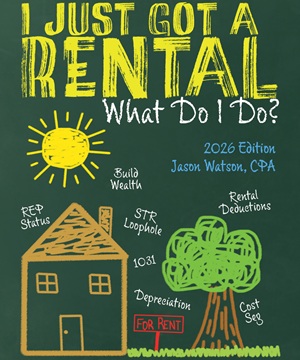 This KB article is an excerpt from our 530+ page book (yeah, thick, there are some picture pages, but no scratch and sniff) which was updated April 5, 2026, and is available in paperback from Amazon, as an eBook for Kindle and as a PDF from ClickBank. We used to publish with iTunes and Nook, but keeping up with two different formats was brutal. You can cruise through these KB articles online, click on the fancy buttons below or visit our webpage which provides more information.
 |
 |
 |
| $32.95 | $21.95 | $18.95 |

Taxes can be tricky. Chat with a WCG human now and get questions answered.

Everything you need to help you launch your new business entity from business entity selection to multiple-entity business structures.
Designed for rental property owners where WCG CPAs & Advisors supports you as your real estate CPA.
Everything you need from tax return preparation for your small business to your rental to your corporation is here.
WCG’s primary objective is to help you to feel comfortable about engaging with us