
Business Advisory Services
Everything you need to help you launch your new business entity from business entity selection to multiple-entity business structures.


Everything you need to help you launch your new business entity from business entity selection to multiple-entity business structures.

Designed for rental property owners where WCG CPAs & Advisors supports you as your real estate CPA.

Everything you need from tax return preparation for your small business to your rental to your corporation is here.

WCG’s primary objective is to help you to feel comfortable about engaging with us
Table Of Contents
 By Jason Watson, CPA
Posted Monday, March 30, 2026
Part 2 of our miniseries moves from the past (Cost Basis) to the present negotiation table. Ok, no one negotiates at a table these days- when’s the last time you met the buyer? We digress…
Purchase price allocation is where you can make some headway on your tax exposure. When you sell a rental property, the contract might state a single sales price of $1,000,000. However, in the eyes of tax code, you are not selling one asset. Generally, you are selling three distinct types of property bundled together. Huh? (yes this is a bit simplified, but stay with us)
We like to think of these as three different “Tax Buckets.” Every dollar of your sales price must be poured into all or most of these buckets, and the tax rates for each vary wildly. Does it sound better if every ounce of your rental keg must be poured into different glasses? The yard. The boot. The proper 8 ounce glam glass.
Your goal as a seller is simple: Fill the cheapest buckets first. Shocker, right?
Let’s talk about each of these in turn. But first, a small word of caution- when we say fill these buckets in order, truly it is still based on fair market value of each bucket. It cannot be arbitrary.
And! We’ll throw a wrench in the order above near the end of this section, but you have to suffer through a few pages first. It’ll be worth it.
When you sell a rental property, intrinsic to the deal is the conveyance of the land and the building. Yes, they are combined usually, but from a tax return perspective, these are different assets.
How does this affect you? You buy a $500,000 rental property which had land at $100,000 or 20% according to the county assessor. When you later sell for $900,000, the land might simply be $180,000 if the 20% ratio hasn’t changed. As such, more of the purchase price is being allocated to an asset that does not have recapture. That alone is not sexy since it is unlikely to help you with the other buckets.
But what if it could? What if land allocation could help?
What if the land increases more than the overall gain in property value? In other words, the market is rewarding geographic location more than the building itself (and the area could be heading towards the preference to buy, scrape and build new).
In many areas such as waterfront properties or trendy urban centers, the value of the dirt appreciates faster than the structure. If you are selling a property in an area where buyers are scraping homes to build new ones, the market is signaling that the value is almost entirely in the land.
Use this to your advantage. How? Consider-
| Original Purchase Price (cost basis) | 500,000 |
| Depreciation Taken | 75,000 |
| Adjusted Cost Basis (a) | 425,000 |
| Sale Price (b) | 675,000 |
| Preliminary Gain (b – a) | 250,000 |
| Depreciation Recapture | 75,000 |
| Remaining Gain to Be Considered (c) | 175,000 |
| Years of Non-Qualified Use | 3 |
| Years of Total Ownership | 12 |
| Percentage (d) | 25% |
| Non-Excludable Gain (c x d) | 43,750 |
| Excluded Gain under IRC Section 121 | 131,250 |
This table shows a reduction in depreciation recapture. How? The value of the property, as a whole, increased from $500,000 to $650,000. However, according to records or documents at the time of sale, the land increased from $100,000 to $300,000. Where did this $100,000 come from? Either the county assessment of the property (preferred) or an original appraisal (let’s assume it is correct or fair for sake of argument).
As such, when applying the purchase price to land first and building second, the amount applied to the building is $50,000 less than the unadjusted cost basis originally allocated to the building. In turn, the amount of depreciation recapture is reduced from $75,000 to $25,000.
Said in another way- by allocating more of the sales price to the land, you effectively convert what would have been 25% tax (recapture) into 20% tax (capital gains). On a million-dollar sale, this 5% spread can be significant.
Real estate scenarios where the land value increases year over year as a ratio to the overall value of the property are very common- as mentioned earlier, take any lakefront property in a nice area and do some historical review of the county assessment including new building permits for scrapes (tear down and rebuild). It will be enlightening.
Finally, this is an often-overlooked tax planning opportunity even among experienced tax practitioners because many real estate sales simply reuse the original depreciation allocation instead of revisiting the assets’ fair market value.
Fill that land bucket!
This is really two buckets in one with the same tax consequence but has a nuanced twist. Let’s break it down. We can all agree that-
Both asset classes are considered IRC Section 1250 property. So, why do you care?
Depreciation on buildings isn’t recaptured at ordinary income rates. Instead, it becomes unrecaptured Section 1250 gain, taxed at a maximum federal rate of 25%.
Land improvements consist of items exposed to the elements which affects the life and functionality of the item. Think about a 15-year-old asphalt driveway. It is full of cracks, faded, and essentially needs to be ripped up and replaced (but let your buyer do that work!). A 15-year-old wooden fence is leaning and splintered. A lot of land improvements physically degrade to a low true economic value.
The building structure, by contrast, is the shell and contains the foundation, framing, steel and masonry. It is maintained, and it holds (or increases due to substitute materials cost) its market value over time.
When you allocate the purchase price, you want your numbers to be defensible in an audit. Arguing that a 15-year-old fence is worth $500 is incredibly easy to defend. Heck, maybe even $0.
Having said that, here is the real reason we push value to the structure versus land improvements, and it has to do with excess depreciation. Shhh, don’t let anyone else know the secret!
While both the structure and the land improvements are IRC Section 1250 property, they are depreciated differently. Therefore, they are recaptured differently when you sell. Huh?
Under IRS Section 1250 rules, any depreciation you take that is in excess of what straight-line depreciation would have been is considered “Additional Depreciation.” Because commercial and residential structures are required by the tax code (with some exceptions like gas stations) to use straight-line depreciation, they avoid this trap. Land improvements, however, often utilize bonus depreciation or Section 179 expensing. This excess amount is taxed at your ordinary income tax rate up to 37%. Yuck!
Who wants some code? IRC Section 1250(b)(1) reads-
(1) In general
The term “additional depreciation” means, in the case of any property, the depreciation adjustments in respect of such property; except that, in the case of property held more than one year, it means such adjustments only to the extent that they exceed the amount of the depreciation adjustments which would have resulted if such adjustments had been determined for each taxable year under the straight line method of adjustment.
And then, IRC Section 1250(a)(1)(A) comes in with this nonsense-
(A) In general
If section 1250 property is disposed of after December 31, 1975, then the applicable percentage of the lower of—
(i) that portion of the additional depreciation (as defined in subsection (b)(1) or (4)) attributable to periods after December 31, 1975, in respect of the property, or
(ii) the excess of the amount realized (in the case of a sale, exchange, or involuntary conversion), or the fair market value of such property (in the case of any other disposition), over the adjusted basis of such property,
shall be treated as gain which is ordinary income. Such gain shall be recognized notwithstanding any other provision of this subtitle.
See those words “ordinary income” at the end there? Did you pick up on the 1975 part?
Therefore, if you took bonus depreciation or Section 179 expensing on a driveway, and you allocate $50,000 of your sales price to that driveway, you will likely pay 37% ordinary income tax on a large chunk of that $50,000 (the amount that was “additional” beyond straight-line).
If you allocate that same $50,000 to the building structure instead (arguing the driveway has rotted in the sun and elements to a nominal value), that gain is safely capped at 25%. Yay!
In other words, by allocating value to the thing that actually holds value (the building structure) and assigning $0 to the things that rot (the land improvements), you successfully shift your sales profit out of the 37% tax bracket and into the 25% tax bracket.
But wait! You need to be reasonable. $0 driveways just don’t make a lot of sense. You cannot arbitrarily assign a value. Rather, it must be a fair market value determination.
Purchase price allocations, or PPAs for short, are manipulated often to improve tax consequences in deals and they can be scrutinized for abuse. As such, being thoughtful and methodical along with a dose of reasonableness can go a long way.
More on PPA and reasonableness as we shift to personal property.
This one requires a fresh cocktail, or something so please take a moment. An IPA for your PPA. Ok, here we go-
Please recall our discussions on IRC Section 1245 and 1250 property. Quickly, Section 1245 is personal property (often identified with a cost segregation study or purchased as furnishings) and Section 1250 property is the remaining building. Why is this important?
Depreciation recapture on the building is capped at a 25% tax rate. If you are in the 37% marginal tax bracket, you enjoy a nice spread. Tax arbitrage.
Section 1245 property does not enjoy this 25% limit. First, bummer. Second, this can be a large surprise. Imagine $50,000 in Section 1245 recapture at a 37% marginal tax rate. This would be an $18,500 tax bill. You generally want to allocate as little of the purchase price as possible to this bucket to avoid being crushed by ordinary income tax rates. Yup, 5th grade math tells you that.
However, not all Section 1245 property is created equal. To legally and reasonably minimize this bucket, you must distinguish between two sub-buckets: We could call them Thing 1 and Thing 2, but we’ll use “loose” assets and “sticky” assets.
These are items not physically attached to the property such as furniture, kitchen appliances, rugs, and window treatments. This issue is most prevalent with short-term or furnished mid-term rentals.
Some of this gets immediately tricky if you are not selling it furnished since now some of your loose assets will stay and some will go like a Clash song.
Regardless, how you originally handled these assets dictates your tax risk today.
If you purchased $40,000 in furnishings and immediately expensed most of it using the de minimis safe harbor provision (items costing $2,500 or less), you are generally in good shape. Because these items were expensed and typically not tracked on your fixed asset schedule, there is no depreciation to recapture when you sell. However, their tax basis is usually zero, so any portion of the sales price allocated to them could technically produce ordinary income. In practice, used furnishings rarely carry much value, so the amounts involved are usually small and often not worth losing sleep over.
Instead, let’s say you did report the $40,000 in furnishings as one big fat asset on a previous tax return (and we see this all the time). You now have a situation where there is a risk of depreciation recapture on the Section 1245 property which, as you know, does not enjoy the Section 1250 limit of 25%.
As the seller, you want this number to be low both from a tax perspective and a practical one since used furniture has little value. As the buyer, however, you want this number to be high so you can reset the life of the asset, and use bonus depreciation or Section 179 expensing as a nice tax deduction. The rub.
Sidebar: A lot of buyers do not want to pay for furnishings outside of closing via a separate bill of sale since it requires additional cash. Padding the overall sales price by $10,000 to account for the furniture only requires $2,000 in additional cash from the buyer (assuming a 20% down payment). This will likely not affect appraisals or loan-to-value calculations, and it is often easier for buyers to swallow, even if it complicates your tax allocation as a seller.
We’ll give you a rule of thumb in a bit. Next, let’s get sticky with it.
These are items typically identified in a cost segregation study such as specialty lighting, dryer hookups, dedicated electrical for appliances, and carpeting, and about a million other little things that are considered personal property.
Unlike a low-mileage couch, buyers do expect these things to be present in the property. They can be demanding that way, right? A house without dryer hookups or lights no longer functions as expected. Therefore, the buyer is assigning some value to them in their purchase offer. You cannot immediately argue that Section 1245 property from a cost seg is worthless, but you can argue the building components are rapidly depreciating (hence the 5- and 7- year asset lives).
So, how do you exit a cost segregation study? In other words, how do you minimize your recapture pain when you deducted that big cost seg depreciation?
If you bought a fancy pants short-term rental property and identified $200,000 of IRC Section 1245 property through an even fancier cost seg study, you likely depreciated that $200,000 rapidly with bonus depreciation or Section 179 expensing (you might have even opted out of 5-year bonus depreciation to spread the benefit while taking all of 7- and 15- year).
Regardless, and assuming 5 years later for the possible bonus opt-out, the IRS default expectation is to recapture that full $200,000 upon sale.
Recapture is calculated based on the fair market value (FMV) of the assets at the time of sale, not their original cost. While the IRS might argue the items are valuable because they make the building function, the counterargument is fair market value all over again. If the specialized wiring or carpeting were severed from the building, their value on the open market would be negligible.
Then again, buyers expect most if not all the IRC Section 1245 property to be present and functioning, so there is value.
The circular reference and eventual conundrum become- how much value?
If your sales contract is silent on allocation, which is common since no one thinks about this stuff until after the fact, here is a table to consider-
| Loose Furnishings | Sticky Cost Seg | |||||
| Year | 5-Year | 7-Year | 5-Year | 7-Year | ||
| 0-2 | 50% | 50% | 70% | 80% | ||
| 3-4 | 30% | 30% | 50% | 60% | ||
| 5-6 | 10% | 20% | 30% | 40% | ||
| 7-9 | 0% | 10% | 10% | 20% | ||
| 10+ | 0% | 0% | 10% | 10% | ||
What are we saying here? If your cost segregation study identified $60,000 in 5-year property, and that property from the service date (not the original date of build) is 5-6 years old, then we would allocate 30% of $60,000 or $18,000 of the purchase price to the 5-year property asset class.
Notice the floors in this approach. Loose furnishings eventually drop to a 0% floor because a 10-year-old mattress or appliance is practically worthless and holds no resale value. “Sticky” cost seg assets, however, hold a 10% floor; even if they are heavily aged, that specialized wiring or plumbing retains an inherent, functional connection to the building itself.
Where did this table come from? We developed it and refined it over time. It is heuristic guidance, not IRS standard. If you want an exact fair market value of your Section 1245 property, cost segregation companies can provide that too. This makes sense when the numbers get big such as large commercial properties with significant Section 1245 property.
When fair market values allow flexibility, sellers typically prefer allocations in this order-
We prefer sticky ahead of loose simply because it is harder to justify a nominal or super low value for the cost segregation-identified Section 1245 property, so filling that last smells better if questioned. Also, you might find that with the right appraisal (i.e., detached third party without a dog in the fight) and a smart tax professional, there might be very little purchase price left to allocate to the Section 1245 bucket.
Recall that blurb before about throwing a wrench into the works? Here it is…
Another argument could be made to allocate to IRC Section 1245 property after land and before building structure and land improvements. Why? If you know the fair market value of the Section 1245 property, then allocate accordingly, leaving the residual gains pushed into the building structure and land improvements which have more favorable depreciation recapture rates.
At the end of it all, however, and we said before, purchase price allocations remain a fair market value analysis first. If at the end of your bucket-filling process you find your sticky cost seg and loose furnishings 1245value to be way too high, then the fair market value on other assets must be too low.
As you sharpen your pencil, keep these basics in mind on PPAs and fair market values, and the reasonableness underscoring it all-
Jason Watson, CPA, is a partner and the CEO of WCG CPAs & Advisors, a boutique yet progressive tax, accounting and rental property consultation and real estate CPA firm with over 90 team members and 7 partners headquartered in Colorado serving real estate investors worldwide.


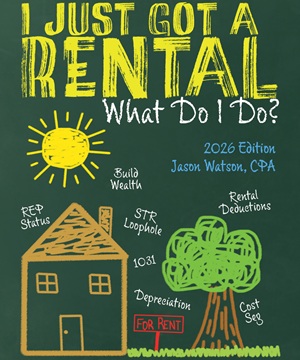 This KB article is an excerpt from our 530+ page book (yeah, thick, there are some picture pages, but no scratch and sniff) which was updated April 5, 2026, and is available in paperback from Amazon, as an eBook for Kindle and as a PDF from ClickBank. We used to publish with iTunes and Nook, but keeping up with two different formats was brutal. You can cruise through these KB articles online, click on the fancy buttons below or visit our webpage which provides more information.
 |
 |
 |
| $32.95 | $21.95 | $18.95 |

Taxes can be tricky. Chat with a WCG human now and get questions answered.

Everything you need to help you launch your new business entity from business entity selection to multiple-entity business structures.
Designed for rental property owners where WCG CPAs & Advisors supports you as your real estate CPA.
Everything you need from tax return preparation for your small business to your rental to your corporation is here.
WCG’s primary objective is to help you to feel comfortable about engaging with us