
Business Advisory Services
Everything you need to help you launch your new business entity from business entity selection to multiple-entity business structures.


Everything you need to help you launch your new business entity from business entity selection to multiple-entity business structures.

Designed for rental property owners where WCG CPAs & Advisors supports you as your real estate CPA.

Everything you need from tax return preparation for your small business to your rental to your corporation is here.

WCG’s primary objective is to help you to feel comfortable about engaging with us
Table Of Contents
 By Jason Watson, CPA
Posted Monday, March 30, 2026
Part 1 of our miniseries first focuses on a cost basis audit, or what we jokingly call a trip down memory lane. Some would say revisionist history, but that seems extreme. We then turn our focus to depreciation recapture and / or Section 179 benefit recapture to warm up the IOU the IRS (and perhaps your state) extended to you over the years, and shockingly they are showing up at closing to call in the chit.
The first thing we recommend when selling any property, especially a rental property which might not enjoy a capital gains exclusion, is a cost basis audit. What do we mean here?
When WCG CPAs & Advisors gleefully accepts a new client, there is some level of trust in the prior tax professional’s work. For example, we obtain a fixed asset listing with associated depreciation schedules, and we see a rental property asset with a $400,000 building unadjusted cost basis and another $100,000 asset allocated to land. Cool.
But!
Were acquisition costs missed such as title fees and travel expenses associated with the purchase? Did the rental property owner install a new deck, but never told anyone? Is this $500,000 ($400,000 + $100,000) correct, or did something break within the gamut of prior year tax returns along the way?
No one cares until it comes time to sell and compute your gain. In other words, if $10,000 was missed on your cost basis, your depreciation might be artificially lowered by a few bucks, but who cares in the interim. However, this $5,000 at your long-term capital gains rate of 23.8% is suddenly more than a few bucks.
Therefore, we encourage a cost basis audit. This is a detailed review of the original purchase price, plus acquisition costs and improvements. This is a forensic review of your original purchase settlement statement and your history of improvements.
What are we looking for? Missed acquisition costs! Many tax preparers simply grab the “Contract Sales Price” from the first page of the closing statement or rely on county records, and move on. They often miss the capitalized costs buried on other pages. Did you pay for title insurance? Transfer taxes? Recording fees? Legal fees? These are all added to your basis.
What about forgotten improvements? Did you install a new deck in 2019? Did you replace the HVAC system in 2020? Real estate investors are notorious for paying cash for improvements or putting them on a personal credit card and forgetting to tell their accountant. If you spent $15,000 on a new roof three years ago but never added it to your depreciation schedule, that money is effectively gone.
There is a catch. You need to be extremely careful not to “double dip” on expenses.
As you might be aware, under the de minimis safe harbor rules, you may have elected to immediately expense items costing $2,500 or less (invoked annually). If you bought a $1,500 water heater in 2021 and deducted it as a repair expense, you received your tax benefit in 2021. You cannot also add that $1,500 to your cost basis now.
Don’t forget about the other safe harbors too such as small taxpayer safe harbor and routine maintenance safe harbor. These safe harbors can allow immediate expensing of items that are otherwise considered improvements, and therefore added to your cost basis.
Some of this is a challenge because you might know what your tax accountant did 7 years ago when you submitted a receipt for that HVAC replacement- then again, if it is not listed as an improvement on your fixed asset listing, at times we must then assume it was expensed.
Expensed or added to cost basis. Pick one. You cannot do both. Sorry, Charlie.
As we defined in our glossary- If you sell or otherwise dispose of depreciated business property including real estate property for a gain (the sale price exceeds the adjusted cost basis), depreciation recapture permits the IRS to take back (i.e., “recapture”) some of the tax benefits you received over the years through depreciation deductions. As such, depreciation might be a little tax bomb or IOU to the IRS.
When you sell, your gain is split into two buckets, and they are taxed differently. Capital gain is the appreciation of the rental property above its original purchase price. Recapture “gain” is the portion of the gain that is attributed to the depreciation you took.
Sidebar: Allowed versus allowable. There is nasty little tidbit in the tax code which states that cost basis must be reduced by depreciation allowed (what you actually took) or allowable (what you should have taken).As such, if you did not deduct depreciation in the past, we need to compute the missing depreciation, expense that with a Form 3115 and IRC Section 481(a) adjustment, and then “sell” the property.
The play on depreciation with assets which don’t normally depreciate, such as real estate, is to take the cash savings from reduced taxes and redeploy them into other investments. This is nearly identical to any pre-tax IRA or 401k contribution. The IRS will be asking for you to pay taxes in the future; until then, you enjoy more spendable cash “on loan” from the IRS.
Please recall our discussions on Section 1245 and 1250 property. Quickly, Section 1245 is personal property and is usually identified with a cost segregation study. Section 1250 property is the remaining building. Why is this important?
Here is where exact terminology matters. True depreciation recapture (such as the gain on Section 1245 personal property) is taxed as ordinary income. However, the standard straight-line depreciation taken on your physical rental building (Section 1250 property) is technically classified by the IRS as Unrecaptured Section 1250 Gain.
Unrecaptured Section 1250 gain is not ordinary income; it is a specific subset of long-term capital gain that is capped at a maximum tax rate of 25%. As such, if your marginal ordinary income tax bracket is 37%, this portion of your gain is protected by that 25% ceiling. This creates a fantastic tax arbitrage: you were able to deduct the depreciation over the years against your 37% ordinary income, but you only must “pay it back” at a maximum rate of 25% when you sell.
This leads us to purchase price allocations between all the various types of property and asset classes.
Jason Watson, CPA, is a partner and the CEO of WCG CPAs & Advisors, a boutique yet progressive tax, accounting and rental property consultation and real estate CPA firm with over 90 team members and 7 partners headquartered in Colorado serving real estate investors worldwide.


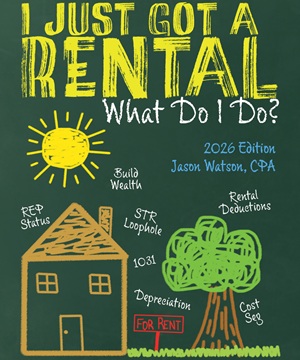 This KB article is an excerpt from our 530+ page book (yeah, thick, there are some picture pages, but no scratch and sniff) which was updated April 5, 2026, and is available in paperback from Amazon, as an eBook for Kindle and as a PDF from ClickBank. We used to publish with iTunes and Nook, but keeping up with two different formats was brutal. You can cruise through these KB articles online, click on the fancy buttons below or visit our webpage which provides more information.
 |
 |
 |
| $32.95 | $21.95 | $18.95 |

Taxes can be tricky. Chat with a WCG human now and get questions answered.

Everything you need to help you launch your new business entity from business entity selection to multiple-entity business structures.
Designed for rental property owners where WCG CPAs & Advisors supports you as your real estate CPA.
Everything you need from tax return preparation for your small business to your rental to your corporation is here.
WCG’s primary objective is to help you to feel comfortable about engaging with us