


Posted Saturday, June 20, 2026
Table Of Contents
Rental Property Bookkeeping
 Rental property bookkeeping has its own set of rules, quirks, and ‘where does this go?’ moments. Whether you are a landlord with a single rental or an investor running a portfolio, the everyday transactions that look simple are often the ones that trip people up:
- A security deposit is not income, until it is.
- A new roof might be a repair or a capital improvement depending on how you scope it.
- Your Airbnb 1099-K or 1099-MISC shows gross revenue while your bank account shows net. Yuck.
Get these wrong and your tax return is forced to react to bad information, which usually means you overpay or invite questions you would rather avoid.
WCG specializes in real estate investors, and rental properties are a business like any other. Tracking revenue matters, sure, but tracking expenses correctly is where the real money hides. We organize rental income, expenses, loans, improvements, and owner activity so your books are genuinely useful, for tax planning, for tax preparation, and for weighing the next acquisition.
- Here is the part most owners underestimate. If the books are not tracking the right things throughout the year, the best tax strategy has nothing to work with. Standard bookkeepers and tax preparers sees a $5,000 invoice and guesses between expense and asset. We build a ledger designed to defend every deduction as the work happens, applying the de minimis, small taxpayer, and routine maintenance safe harbors in real time rather than reacting at year-end.
- Lenders and investors prefer formalized accounting. Lenders, especially unconventional or hard-money lenders, want a story they can feel good about. Proper rental property bookkeeping services helps everyone gain comfort in providing capital for that next purchase or major renovation.
- Not every investor needs the same level of support. A single long-term rental has very different needs than a growing short-term rental or vacation rental portfolio, or a commercial property with multiple tenants. That is why rental property bookkeeping services are offered in three levels.
|
Investor
Foundation Organized, Tax-Ready Records
Starting at
$125/mo
|
Investor
Insight Property-Level Reporting
Starting at
$225/mo
|
Investor
Horizon Portfolio Visibility & Planning
Starting at
$450/mo
|
|
Core Rental Bookkeeping |
|||
| Rental Income & Expense Recording | |||
| Maximizing Bonus, Sec 179 In Real Time | |||
| Short-Term Rental Activity Tracking | Add-On | Add-On | Add-On |
| Hotel or Lodging Tax, TOT | Add-On | Add-On | Add-On |
| Bank & Credit Card Reconciliation | |||
| Financial Statement Preparation | |||
| Tax Ready Rental Records | |||
| Minimum Delivery Cadence | 2x Per Year | 3x Per Year | 6x Per Year |
Number of Rentals |
|||
| Included Number of Rentals or Units | 1 | up to 2 | up to 3 |
| Long-Term Per Unit Add-On | $25/mo | $50/mo | $50/mo |
| Short-Term Per Unit Add-On | $50/mo | $75/mo | $75/mo |
| Duplex, Quads, Commercial, Retail | Scoped | Scoped | Scoped |
Property-Level Visibility |
|||
| Per-Property Profit & Loss | — | ||
| Online Reporting Dashboard [more] | — | ||
| Scheduled Review Conversations | — | ||
Portfolio-Level Visibility |
|||
| Consolidated Portfolio Reporting | — | — | |
| Cash Flow & Financing Support | — | — |

Short-Term Rentals (The ``Mini-Hotel`` Model)
WCG has become a coast-to-coast leader in short-term rental tax strategy, and short-term rental bookkeeping is where defensive accounting earns its keep. While a single vacation rental can sometimes fall into simple annual bookkeeping, most STRs behave like high-volume commercial properties, especially in year one. The startup phase is a whirlwind of furniture, linens, repairs, and platform fees, and if you are not tracking it meticulously you are leaving thousands in tax deductions on the table.
 If you run more than one STR, or you self-manage across Airbnb and VRBO while also juggling a boutique property manager, formalized accounting is non-negotiable. We solve the three biggest headaches for bookkeeping for vacation rentals:
- Gross versus net revenue. Your Airbnb 1099-K shows a gross number while your bank account shows net after fees and commissions. Since the One Big Beautiful Bill Act reset 1099-K reporting thresholds, you may also get a 1099-MISC from a property manager with the same gap between rent received and cash actually touched. We bridge that gap so the IRS never sees a discrepancy.
- Occupancy and lodging tax. If you collect and remit lodging taxes, your books need to be bulletproof. Platforms handle some of this, but it gets messy fast once you mix multiple platforms with your own direct bookings.
- The startup pile. We make sure every piece of furniture and every minor repair is categorized to maximize your Section 179, bonus depreciation, and de minimis safe harbor opportunities.
One vacation rental might be fine on annual compliance bookkeeping. But once you scale to three or more units, or you are using the STR Loophole to offset W-2 income , defensive accounting is not optional. In an audit, the IRS does not just look at your calendar; they look at your ledger to see whether your activity matches your claims. Material participation and time logs need corroboration in your financial data, and that corroboration lives in the books.
Short-Term Rental Software Integrations
You already know your tech stack. What we know is that property management systems, channel managers, and fintech tools all claim to integrate seamlessly with QuickBooks Online. Mostly they do. But “mostly” is where your accountant earns their keep.
 Bnbtally handles channel-specific payout mapping for Airbnb, Vrbo, and Booking.com, parsing the messy line items platforms spit out into clean property-level classes. Hostaway and Guesty offer direct QBO syncs for multi-unit operators. Hospitable’s Mogul plan pushes guest data and owner statements automatically. Topkey auto-tags transactions and catches owner billables at scale. Clearing handles trust accounting and account segregation for multi-property managers.
Every one of those integrations has a failure mode. Phantom income, duplicate entries, misallocated payouts. The tools are good. Blind trust in the tools is where books go sideways.
WCG does not let software and QBO, Xero and REIHub talk directly to each other without oversight. We pull reports, review the data, and make clean adjusting entries rather than assuming the sync got it right.




Improvements Versus Repairs
Splitting expenditures between an immediate expense and a capital improvement is where defensive bookkeeping pays for itself, and the best time to make that call is when the work happens, not the following April. When a $9,000 invoice for “the roof” hits your account in June, we want to discuss it then, while the contractor scope, the invoice detail, and your memory are all fresh. By tax time, that opportunity is often frozen.
The first question is always whether a safe harbor applies:
- De minimis safe harbor allows items under $2,500 per invoice or item to be expensed immediately rather than capitalized. Simple in concept, but timing matters. Items purchased before the property is placed in service cannot use this safe harbor as a current-year operating expense. They get capitalized and then hit with Section 179 or bonus depreciation once the rental opens. Purchase after placement in service and the safe harbor works exactly as intended.
- Safe harbor for small taxpayers applies if your building’s unadjusted basis is $1 million or less and your total annual repairs, maintenance, and improvements stay under $10,000 or 2% of the building’s unadjusted basis, whichever is more restrictive. Meet both tests and all of it can be expensed.
- Routine maintenance safe harbor covers recurring upkeep you reasonably expect to perform more than once every 10 years to keep a building system in normal operating condition. No capitalization required.
 If no safe harbor applies, we move to the Unit of Property analysis. Under IRS regulations we do not just look at “the house.” Rather, we look at all nine building systems: the structure itself plus plumbing, electrical, HVAC, elevators, escalators, fire protection, gas distribution, and security. Analyzing each system separately is where the expertise lives. A major expense can often be classified as a repair when it affects only a minor portion of a single system, which means an immediate deduction instead of one buried in a 27.5-year depreciation schedule.
From there we apply the BRA test, betterment, restoration, or adaptation, to each Unit of Property. If the expenditure clears any of those three standards it is a capital improvement and must be capitalized. If it does not, it is a repair and immediately deductible.
A standard bookkeeper sees a $5,000 invoice and guesses between expense and asset. That is a coin flip you cannot afford. We apply these standards as the work happens, building a ledger designed to defend every deduction. That is the difference between a preparer who reacts at year end and a strategist who builds a bulletproof ledger from the start.
Tax Planning Runs on Accurate Rental Data
Rental profits are a good problem, but they are still a tax problem. Once a rental property starts producing positive income, the question changes from “Did I make money?” to “What can we still do before year-end?” To make matters worse, you might have positive cash flow but a tax loss, and this needs to be planned for.
 That planning starts with clean books. We need to know whether the profit is real, whether repairs have been properly separated from improvements, and whether upcoming expenses should be paid before year-end or pushed into the next tax year.
Good rental bookkeeping also helps us spot capital spending before it becomes a March surprise. Some costs are deductible repairs. Others are improvements that must be capitalized and depreciated. Certain assets may qualify for bonus depreciation or Section 179, but the answer depends on what was purchased, when it was placed in service, how the rental is used (STR versus LTR) and / or whether the rental activity has enough taxable income to absorb the tax deduction.
That is where rental property bookkeeping becomes tax planning which leads to tax strategy. If we can see rental profit in October or November, we can talk about accelerating repairs, maintenance, equipment and appliance purchases, and review safe harbor elections, estimated taxes and cash flow while there is still time to act. If we identify it in March, we are mostly just reporting history.
Clean books do not magically eliminate tax. They give us the information to manage it.



Classed Transactions
When you own multiple properties, transactions are classed or tracked inside your accounting platform so each activity reports separately while living in one data file. Whether you use QuickBooks Online, Xero, or REIHub, we make sure each property shows in its own column for clean revenue and expense analysis.
 Common expenses shared across properties like an umbrella insurance policy or a maintenance employee’s wages get allocated to each property. That allocation can be based on revenue, where more revenue means more risk and more maintenance, or on a straight percentage, where three rentals split an umbrella policy one-third each. These situations call for a conversation to discuss the methodology.



Which Accounting Platform Is Right For You?
We exclusively support three cloud-based platforms for rental property bookkeeping: QuickBooks Online, Xero and REI Hub. All three give you real-time access from any device, but the right choice depends on your portfolio, reporting needs and tax complexity.
- REI Hub is purpose-built for rental property owners and handles per-property tracking natively. It is often the cleaner, simpler option for landlords with smaller long-term rental portfolios who want organized Schedule E reporting without a full-blown accounting system.
- Xero is a strong middle ground. It provides formalized accounting at a fraction of the QuickBooks cost, especially when you need Classes or tracking categories to separate properties into distinct reporting buckets. For investors with multiple properties, Xero often delivers the bookkeeping muscle without forcing you into a top-tier QuickBooks subscription just to open up property-level reporting.
- QuickBooks Online is the workhorse when the tax and reporting structure gets more complex. It is usually the better fit for partnership tax returns, multiple stakeholders, full financial statements, outside basis tracking and capital accounts that need to be airtight.
The platform matters, but cadence matters too. Most landlords with one to five long-term rentals can usually stay tax-ready with semi-annual bookkeeping, assuming the activity is straightforward.
 Once you reach six or more rentals, bookkeeping becomes less forgiving. More properties means more transactions, more repairs, more bank activity and more chances for tax decisions to get buried. At that point, we generally recommend periodic bookkeeping during the year rather than twice a year, or worse, waiting until tax season. For larger portfolios, especially those north of twenty rentals, bi-monthly bookkeeping often makes more sense simply because the volume and decision-making require it.
The goal is not to build fancy books for the sake of fancy books. The goal is to catch the decisions that matter while there is still time to do something about them.
We are platform-agnostic. Our job is to match the tool and cadence to your rental portfolio, not default to the most expensive option because it is the most familiar. And one note on data custody: we hold the pen, but you own the books. Your financial data is yours, and you have full access to it at any time. If you ever leave, you leave with your data.
Data Analysis
 Reach Reporting integrates seamlessly with QuickBooks Online and Xero to provide real-time financial reporting and tools for financial performance data in a secure and easy way. With the built-in dashboards and report builder, WCG CPAs & Advisors connects your financial data to create powerful dashboards and enhanced visuals. Backed by their SOC 2 Type I and Type II certifications, the Reach Reporting app only retrieves data from the online platform and never modifies or replaces any information stored there.
Reach Reporting makes reporting, forecasting and budgeting easy with powerful dashboards and enhanced visuals. You, the business owner, will gain valuable insights into your business trajectory with their 3-Way Forecasting feature. By connecting your profit & loss, balance sheet, and cash flow statement, we create a comprehensive view of your financials with automated cash flow forecasting.

I Just Got A Rental, What Do I Do?
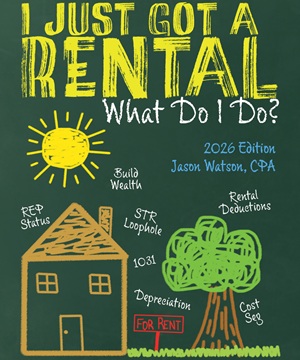 I just got a rental, what do I do? Purchasing a rental property is certainly challenging, but operating one to build wealth and find tax efficiency is equally challenging. This is our second book. Our first book, Taxpayer’s Comprehensive Guide to LLCs and S Corps, was first published in 2014 and was well-received by small business owners and tax professionals, so we thought a book on rental properties and real estate investments would be equally helpful. So, here we are with our second iteration, or the 2026 edition. We update it frequently throughout the year (last update was April 5, 2026).
Our rental property book starts with entity structures and moves into asset management such as acquisition, cost segregation, rental safe harbors, repairs versus improvements, accelerated depreciation, partial asset disposition, and 1031 like-kind exchange. From there we discuss various rental considerations like passive activity losses, short-term rental loophole, real estate professional status, and material participation including what time counts, and what time doesn’t count.
Finally, the good stuff! Rental property tax deductions such as travel, meals, automobiles, interest tracing, home office and common expenses. Fun!
It is available in paperback for $32.95 from Amazon and as an eBook for Kindle for 21.95. Our book is also available for purchase as a PDF from ClickBank for $18.95.

































Table Of Contents

Tax Planning Season
Tax planning season is here! Let's schedule a time to review tax reduction strategies and generate a mock tax return.

Bookkeeping Services
Tired of maintaining your own books? Seems like a chore to offload?