Business Advisory Services
Everything you need to help you launch your new business entity from business entity selection to multiple-entity business structures.

Hey - Our site just had a makeover and we are sorting through the hiccups!

Everything you need to help you launch your new business entity from business entity selection to multiple-entity business structures.


Designed for rental property owners where WCG CPAs & Advisors supports you as your real estate CPA.

Everything you need from tax return preparation for your small business to your rental to your corporation is here.

Posted Friday, August 1, 2025
Table Of Contents

And… our Tax Patrol platforms including Investor Tax Patrol such as-
include periodic scheduled quick chats, or what we call a PQC or just a Quick Chat. What the heck is a PQC?
All WCG CPAs & Advisors platforms include access to our tax professionals for quick, ad-hoc questions throughout the year. We call these Periodic Scheduled Quick Chats.
What is considered a quick chat?
A quick chat is a scheduled, 20-minute phone or video meeting designed to cover common questions with straightforward answers. Think of it as a “sanity check” or a “fact-finding” mission.
When are they available?
Quick Chats are available May through November. (Why? Because from December to April, we are in the trenches preparing your tax returns!)
How many do I get?
Here are some examples of a periodic scheduled quick chat-

Real Estate & RentalsThe big list of questions above are common, everyday, pedestrian, garden-variety type of questions that we can answer from the beach or ski lift. While you might be surprised, WCG CPAs & Advisors doesn’t know everything. We know! Crazy talk, right?
The Internal Revenue Code has over 4 million words. King James Bible? 783,137 words. War and Peace, English translation? 587,000 words. California Revenue and Taxation Code (the RTC)? No one knows, but estimates are about 900,000.
Oh, and let’s not forget that we have 40 other states to worry about plus all the silly little city tax codes.
So, while we are pretty smart and we are pretty good at quick research, we also cannot know everything. Some narrow band of tax code is going to escape us every time. We have a client who was a fire fighter in California. He retired during this small window of time where his pension income was not taxable by California. A few years earlier, taxable. A few years later, taxable. His union published a lovely cheat sheet for their members to understand this little nuance plus some others. Of course, he graciously gave it to us and said, “I don’t expect you to know this off the top of your head, so here ya go.”
What does all this mean? We are continuously balancing professional development (things we ought to know and would like to know to help our clients) and nuanced things like fire fighter pensions in California.
Therefore, at times, we must charge a fee for research to answer your questions. In other words, if your question requires us to open a tax law book (figuratively), crunch numbers or call a state agency, that is a tax advisory engagement, not a quick chat.
When do we go from periodic scheduled quick chats (PQCs) to tax advisory? It is tricky and it mostly hinged on “making a decision” with the advice we provide. Here are some examples-
| PQCs (information) | Tax Advisory (strategy) |
| I did a cost seg which came in at $120,000 of eligible property for bonus depreciation. I plan to deduct it all. | Should I use 100% bonus depreciation on all asset classes, or only use one or two of the classes available (5- 7- and 15-year)? |
| I purchased a heavy truck for $90,000. I plan to deduct the max. | Should I purchase a heavy truck this year or next? Should I do the max depreciation, or plan it out? |
| I max’d out my Roth 401k. | Should I max out my Roth 401k or pre-tax 401k, assuming a 22% marginal tax rate in retirement and a 8% rate of return? |
| I received $30,000 in capital gains this year from selling stock. | Should I realize more gains this year or defer to next year to optimize my AGI and avoid triggering NIIT or AMT? |
| I sold the rental on Elm Street for $450,000. | I have the option to do an installment sale on the Elm Street rental over 5 years. Should I take it? (follow-up from WCG- Did you risk adjust the purchase price?) |
There are 6,772 other examples that we came up but don’t want to bore you. Where do we go from here? Easy! Your job is to extract the most out of your WCG CPAs & Advisors tax planners. Our job is to have the awkward scope conversation.
Email is a wonderful tool for sending data, memorializing decisions, and asking simple "Yes/No" questions. It is also a terrible tool for explaining complex tax strategy. To ensure we remain efficient (and sane), we operate under two primary communication rules:
To produce high-quality work, our tax team needs uninterrupted focus. As such, we generally process email on Mondays and Thursdays. Why? It allows us to be heads-down in your data on Tuesdays, Wednesdays and Friday (during tax season) without distraction.
Need us sooner? Call us! We are not allergic to the phone. If it is urgent, a 5-minute phone call beats a 3-day email wait every time.
If your email requires more than 5–10 minutes to write a response, we will not reply via email. Instead, we will call you or send a calendar link to discuss. Why? The PB&J Concept!
Everyone loves a Peanut Butter & Jelly sandwich. But trying to explain how to make one via email takes 45 minutes. Seriously! Consider all the options. Crunchy or smooth? Strawberry or Grape? Diagonal cut or straight? Toasted? Pros and cons of each. Proofreading.
We could trade 15 emails debating jelly, or we could have a 12-minute conversation via Teams or phone call, build the perfect sammy, come away more fulfilled, and move on with our lives.
We know conversations can be forgotten within minutes for the busy person. As such, after every meeting, we send a recap email to memorialize the discussion. While no one likes to read anyway, this recap email also gets captured by our workflow software allowing all other team members to view the recap as necessary.
Our email response is limited to short 5-10 minute responses. Otherwise we schedule a meeting to discuss. We understand that this communication style might not work for everyone.
Note: We always make exceptions for our deployed military clients (or those trapped on a secure no-comms base), expats in weird time zones, or those with accessibility needs.
So many things appear to be tax-related, but they are actually investment-related. While we appreciate the trust you place in us, not all things with a dollar sign are handled by your tax professional.
We operate under a "Stay in Our Lane" philosophy. Even though we have CFPs and former financial advisors on our team, when we are wearing our CPA hats, we must defer to those who provide financial planning and retirement advice on a daily basis.
Here are a few common examples of how to distinguish between a tax question and a financial advisor question:
FA: "Yes/No based on your cash flow and retirement goals."
Average CPA: "If you do, you will defer $x,xxx in taxes."
Good CPA (Us): "Be mindful of all your investment cash being illiquid or trapped in a qualified retirement account. There are other ways to build wealth which might have some tax efficiency as well such as real estate, structured equipment leases, working interest in oil and gas wells, among other things."
FA: "Here is my advice based on your long-term betting regarding future tax rates vs. current rates."
Average CPA: We can model the immediate tax impact, but the decision is a retirement and investment strategy.
Good CPA (Us): "It depends on your age (how close you are to those 'not working years') and your projected retirement income. Keep in mind the Rule of 72—your investment will generally double every 9 years. If you are 40, you might have 3 doublings before you need the money. Please coordinate with your financial advisor, but know that we have strong feelings towards Roth contributions here]."
FA: "You should convert $50k this year to hit your accumulation goals."
Average CPA: "If you convert $50k, you will stay in the 24% bracket. If you convert $75k, about $25k will be in the 32% bracket."
Good CPA (Us): "Let's pair that conversion with a cost segregation study on your short-term rental to offset the tax hit."
FA: "Let's discuss the market allocation and growth strategy since these items need to be adjusted for your risk profile."
CPA: "We can calculate the Required Minimum Distributions (RMDs) and the tax bite, but not the growth strategy."
Your job is to ask us anything. Our job is to either answer it or say, "We are unable to help, but we know who can." We are not punting- plenty of that to go around these days as you can imagine. We are staying in our lane in a legal and suitability sense, and kindly deferring to others who are more capable.
Also! Keep in mind that we are happy to interface directly with your financial advisor- this cuts through all the shuttle diplomacy nonsense and inherent miscommunication.
If you need more than a PQC… if you need a quickie Tax Advisory session, you can schedule a 40-minute consultation for $250 with one of our Partners. This is a nice way to ask some advisory-esque questions that perhaps don’t require the depth and complication of Planning Project.

Click the button below to schedule an amazing 40-minute paid consultation with a WCG CPAs & Advisors Partner.
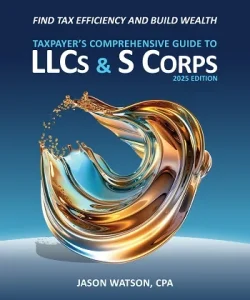
WCG CPAs & Advisors and Jason Watson, CPA, have released the 2025 Edition of Taxpayer’s Comprehensive Guide to LLCs and S Corps. Over 400 pages of pure pleasure! This edition has updated 2025 data such as IRA and 401k limits including Social Security wage limits, but it also has a bunch of new information spread out various chapters such as customized multi-entity structures, expanded reasonable shareholder salary sections, more tax reduction mechanics among various little tidbits gleaned from hundreds of small business consultations. Riveting!
It is available in paperback for $49.95 from Amazon and as an eBook for Kindle for $39.95. Our book is also available for purchase as a PDF from ClickBank for $29.95. Why do we all love 95 cents? We all know that 39.95 is really 40 bucks. At least we are not like gas stations… $39.949. Silly! Yet we digress. Apple iBook, Barnes and Noble Nook, among others are not utilized since their format is challenging to make mini updates here and there.
How can I avoid self-employment taxes? This simple question was the inspiration for creating an article describing the benefits of an S Corporation. That original article, which was about four pages long, quickly became a series of Knowledge Base articles on the WCG website. The articles touched on basic topics such as how to elect S Corp status, shareholder payroll, reasonable salary determination and liability protection. Those broad topics demanded much more information, both horizontally by spanning into more related issues, and vertically by digging deeper into the granular yet riveting levels of the tax code. Beyond general S Corp benefits, our book will show you-
This book is written with the general taxpayer in mind. Too many resources simply regurgitate complex tax code without explanation. While in some cases tax code and court opinions are duplicated verbatim because of precision of the words, this book strives to explain many technical concepts in layperson terms with some added humor and opinions. We believe you will find this book educational as well as amusing.
Each week we receive several phone calls and emails from small business owners and other CPAs across the country who have read our Taxpayer’s Comprehensive Guide to LLCs and S Corps and praised the wealth of information. Regardless of your current situation, whether you are considering starting your own business or entertaining a contracting gig, or you are an experienced business owner, the contents of this book are for you.
While this book’s origins were based on reducing self-employment taxes through an S Corporation election, it has dramatically expanded to sound business advice from entity structures to operational considerations to business tax deductions and retirement planning.
Enjoy! And please send us all comments, hang-ups and static. This book is as much yours as it is ours, except the tiny royalty part- that’s ours. Stop by and we’ll buy you a beer with the pennies.
While we have you, please check out our rental property book aimed at real estate investors, I Just Got A Rental, What Do I Do?
If you buy our 430-page book and think that we didn’t help you understand small business tax law or the benefits of S corporations, let us know. We never want you to feel like you wasted your money. If you are ready to add some insightful reading into your day, click on one of the preferred formats. Amazon is processed by Amazon, and the PDF is safely processed by ClickBank who will email you the PDF as an attachment.
![]() | ![]() | ![]() |
| $49.95 | $39.95 | $29.95 |
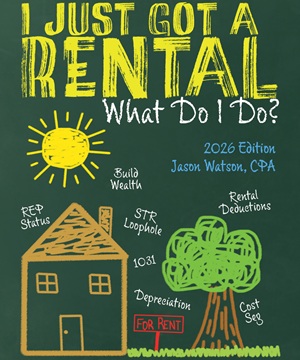
I just got a rental, what do I do? Purchasing a rental property is certainly challenging, but operating one to build wealth and find tax efficiency is equally challenging. This is our second book. Our first book, Taxpayer’s Comprehensive Guide to LLCs and S Corps, was first published in 2014 and was well-received by small business owners and tax professionals, so we thought a book on rental properties and real estate investments would be equally helpful. So, here we are with our second iteration, or the 2025 edition. We update it frequently throughout the year (last update was October 6, 2025).
Our rental property book starts with entity structures and moves into asset management such as acquisition, cost segregation, rental safe harbors, repairs versus improvements, accelerated depreciation, partial asset disposition, and 1031 like-kind exchange. From there we discuss various rental considerations like passive activity losses, short-term rental loophole, real estate professional status, and material participation including what time counts, and what time doesn’t count.
Finally, the good stuff! Rental property tax deductions such as travel, meals, automobiles, interest tracing, home office and common expenses. Fun!
It is available in paperback for $19.95 from Amazon and as an eBook for Kindle for 15.95. Our book is also available for purchase as a PDF from ClickBank for $12.95.
WCG has a team of real estate CPAs ready to assist you with your rental property and real estate investments. Very few tax professionals and CPA firms specialize in real estate to provide you solid consultation, tax planning including tax reduction strategies, and tax return preparation. We are experts in-
This book is written with the general rental property in mind. Too many resources tell you the general rule but don’t bother to back it up with Internal Revenue Code, Treasury Regulations and Tax Court cases. Our book lays it all out, explains the madness, adds some humor and various conundrums. Example? Water heaters and hot tubs- crazy stuff to consider.
Enjoy! And please send us all comments, hang-ups and static. This book is as much yours as it is ours, except the tiny royalty part- that’s ours. Stop by and we’ll buy you a beer with the pennies.
If you buy our 480-page book and think that we didn’t help you understand rental property tax laws, let us know. We never want you to feel like you wasted your money. If you are ready to add some insightful reading into your day, click on one of the preferred formats. Amazon is processed by Amazon, and the PDF is safely processed by ClickBank who will email you the PDF as an attachment.
![]() | ![]() | ![]() |
| $19.95 | $15.95 | $12.95 |
So many things appear to be tax return related or even business advisory related, but they are outside of our purview. While we appreciate the trust that you have in us, not all things with a dollar sign are handled by your tax professional or business consultant. Several examples come from 401k and investment planning such as-
Your job is to ask us anything, and our job is to say “we are unable to help but we know who can.” While we have two CFPs and former financial advisors on our team, we must stay in our lane and defer to those who provide financial planning and retirement advice on a daily basis.
A Quick Chat is a 20-minute scheduled phone or video call designed to answer straightforward tax questions. Think of it as a “sanity check” or a way to get clarity on rules—not for long-term strategy or complex modeling.
They are included in your subscription. WCG’s Business Advisory and Tax Patrol platforms include these chats as part of your annual fee (think of them like the oil changes included with your car purchase).
Business Advisory and Tax Patrol clients receive three (3) Quick Chats per year. Tax-Only engagements include one (1) Quick Chat annually.
Quick Chats are available from May through November. This ensures we are available to you when planning decisions can still affect the current year. (Note: From December to April, our team is heads-down in tax returns, so Quick Chats are paused).
Entity setup basics, S Corp rules, payroll mechanics, tax deductions, compliance deadlines, and general “does this even work?” questions fit perfectly.
Questions that require research (“What is the city tax code in Topeka?”), calculations (“How much will I save if…?”), or subjective recommendations (“Should I sell my rental?”) move into paid Tax Advisory territory.
Absolutely. Common rental property and real estate questions—like LLC structure, Short-Term Rental (STR) rules, or cost segregation basics—are fair game.
If the conversation drifts into complex tax planning, your tax professional will pause and say, “This sounds like a bigger conversation.” We can then schedule a paid Tax Advisory session (40 minutes to start usually) to give that topic the time and modeling it deserves.
Email is great for logistics but terrible for nuance (see our “PB&J Theory”). Anything requiring depth is handled by phone or video to avoid miscommunication, “reply-all” nightmares, and wasted time.
If your question requires a decision, a calculation, or a deep dive, you can schedule a dedicated 40-minute Tax Advisory Session. Business Advisory clients have two of these included; others such as Tax Patrol and Investor Tax Patrol including Tax Only Engagements (TOEs) can add them à la carte.
Table Of Contents

Tax planning season is here! Let's schedule a time to review tax reduction strategies and generate a mock tax return.

Tired of maintaining your own books? Seems like a chore to offload?
Did you want to chat about this? Do you have questions about WCG’s tax planning service levels including tax strategy?
The tax advisors, business consultants and rental property experts at WCG CPAs & Advisors are not salespeople; we are not putting lipstick on a pig expecting you to love it. Our job remains being professionally detached, giving you information and letting you decide within our ethical guidelines and your risk profiles.
We see far too many crazy schemes and half-baked ideas from attorneys and wealth managers. In some cases, they are good ideas. In most cases, all the entities, layering and mixed ownership is only the illusion of precision. As Chris Rock says, just because you can drive your car with your feet doesn’t make it a good idea. In other words, let’s not automatically convert “you can” into “you must.”
Let’s chat so you can be smart about it.
We typically schedule a 20-minute complimentary quick chat with one of our Partners or our amazing Senior Tax Professionals to determine if we are a good fit for each other, and how an engagement with our team looks. Tax returns only? Business advisory? Tax strategy and planning? Rental property support?

Everything you need to help you launch your new business entity from business entity selection to multiple-entity business structures.

Designed for rental property owners where WCG CPAs & Advisors supports you as your real estate CPA.

Everything you need from tax return preparation for your small business to your rental to your corporation is here.