
Business Advisory Services
Everything you need to help you launch your new business entity from business entity selection to multiple-entity business structures.


Everything you need to help you launch your new business entity from business entity selection to multiple-entity business structures.

Designed for rental property owners where WCG CPAs & Advisors supports you as your real estate CPA.

Everything you need from tax return preparation for your small business to your rental to your corporation is here.
Table Of Contents
 By Jason Watson, CPA
Posted Sunday, March 22, 2026
Let’s try to clear up some confusion on hours. There are two sets of hours. There are the hours that make up the 750 hours test to be called a real estate professional. We’ll call those REPS hours.
The other set of hours is material participation hours. We’ll call those MP hours.
Think of REPS hours as determining whether you qualify as a real estate professional at all, while material participation determines whether losses from a specific rental activity are treated as non-passive.
Cool, so, what hours count?
You may count hours from all of your real property trades or businesses toward the 750-hour test. Please do not confuse this with the formal election to treat all your rental properties as a single activity to satisfy one of the seven material participation tests. These groupings are very much different.
For the 750-hour test, there is no formal, irrevocable election required to “group” your time. The tax code effectively treats these hours as a giant bucket. As long as the work is performed in a qualifying real property trade or business and you materially participate in that activity, the hours count toward the 750-hour threshold.
You could have multiple sources of qualified material participation hours from time spent on your rental properties directly, to time spent as a real estate broker, to time spent as a home remodeler. Specifically, you spend 98 hours on your sole rental property, 120 hours as a real estate broker, and you also spend 550 hours remodeling homes. This is a total of 768 hours. No special election is required to count those hours together. With reference to our recently stated basics, you are now over the first of three hurdles to leverage the real estate professional status.
But wait! What about time spent on your short-term rental? We’ll get to that in a bit, and the answer isn’t one you are going to like.
If you make the formal election under Treasury Regulation Section 1.469-9(g) to treat all your rental real estate interests as a single activity, that helps material participation (which we talk about later). However, it is not required to use this grouping election for your 750 hours as we alluded to above.
Spouses cannot combine hours to satisfy the 750-hour test. Both spouses may qualify, but if things are tight, it is ideal to pick one person to focus their time on achieving the necessary amount of time.
You do not have to be a licensed real estate agent or broker to be considered participating in a brokerage trade or business. However, mortgage brokerage activities are generally not considered a real property trade or business for purposes of IRC Section 469(c)(7). Chief Counsel Advice 201504010 states-
Webster’s Dictionary defines “real estate” as “property consisting of buildings and land; the business of selling land and buildings,” and defines “brokerage” as “the business of a broker” or the “broker’s fee or commission.”1 Webster’s defines a “broker” as “a person who helps other people… to buy and sell property.”2 Accordingly, the common and ordinary construction of “real property brokerage” for purposes of § 469(c)(7)(C) involves bringing together buyers and sellers of real property. This definition of “real property brokerage” does not include the brokerage of financial instruments.
Therefore the “financing” of real property such as by bringing together lenders and borrowers is not a real property brokerage trade or business within the meaning of §469(c)(7)(C).
Webster? Really?!
Since obtaining a real estate license is generally straightforward with relatively low barriers to entry, WCG CPAs & Advisors recommends being licensed for two reasons. It buttresses your overall 750 hours argument, and you might have access to additional resources to help you with real estate investment (and you might save a few bucks on commissions too).
Sidebar: 750 hours is not an easy target to hit for the casual real estate investor. It is basically 2 solid days a week, every week. Being a licensed agent provided more opportunities to safely and legally build REPS hours.
Interestingly, in Agarwal v. Commissioner, Tax Court Summary 2009-29, the IRS attempted to argue that an agent was not a licensed “broker” and thus could not be involved in a brokerage trade. Come on, IRS?! The Tax Court also relied on the Webster definition of the term “brokerage” and found in favor of the real estate agent.
Let’s review IRC Section 469(c)(7) again since it’s been a few pages and likely a cocktail ago-
For purposes of this paragraph, the term “real property trade or business” means any real property development, redevelopment, construction, reconstruction, acquisition, conversion, rental, operation, management, leasing, or brokerage trade or business.
Here is an interesting and perhaps quirky development for the next cocktail: Hours spent as an employee do not count toward your REPS threshold unless the employee is a 5% or greater owner in the entity conducting the real property trade or business, per IRC Section 469(c)(7)(D)(ii) and Treasury Regulations Section 1.469-9(c)(5). For example, if you are a receptionist for a real estate developer and own no equity in the company, those hours generally cannot be used toward the 750-hour requirement.
In Calvanico v. Commissioner, Tax Court Summary Opinion 2015-64, and Pungot v. Commissioner, Tax Court Memo 2000-60, the taxpayers were denied real estate professional status because they did not own the required 5% of their respective employers, and consequently, the hours spent in their real property trades or businesses did not count toward material participation.
Sidebar: Specifically, in Calvanico, the court held that a real estate appraiser who worked for a public accounting firm was in a real property trade or business. However, the accountants and support staff were not considered working in real estate.
The Calvanico Tax Court case has some mini lessons:
Who wants some gray water? Better than brown water, right? Yeah, we had to go there.
Can you avoid the employee limitation by forming your own S corporation and consulting for a real estate firm instead of working as an employee? Theoretically, Yes. Theory and reality rarely occupy the same space, but let’s give it a whirl.
In this arrangement, you aren’t an employee of the real estate firm; you are an independent contractor providing management services. Since you own 100% of your S Corp, every hour spent on that real estate trade or business drops right into your 750-hour REPS bucket. Cautious Yay.
For this structure to hold water, the relationship must be a true B2B (business-to-business) engagement. Your S Corp should have a formal service contract, invoice the real estate firm for services, and ideally, provide similar services to other clients to demonstrate true independence. The last one is tough since many consultants have singular clients.
The IRS hates form over substance. Like a lot. If you were a W-2 big shot on Friday and became a 1099 consultant on Monday (doing the exact same job, at the same desk, with the same laptop) the IRS will likely reclassify you as an employee. If they successfully argue that your S Corp is merely a disguised employment shell or a tax vehicle, those consulting hours are likely disqualified for REPS because you don’t own 5% of the entity actually conducting the business (your supposed client).
Moreover, there is a possible counterargument to the S corporation consulting strategy. Even if the contractor relationship itself is respected, the IRS could argue that you aren’t actually in a real property trade or business, but rather a professional services trade or business that just happens to have a real estate client.
For example, accounting consulting, marketing consulting, or HR consulting for a real estate firm might be viewed as professional services rather than participation in the real property trade or business itself.
On the other hand, consulting that directly involves property management, development oversight, leasing strategy, construction management, or brokerage activity is much easier to connect to the statutory definition. As always, the closer the work is to the actual operation or management of real property, the stronger the argument that the hours qualify.
If you choose this path, you must be prepared to prove that your S Corp is a distinct, independent enterprise with its own profit motive and operational autonomy, and genuine contractor relationship.
Jason Watson, CPA, is a partner and the CEO of WCG CPAs & Advisors, a boutique yet progressive tax, accounting and rental property consultation firm with over 90 team members headquartered in Colorado serving real estate investors worldwide.


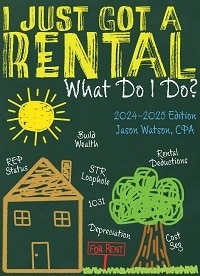 This KB article is an excerpt from our 480+ page book (some picture pages, but no scratch and sniff) which was updated October 6, 2025, and is available in paperback from Amazon, as an eBook for Kindle and as a PDF from ClickBank. We used to publish with iTunes and Nook, but keeping up with two different formats was brutal. You can cruise through these KB articles online, click on the fancy buttons below or visit our webpage which provides more information.
 |  |  |
| $19.95 | $15.95 | $12.95 |

Taxes can be tricky. Chat with a WCG human now and get questions answered.

Everything you need to help you launch your new business entity from business entity selection to multiple-entity business structures.
Designed for rental property owners where WCG CPAs & Advisors supports you as your real estate CPA.
Everything you need from tax return preparation for your small business to your rental to your corporation is here.