


Posted Sunday, June 21, 2026
Table Of Contents
Property Management Bookkeeping Services
 You run a property management company. You already have software that collects rent, tracks work orders, and spits out owner statements. What you may not have is a real estate CPA firm that understands the difference between the books for your management company and the trust money flowing through it on behalf of your owners and tenants. That distinction is the whole job, and it is where most generic bookkeepers get lost and you get in trouble.
We do property management bookkeeping the way it should be done: your management company’s own financials kept clean and current, and the money that belongs to other people treated with the care the law already demands. We are not a data-entry shop that codes transactions and hopes. We are rental property accountants who know what a rent roll, a security deposit liability, and a property owner draw actually represent, and we keep them straight.
Here is what that looks like in practice, and three things we do that a typical bookkeeper does not.
Trust Account Reconciliation
We reconcile your trust or separate account, within clearly defined limits. Whether your state requires a full broker trust account or simply a separate account segregated from your operating funds, we perform the monthly reconciliation and code the transactions that flow through it. We do this on a defined scope: we reconcile and categorize, we do not vouch that the balance is correct or that the account is compliant. That boundary is not us being cautious for its own sake. In most states, the law keeps trust compliance squarely on the broker, and it cannot be handed off to the property management CPA. We will explain exactly how this works further down, because it matters and you deserve the detail.
Issue Owner 1099s
We issue your 1099s. Property managers sit in the middle of a lot of payments, to owners and to vendors, and that creates real 1099 filing obligations that are easy to get wrong. We handle the issuance so the right forms go to the right people and you are not scrambling in January.
Tax Strategy Support For Your Owners
We support your owners and their tax matters. Your owners are real estate investors, and at tax time they have questions your management company gets pulled into. Yuck! You have better things to do. We help you support them: clean, tax-ready owner reporting, and a firm behind you that actually knows rental and short-term rental taxation when the harder questions come up. You manage the properties. We help you carry the financial and tax weight that comes attached.
Expertise Behind the Property Management Accounting
Property management sits at an awkward intersection. You are running a real business with employees, payroll, headaches, marketing, more headaches, and a P&L of your own, and you are simultaneously the financial steward for dozens or hundreds of other people’s assets. Most accounting firms understand one side or the other. We work in both.
We Know Real Estate
This is not a department we bolted on. We are deep in rental property and short-term rental taxation every single day, including:
- Entity structure and setups
- Material participation and the short-term rental rules
- Cost segregation and accelerated depreciation
- Passive activity limits and loss carryforwards
- The acquisition, improvement, repairs and disposition questions your owners actually ask
When your owners have hard questions, you are not relaying them to a generalist. You have a real estate CPA firm behind you that lives in this material.
 We Know Business
We treat your management company like the operating business it is. Clean financials, sensible structure, tax planning and strategy for the entity and its owners, and an understanding of how management fees, leasing commissions, and reserves actually move through your bank accounts and eventually your books. You get an accounting partner who can talk owner trust accounting in one breath and your own S Corp reasonable compensation in the next. Ok, maybe a fresh coffee in between.
We Are Built for the Volume
Property management bookkeeping is not a handful of transactions a month. Oh, if life could be easy, right? Rather, it is rent receipts, vendor payments, security deposits in, security deposits returned and owner payments, including reconciliations across a lot of doors, every month, on a deadline.
Our accounting services team is more than ten people deep, and high-volume, recurring work is what WCG does. You are not handing your books to a solo bookkeeper who is one vacation away from falling behind. You are working with a team that is structured to keep pace as you grow. We are also a structured CPA firm of over 90 tax and accounting professionals who will scale as you scale.
We Are in the Room
WCG CPAs & Advisors are members of the Vacation Rental Management Association, and that matters for a practical reason, not a decorative one. VRMA is where this industry’s operators, software platforms, and service providers actually convene, and we share that ecosystem with the tools and partners you already use.
Enterprise Bank & Trust, one of the specialty trust-account banks we work alongside, is a VRMA sponsor. So are platforms like Guesty and Hostaway and tax-automation tools like Avalara. You know this already, we get it, yet being in that room means we are not learning your world from the outside. We are already in it, tracking the same regulatory shifts, software changes, and industry standards you are.
What You Are Actually Buying
A quick plain-language tour of the menu below, because “starting at” numbers do not tell you much on their own, do they?
- Monthly or Bi-Monthly Accounting. This is your management company’s own books, done the WCG way: transactions coded correctly, accounts reconciled, financial statements prepared, and everything kept tax-ready. It is the same Bookkeeping + Analysis approach we bring to every business we serve, pointed at the particulars of a property management company.
 Monthly Trust or Separate Account Reconciliation. Monthly, because the law gives you no other option (mostly), and within the defined scope we covered above: we reconcile and code, you and your broker stay responsible for compliance and for the balance itself. The how, the why, and the state-by-state nuance are all spelled out below.
- Owner 1099 Issuance. We reconcile the amounts first, then eFile with the IRS and the state where required, and mail the form to each recipient. You also get a full PDF stack for your records. No January scramble, no wondering whether the numbers tie to the books, because we reconciled them off the books we already keep. Ok, still a scramble, but a much smaller one.
- Lodging & Sales Tax. This is the messy one, and it is messy by nature, not by our doing. Short-term and vacation rentals can trigger state sales tax, county lodging tax, city occupancy tax, and tourism district taxes, sometimes all at once, each with its own rate, filing frequency, and rules. When you collect and remit these on your owners’ behalf, the complexity multiplies with every jurisdiction you touch. We keep it filed, on time, and off your plate. And Yes, we complain about it to each other as we sip margaritas.
 Monthly Trust or Separate Account Reconciliation. Monthly, because the law gives you no other option (mostly), and within the defined scope we covered above: we reconcile and code, you and your broker stay responsible for compliance and for the balance itself. The how, the why, and the state-by-state nuance are all spelled out below.

Trust Accounting and Bank Reconciliations
Let’s talk about the money that is not yours and the 800 pound gorilla named Fiduciary.
A property management company runs two very different pools of money as you know. There is your money, the management fees and leasing commissions you have earned (yay!), which belong in your operating account. And there is everyone else’s money, the rent, the owner funds, the tenant or guest security deposits, which belongs in a trust or separate account and is held on their behalf. Mixing the two is called commingling, and it is the single fastest way a property manager gets into real regulatory trouble. Again, you know this and we know this, so how do we work together to ensure orange isn’t the new black?
The One Rule Everything Else Hangs On
Trust accounting has a lot of state-by-state detail, but underneath all of it sits one idea, the three-way reconciliation. At any moment, three numbers must agree:
- The reconciled balance in the trust bank account
- The balance in your trust general ledger
- The sum of every individual owner and tenant ledger
Bank equals book equals the sum of the parts. When those three tie out, the money is where it should be and you can prove it. When they drift apart, something is wrong, and “something is wrong” in a trust account is not a problem you want to find during an audit. There are challenges too- the bounced security deposit, the in-transit return of funds, the funds temporarily held back on July 31 to pay out a repair ticket on August 5, etc. All messy. All ongoing and never-ending.
This three-way reconciliation, done every month, is the heart of what we do for your trust or separate account.
Where We Draw the Line, and Why the Law Draws It There
 Where We Draw the Line, and Why the Law Draws It There
Here is the part most property management CPA firms are not straight with you about.
We reconcile your trust or separate account and we code the transactions that flow through it. We do not vouch that the balance is correct, and we do not certify that your account is compliant. That is our scope, on purpose, and the reason is not caution. It is the law.
In most states, responsibility for trust account compliance sits with the broker, personally, and it cannot be delegated away. Period. Full-stop.
The qualifying broker or broker-in-charge is the one the state holds accountable no matter who keeps the books. So when we say we will not vouch for compliance, we are not dodging or shirking common accounting standards. We are declining to sell you something the state never allowed you to hand off in the first place. A firm that promised to take that burden off your shoulders would either not understand the rules or would be misleading you about them. Maybe both.
What we do instead is real and valuable: we keep your trust records clean, current, and reconciled, so that when you sign off on your account, as only you can, you are signing off on books you can actually trust.
The Rules Are Not the Same Everywhere
Trust accounting is governed state by state, and the differences are not trivial. A few examples of what we mean:
- California lets a broker keep up to $200 of their own money in the trust account to cover bank fees, and no more. Go past it and you are commingling. California’s PDF on Trust Funds
- Florida has a quirk that surprises people: for residential management, the law allows the landlord to hold the security deposit and advance rent directly, which means in some arrangements the broker may not need a separate escrow account at all. Florida’s Statute on LandLord Duties
- Nevada makes property managers run two separate trust accounts, one for rental operations and one for security deposits, not one account doing double duty. Nevada’s Law on Two Accounts
- North Carolina takes it far enough that a broker can trade routine state audits for a formal CPA examination of their trust account. That examination is a separate attest engagement, not bookkeeping, but it shows how seriously these states treat the money, and clean, reconciled records make that kind of review faster and cheaper if you ever need one. NCREC’s Trust Accounting
We keep current on these rules because they change, and because the right answer in one state is a violation in another. You should not have to become a trust accounting expert in every state you operate in. That is our job, and we love it (mostly).


Wait, There's More: Where Tech Meets Trust
The three-way reconciliation we just walked through does not happen in a vacuum. It happens inside whatever platform you run, and each one handles trust accounting a little differently. Those differences are exactly where a reconciliation either closes cleanly or fights you every month.
We Know How the Platforms Handle Trust Accounting
AppFolio, Buildium, Yardi, Propertyware, Rent Manager, DoorLoop. We are comfortable in all of them, and “comfortable” means more than logging in:
- AppFolio reconciles from the property ledger up, using an adjusted cash balance that has to tie out to the penny, powerful, but with more places to trip.
- Buildium runs a more traditional bank reconciliation that feels familiar to anyone with a general accounting background.
- Yardi scales to large and commercial portfolios but asks more of you in setup and reporting.
- Propertyware and Rent Manager are deep and customizable, which is a strength and a learning curve at the same time.
- DoorLoop is newer and clean, with a tight QuickBooks sync built in.
Knowing these quirks is the difference between trust records that tie out and trust records that quietly drift.
A Candid Word About QuickBooks
 A Candid Word About QuickBooks
We love QuickBooks. We also need to be straight with you: QuickBooks Online, by itself, is not a trust accounting system.
You can force it to behave like one with separate accounts, class tracking, custom reports, and a lot of manual discipline including sledgehammer for your square peg. However, you are swimming upstream, and every manual workaround is a place a trust account can quietly fall out of balance. QuickBooks is excellent at what it is built for, your management company’s own corporate books, payroll, taxes, and overhead. It is not built to carry per-owner and per-tenant trust ledgers on its own.
Sidebar: It is easy to pick on QuickBooks. Call them SlowBooks or BadBooks or PainBooks, sure, but most accounting platforms including Xero, Freshbooks, Waveapps, REIHub, Stessa, etc. have severe limitations.
So we do not ask it to. We let your property management platform do the trust accounting it was designed for, we use QuickBooks or Xero for your corporate books, and we keep the two in sync. Right tool, right job.




Data Analysis
 Reach Reporting integrates seamlessly with QuickBooks Online and Xero to provide real-time financial reporting and tools for financial performance data in a secure and easy way. With the built-in dashboards and report builder, WCG CPAs & Advisors connects your financial data to create powerful dashboards and enhanced visuals. Backed by their SOC 2 Type I and Type II certifications, the Reach Reporting app only retrieves data from the online platform and never modifies or replaces any information stored there.
Reach Reporting makes reporting, forecasting and budgeting easy with powerful dashboards and enhanced visuals. You, the business owner, will gain valuable insights into your business trajectory with their 3-Way Forecasting feature. By connecting your profit & loss, balance sheet, and cash flow statement, we create a comprehensive view of your financials with automated cash flow forecasting.

I Just Got A Rental, What Do I Do?
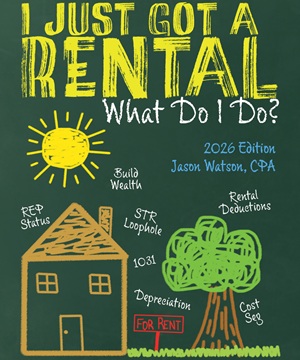 I just got a rental, what do I do? Purchasing a rental property is certainly challenging, but operating one to build wealth and find tax efficiency is equally challenging. This is our second book. Our first book, Taxpayer’s Comprehensive Guide to LLCs and S Corps, was first published in 2014 and was well-received by small business owners and tax professionals, so we thought a book on rental properties and real estate investments would be equally helpful. So, here we are with our second iteration, or the 2026 edition. We update it frequently throughout the year (last update was April 5, 2026).
Our rental property book starts with entity structures and moves into asset management such as acquisition, cost segregation, rental safe harbors, repairs versus improvements, accelerated depreciation, partial asset disposition, and 1031 like-kind exchange. From there we discuss various rental considerations like passive activity losses, short-term rental loophole, real estate professional status, and material participation including what time counts, and what time doesn’t count.
Finally, the good stuff! Rental property tax deductions such as travel, meals, automobiles, interest tracing, home office and common expenses. Fun!
It is available in paperback for $32.95 from Amazon and as an eBook for Kindle for 21.95. Our book is also available for purchase as a PDF from ClickBank for $18.95.

































Table Of Contents

Tax Planning Season
Tax planning season is here! Let's schedule a time to review tax reduction strategies and generate a mock tax return.

Bookkeeping Services
Tired of maintaining your own books? Seems like a chore to offload?