
Cost Segregation: Mixing High Tech With Sticks And Bricks

Cost Segregation: Mixing High Tech With Sticks And Bricks

By: Jason Watson / Posted Saturday, January 24, 2026
Posted By: Jason Watson

Overview of High Tech Cost Segregation

  • The Goldilocks problem. Cost segregation has long been a choice between “expensive but thorough” and “cheap but generic,” and most rental owners don’t love either extreme.
  • The DIY trade-off. Traditional DIY cost segregation keeps fees low by leaning on statistical assumptions, which often means lower allocations to 5-, 7-, and 15-year property and a more conservative risk profile.
  • Technology narrows the gap. RentalWriteOff occupies the middle ground by materially improving the traditional DIY residual approach using property-specific data instead of neighborhood-level averages.
  • Photos beat proxies. By analyzing actual property photos and data through its Smart Analysis engine, RentalWriteOff can recognize finish quality and condition, not just asset presence, leading to more appropriate short-life allocations.
  • Enhanced residual, not engineering. RentalWriteOff still uses an IRS-recognized Residual Estimation Method, but layers in detailed RCNLD calculations, credible cost sources, and extensive documentation to produce a study that’s far more defensible than legacy DIY reports.
  • Basis allocation still matters. Starting with objective third-party data, such as assessor land-to-improvement ratios, and adjusting based on property-specific facts is often more defensible than round-number allocations — and cases like Nielsen are why that mindset is gaining traction.

diy cost segFor most residential rental property owners, traditional cost segregation has historically meant a choice between expensive boots-on-the-ground studies (or at least something reserved for the rich and shameless) or low-cost DIY tools that rely heavily on averages. Why spend $5,000 on an engineering team to fly out and count light switches in a duplex? Historically, that math just didn’t pencil out, and thousands of dollars in depreciation were left on the table every year.

On the other end of the spectrum are legacy do-it-yourself cost segregation providers that rely primarily on statistical databases, averages, and proxy data rather than property-specific inputs. A homogenization of a bunch of real estate that is similar, but not identical, to your snowflake rental property. However, the massive benefit was a reduced cost- $1,000 or less. Suddenly, the cash flow IRR makes sense with or without pencils.

The downside to traditional DIY cost segregation is about 7-10% lower amounts of what everyone is after- 5, 7 and 15-year property. The stuff that is eligible for accelerated depreciation, primarily through bonus depreciation and, in narrower fact patterns, Section 179 expensing. Using 8% as an average and a building that is worth $480,000 is $38,000 in “lost” depreciation and at 32% marginal tax rate, that is $12,000. Hmmm… right? Is spending $4,000 more to get an extra $12,000 worth it? Perhaps. Perhaps not.

Sidebar: Residual Estimation Method (commonly used with DIY cost seg) is historically lower than a Detailed Engineering Cost Estimate based on our experience of reading thousands of cost seg reports. Ok, not totally true- perhaps hundreds. Still, a lot.

Is there a Goldilocks version of cost segregation? A middle-ground approach that improves accuracy and defensibility without requiring a full engineering site visit?

We are thrilled to announce our partnership with RentalWriteOff, a technology-first cost segregation platform designed to materially improve traditional DIY cost segregation without moving all the way to boots-on-the-ground engineering. We aren’t just giving you a link to a website; we’ve integrated the RentalWriteOff proprietary “Smart Analysis and Smart Itemization” engine directly into the WCG CPAs & Advisors ecosystem.

Why Smart Analysis Is A Game-Changer

As we stated before, most DIY tools use “statistical databases” to guess what’s inside your walls- essentially using a ZIP code average to determine your tax savings. RentalWriteOff’s Smart Analysis uses property-specific photos and data to inform component identification and valuation, rather than relying solely on neighborhood-level assumptions. Ok, before you roll your eyes at the most overused term in 2025 (and likely 2026)… artificial intelligence… or AI… or LLM… or whatever… keep in mind that artificial intelligence and dynamic algos are here to stay, and are here to improve cost segregation.

How?

By analyzing your specific property photos and details, the engine identifies finish quality rather than just presence. If you have premium granite countertops, high-end crown molding, or luxury vinyl plank flooring, the Smart Analysis AI tools recognize that higher-tier finish. The result? You get more allocation (or what you could say, “more appropriate allocation”) to Section 1245 property because the software is analyzing your actual assets, not a generic neighborhood average.

Residual Estimation Method

The Residual Estimation Method is an abbreviated cost segregation approach where a cost segregation report preparer identifies only the short-lived assets and subtracts their total estimated cost from the overall building cost. The remaining balance is then assigned to the building as a “residual” amount.

IRS Publication 5653 (the Cost Segregation Audit Techniques Guide) describes the Residual Estimation Method as an abbreviated approach that is generally simpler but can be less precise and more difficult to document than full engineering studies. The ATG notes that while the Residual Estimation Method is simpler and less time-consuming than engineering approaches, it might also be less accurate.

RentalWriteOff uses this method. To be fair, however, and this is a big however, their technology takes the Residual Estimation Method to a whole new level. Sure, it is still short of a fully engineered cost segregation study, but it is materially more defensible and often produces higher allocations to 5-, 7-, and 15-year property than legacy DIY tools. A perfect blend of accuracy and cost efficiency.

The process starts with Smart Analysis (the input) and ends with Smart Itemization (the output). While the study still follows a residual framework, the technology applies detailed RCNLD calculations, credible cost sources, and proportional basis allocation to produce documentation that more closely resembles engineering-style support than traditional DIY reports- where high tech mixes with sticks and bricks.

Why WCG Chose This Engine To Partner With

  • The Enhanced Residual Approach: Rather than relying on simple averages or back-of-the-napkin estimates, the platform applies the IRS-recognized Residual Estimation Method using detailed Replacement Cost New Less Depreciation (RCNLD) analysis. The result is a high-end, defensible report complete with detailed asset schedules, credible cost sources, and photo-based documentation.
  • The Price Point: A practical price point that delivers a materially upgraded residual study, backed by the RentalWriteOff warranty.
  • Methodology Support: RentalWriteOff contractually supports and explains its methodology if questions arise, while WCG remains responsible for tax reporting and planning.

Turning A $600,000 Purchase Into A Nice Tax Deduction

Let’s look at the numbers for a typical $600,000 total purchase. To determine depreciable building basis, we start with a reasonable land-to-improvement allocation. In many cases, county assessor ratios provide an objective, third-party starting point that has gained increased support in recent court decisions, including Nielson v. Commissioner, Tax Court Summary Opinion 2017-31  where the court emphasized reasonableness and contemporaneous valuation data over arbitrary allocations. Where appropriate, assessor data may be adjusted based on property-specific facts, appraisals, or other credible valuation inputs.

The RentalWriteOff engine performs a deep dive into that building basis (let’s assume $450,000), identifying 5-, 7-, and 15-year property. Using our example, you might have 25% of the $450,000 or $112,00ish that is eligible for accelerated depreciation or Section 179 expensing. Provided you qualify for the short-term rental loop or real estate professional status (REPS) or have other rental profits, this could put $40,000 in your pocket at a 35% marginal tax rate.

The State Caveat: Many states decouple from federal bonus depreciation. In those cases, we might need to leverage Section 179 to achieve similar results. However, Section 179 comes with a “clawback” sting- if the business use of the property falls to 50% or less, the IRS will want that benefit back. In other words, it might be painful if you convert your STR into a second home or vacation home. And Yes, this all assumes your rental activity is considered a trade or business that you participate in operating on a regular and continuous basis with a profit motive.

The Human Element: Sanity Checks & Review

We don’t just “set it and forget it.” Technology doesn’t operate unchecked. While technology drives efficiency, human review remains part of the process to identify obvious errors or inconsistencies before the study is finalized.

Their team performs a human-based sanity check on every report to ensure the AI isn’t having a bad day and “hallucinated” a second kitchen or missed a deck. Once the report hits our desk, we perform a casual review to identify any glaring problems before we input the data into your tax return. (Note: While we review for accuracy, RentalWriteOff remains the technical engine and warrantor of the study’s methodology).

Sample RentalWriteOff Report

This sample report shows the Residual Estimation Method enhanced with property-specific photos, detailed cost data, and RCNLD analysis. See how technology can materially improve traditional DIY cost segregation without requiring a boots on ground study.

How to Kick It Off

Ready to kick off this high tech cost segregation party? We’ve streamlined the intake so you can finish your part in under an hour.

  • Snap & Upload: Provide the appraisal and specific photos and perhaps video.
  • Smart Analysis and Itemization: The AI “worms” through the visuals, pricing out your components based on their actual quality.
  • Finalize: After the human sanity checks, we deliver your comprehensive, audit-ready study in 1 to 2 business days.

Wait, what about the $1,500,000+ properties? While RentalWriteOff is strong in the residential “sweet spot,” it is not a replacement for full engineering studies on large or complex properties. However, we partnered with them because they represent a meaningful step up from traditional DIY cost segregation for residential rentals. Should you need more complex analysis, or if a traditional boots-on-the-ground engineering study is a more appropriate choice, we can chat about other options!

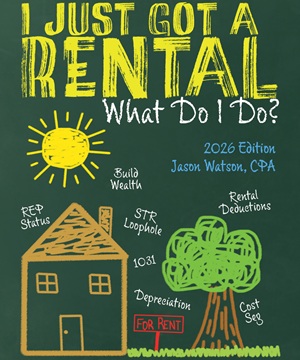
I Just Got A Rental, What Do I Do?

I just got a rental, what do I do? Purchasing a rental property is certainly challenging, but operating one to build wealth and find tax efficiency is equally challenging. This is our second book. Our first book, Taxpayer’s Comprehensive Guide to LLCs and S Corps, was first published in 2014 and was well-received by small business owners and tax professionals, so we thought a book on rental properties and real estate investments would be equally helpful. So, here we are with our second iteration, or the 2025 edition. We update it frequently throughout the year (last update was October 6, 2025).

Our rental property book starts with entity structures and moves into asset management such as acquisition, cost segregation, rental safe harbors, repairs versus improvements, accelerated depreciation, partial asset disposition, and 1031 like-kind exchange. From there we discuss various rental considerations like passive activity losses, short-term rental loophole, real estate professional status, and material participation including what time counts, and what time doesn’t count.

Finally, the good stuff! Rental property tax deductions such as travel, meals, automobiles, interest tracing, home office and common expenses. Fun!

It is available in paperback for $19.95 from Amazon and as an eBook for Kindle for 15.95. Our book is also available for purchase as a PDF from ClickBank for $12.95.

We Are Real Estate CPAs

WCG has a team of real estate CPAs ready to assist you with your rental property and real estate investments. Very few tax professionals and CPA firms specialize in real estate to provide you solid consultation, tax planning including tax reduction strategies, and tax return preparation. We are experts in-

This book is written with the general rental property in mind. Too many resources tell you the general rule but don’t bother to back it up with Internal Revenue Code, Treasury Regulations and Tax Court cases. Our book lays it all out, explains the madness, adds some humor and various conundrums. Example? Water heaters and hot tubs- crazy stuff to consider.

Enjoy! And please send us all comments, hang-ups and static. This book is as much yours as it is ours, except the tiny royalty part- that’s ours. Stop by and we’ll buy you a beer with the pennies.

How To Purchase Our Rental Property Book

If you buy our 480-page book and think that we didn’t help you understand rental property tax laws, let us know. We never want you to feel like you wasted your money. If you are ready to add some insightful reading into your day, click on one of the preferred formats. Amazon is processed by Amazon, and the PDF is safely processed by ClickBank who will email you the PDF as an attachment.

$19.95$15.95$12.95

Frequently Asked Questions

What is RentalWriteOff, exactly?

RentalWriteOff is a technology-driven cost segregation platform that uses an IRS-recognized residual method enhanced with property-specific data, photos, and detailed cost modeling to improve on traditional DIY studies.

Is this the same as a fully engineered, boots-on-the-ground cost segregation study?

No. This approach stops short of a full engineering site visit, but it’s a meaningful step up from legacy DIY tools that rely mostly on averages and assumptions.

How is this different from other DIY cost segregation providers?

Most DIY providers lean heavily on statistical databases. RentalWriteOff uses actual property photos and data to inform allocations, which usually produces more appropriate and defensible results.

Does RentalWriteOff still use the Residual Estimation Method?

Yes. It uses an IRS-recognized residual approach, but layers in detailed Replacement Cost New Less Depreciation (RCNLD) analysis, credible cost sources, and extensive documentation.

What are “Smart Analysis” and “Smart Itemization”?

Smart Analysis refers to how the platform evaluates your property photos and data, while Smart Itemization is how those inputs are translated into a detailed asset schedule. Fancy names, but the real win is better documentation.

Will this always produce higher 5-, 7-, and 15-year allocations?

Not always but usuall. The goal isn’t to be aggressive for the sake of being aggressive, but to be more accurate than average-based DIY studies (which often under-allocate by design).

Do I still work with WCG, or am I handed off to a tech company?

You work with WCG. RentalWriteOff operates behind the scenes as the technical engine, while WCG handles planning, reporting, and making sure it actually fits your tax picture.

How fast does the process take?

Once intake is complete, most studies are delivered in about 1–2 business days. Fast, but not “we guessed and hit print” fast.

Is this defensible if the IRS ever asks questions?

The study follows IRS-recognized methodology, includes detailed documentation, and RentalWriteOff supports its approach if questions arise. No study is audit-proof, but this is far better than a thin spreadsheet.

Is RentalWriteOff right for every rental property?

Nope. It shines in the residential sweet spot. Larger, more complex, or high-value properties might still justify a traditional boots-on-the-ground engineering study.

Getting Started with WCG CPAs & Advisors

Want to talk to us about tax return preparation, tax planning and strategy, and all the other things that go with it? We are eager to assist! The button below takes you to our Getting Started webpage, but if you want to talk first, please give us a call at 719-387-9800 or schedule an discovery meeting.

Jason Watson, CPA is a Partner and the CEO of WCG CPAs & Advisors, a boutique consultation and tax preparation CPA firm serving clients nationwide with 7 partners and over 90 tax and accounting professionals specializing in small business owners and real estate investors located in Colorado Springs.

He is the author of Taxpayer’s Comprehensive Guide on LLC’s and S Corps and I Just Got a Rental, What Do I Do? which are available online and from mostly average retailers.

Related Blogs

Posted Saturday, January 24, 2026
Tax Planning Season

Tax planning season is here! Let's schedule a time to review tax reduction strategies and generate a mock tax return.

Bookkeeping Services

Tired of maintaining your own books? Seems like a chore to offload?

Offsetting High W-2 Income

Did you have questions about how this works? Do you need to bounce some ideas off of our tax strategists?

The tax advisors, business consultants and rental property experts at WCG CPAs & Advisors are not salespeople; we are not putting lipstick on a pig expecting you to love it. Our job remains being professionally detached, giving you information and letting you decide within our ethical guidelines and your risk profiles.

We see far too many crazy schemes and half-baked ideas from attorneys and wealth managers. In some cases, they are good ideas. In most cases, all the entities, layering and mixed ownership is only the illusion of precision. As Chris Rock says, just because you can drive your car with your feet doesn’t make it a good idea. In other words, let’s not automatically convert “you can” into “you must.”

Let’s chat so you can be smart about it.

We typically schedule a 20-minute complimentary quick chat with one of our Partners or our amazing Senior Tax Professionals to determine if we are a good fit for each other, and how an engagement with our team looks. Tax returns only? Business advisory? Tax strategy and planning? Rental property support?

Text WCG Offices

Text WCG Offices

Need to get in touch through a quick text? We'll respond within a day.

Chat our amazing team

Call Our Team

Need to speak to a tax professional now? Give us a call 719-387-9800 and we'll get you connected.