Business Advisory Services
Everything you need to help you launch your new business entity from business entity selection to multiple-entity business structures.

Hey - Our site just had a makeover and we are sorting through the hiccups!

Everything you need to help you launch your new business entity from business entity selection to multiple-entity business structures.


Designed for rental property owners where WCG CPAs & Advisors supports you as your real estate CPA.

Everything you need from tax return preparation for your small business to your rental to your corporation is here.

WCG’s primary objective is to help you to feel comfortable about engaging with us
Table Of Contents


Maybe you finally vested. Maybe you exited. Maybe grandma left you a retirement account that is now forcing distributions (stretch IRAs went away with the 2019 SECURE Act, the first one). Whatever the source, you have cash. And now, the IRS has its hand out. We are equally surprised as you are.
There is a tendency in the tax world to treat high income like a problem to be solved with a somber face. We disagree. We think you should celebrate it. You earned it. This is a liquidity event as nerdy finance and accountants say- a moment where cash flows into your life and changes your financial landscape.
But celebrating doesn’t mean writing a blank check to the U.S. Treasury. It means being strategic. It means understanding that the tax code is just a series of incentives, and if you play by the rules, you can keep a lot of the wealth you’ve built. Aren’t taxes a success tax anyway? Sure, doesn’t make you feel any better, we get it.
Let’s talk about the spikes, the strategy, and the “Ace in the Hole” you can keep in your back pocket.
First, let’s define a “liquidity event.” It isn’t just selling a business for eight figures. In our world, a liquidity event is any specific trigger that dumps taxable income into your lap and spikes your marginal tax rate. Here are the usual suspects that might have you staring at a 37% federal tax bracket (plus state, plus NIIT):
If you see yourself on this list, congratulations. Now, let’s get to work on wiping out the tax bill. Well, not entirely, but we certainly went from piquing your interest to having your attention with just a few words.
To fight high active income (like wages and bonuses), you need a heavy hitter. You need a strategy that generates non-passive losses to offset active or earned income like W-2 and portfolio income like capital gains.
Let’s kick this off with real estate which is usually “passive,” meaning its losses can only offset passive income (like other rentals). That doesn’t help your RSU problem. But when we combine specific elements, we can fight some tax fire with offsetting fire.
1. The Short-Term Rental (STR) LoopholeThe tax code has a quirk: if the average guest stay at your rental property is seven days or less, the IRS does not view it as a “rental activity” under IRC Section 469. They view it as a business.
This is the “STR Loophole.” But there is a catch: You must materially participate. You generally need to meet one of these tests:
If you pass one of these material participation tests, the losses from the rental property are non-passive. They are now powerful enough to offset your W-2 wages, your bonus, and your RSU income.
What if you hate the idea of turning over an Airbnb guest every 4 days? You want a long-term tenant, but you still want those juicy non-passive losses.
Enter Real Estate Professional Status (REPS). This is the heavyweight champion of tax status, but it requires serious commitment. To qualify, you (or your spouse!) must:
The Spouse Factor: If you are the high-income earner working 50 hours a week in tech or medicine, you will almost never qualify for REPS. You simply cannot prove you spend more time in real estate than your “day job.” But your spouse can. If one spouse qualifies as a Real Estate Professional and you materially participate in your rental properties (aggregate those hours between spouses!), the losses from your long-term rentals become non-passive on your joint tax return. This is the ultimate strategy for married couples where one partner has high W-2 income and the other manages the real estate portfolio.
Okay, you have the property (STR or LTR with REPS). Now we need the paper loss.
Standard depreciation is boring—it takes 39 years to write off a commercial building including short-term rentals (which are deemed non-residential) or 27.5 years for residential. We don’t have 39 years to wait for the tax death of a thousand, well, 39 cuts; we have a tax bill now.
A cost segregation study is an engineering report that slices and dices your property. It identifies assets that aren’t really “the building” such as carpeting, special electrical, decorative lighting, countertops, and landscaping. These are reclassified as 5-year, 7-year, or 15-year property.
On a $1.2M purchase, a cost seg study might identify $200,000 worth of these “short-life” assets (assume that $800,000 is the building, and about 23%ish is identified… or $184,000ish).
Here is where 2025 gets exciting.
Under the old rules, bonus depreciation was fading away. But thanks to the One Big Beautiful Bill Act (OBBBA) passed earlier this year, 100% Bonus Depreciation is back for qualified property placed in service after January 19, 2025. This is the rocket fuel. Instead of depreciating that $200,000 of furniture and fixtures over 5 years, you can deduct 100% of it in Year 1.
The Result: You generate a $200,000 paper loss on your tax return. That loss moves over to the income side of your tax return and wipes out the tax liability on your $200,000 bonus. Or your $200,000 capital gain. Or your $200,000 whatever whatever. Either way we say, Yeah, baby!

We cover these in depth on our Advanced Tax Strategies page, but here are today’s heavy hitters:
Keep in mind these three considerations- any decent tax reduction strategy takes-
If you want a riskless tax deduction, sent $50,000 to your favorite charity. Not really what you had in mind? Yeah, we didn’t think so.
We have to be the buzzkill for a moment because this is where people get hurt. Timing is everything.
We often see a client who expects a massive liquidity event such as a $500,000 severance package in February 2026. Excited about the tax savings, they rush out and buy a luxury STR in December 2025. They do the cost seg, they materially participate, and they generate a huge loss for their 2025 tax return.
The income hasn’t happened yet. They have a $200,000 loss in 2025 with standard income. Sure, the loss creates a Net Operating Loss (NOL) that carries forward, but NOLs can be complex and sometimes less efficient than a direct offset.
Qualification is an annual sport. To use that carry-forward loss effectively, or to offset the income that finally hits in 2026, you generally need to qualify as a material participant in 2026 as well (yes there are some workarounds, but stay with us for a minute on this one).
If you buy the wealth building tax reduction rental property in 2025, do all the work to set it up, and then hand it over to a property manager in 2026 because “the work is done,” you fail the test for 2026. Your rental loss becomes passive. Your massive 2026 income gets fully taxed, and your losses are stuck in a passive bucket and carried forward for eternity (well, not really, but sounds more dramatic this way).
But wait… what if you already bought the property in 2025, but your big liquidity event is delayed until 2028? Did you waste the tax deduction from a cost seg done in 2025?
Absolutely not. You just inadvertently stumbled into one of our favorite advanced strategies: The Retroactive Cost Seg.
You do not have to perform a cost segregation study in Year 1. You can wait.
Buy the property in 2025. Place it in service. Depreciate it slowly (the boring way).
Wait. Take a beat.
Strike in a High-Income Year. In 2028, when you sell your business or hit a huge vesting cliff, we perform the cost segregation study retroactively for the 2025 purchase. Technically with full-on geek speak, we file Form 3115 (Application for Change in Accounting Method) with your 2028 tax return. This allows us to take all the depreciation you “missed” from 2025, 2026, and 2027 and claim it as a single, lump-sum deduction in 2028. This is called a Section 481(a) adjustment. The IRS can call it what they want; we call it sexy.
The bonus depreciation rules are locked in based on the year you placed the property in service, not the year you do the study. So, if you bought in 2025 (a 100% bonus depreciation year thanks to OBBBA), you get to claim that 100% bonus in 2028 when you actually need the tax deduction.
You effectively bank the tax savings for a rainy (or very wealthy) day.
WCG CPAs & Advisors are experts in typical tax reduction techniques including advanced tax strategy. Learn more about the various ways to offset high W-2 income and large one-time income spikes.
Strategic tax planning isn’t just about saving money; it’s about time travel. You are pulling future wealth into the present by leveraging the tax code today.
Whether it’s a surprise bonus, a planned RSU vest, or a calculated Roth conversion, don’t let the tax tail wag the dog.
At WCG CPAs & Advisors, we specialize in the intersection of high income and strategic tax planning. We can help you determine if you qualify for the STR loophole or REPS, run the numbers on a cost seg study, and ensure you play your “Ace in the Hole” at the perfect moment.
Let’s turn that liquidity event into a legacy event. Yeah, Ok, you can roll you eyes at that one. Permission granted. Congratulations ghost rider, the pattern is open.
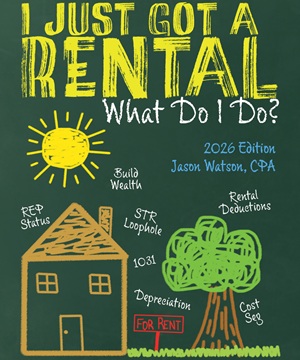
I just got a rental, what do I do? Purchasing a rental property is certainly challenging, but operating one to build wealth and find tax efficiency is equally challenging. This is our second book. Our first book, Taxpayer’s Comprehensive Guide to LLCs and S Corps, was first published in 2014 and was well-received by small business owners and tax professionals, so we thought a book on rental properties and real estate investments would be equally helpful. So, here we are with our second iteration, or the 2025 edition. We update it frequently throughout the year (last update was October 6, 2025).
Our rental property book starts with entity structures and moves into asset management such as acquisition, cost segregation, rental safe harbors, repairs versus improvements, accelerated depreciation, partial asset disposition, and 1031 like-kind exchange. From there we discuss various rental considerations like passive activity losses, short-term rental loophole, real estate professional status, and material participation including what time counts, and what time doesn’t count.
Finally, the good stuff! Rental property tax deductions such as travel, meals, automobiles, interest tracing, home office and common expenses. Fun!
It is available in paperback for $19.95 from Amazon and as an eBook for Kindle for 15.95. Our book is also available for purchase as a PDF from ClickBank for $12.95.
WCG has a team of real estate CPAs ready to assist you with your rental property and real estate investments. Very few tax professionals and CPA firms specialize in real estate to provide you solid consultation, tax planning including tax reduction strategies, and tax return preparation. We are experts in-
This book is written with the general rental property in mind. Too many resources tell you the general rule but don’t bother to back it up with Internal Revenue Code, Treasury Regulations and Tax Court cases. Our book lays it all out, explains the madness, adds some humor and various conundrums. Example? Water heaters and hot tubs- crazy stuff to consider.
Enjoy! And please send us all comments, hang-ups and static. This book is as much yours as it is ours, except the tiny royalty part- that’s ours. Stop by and we’ll buy you a beer with the pennies.
If you buy our 480-page book and think that we didn’t help you understand rental property tax laws, let us know. We never want you to feel like you wasted your money. If you are ready to add some insightful reading into your day, click on one of the preferred formats. Amazon is processed by Amazon, and the PDF is safely processed by ClickBank who will email you the PDF as an attachment.
![]() |
![]() |
![]() |
| $19.95 | $15.95 | $12.95 |
In our world, a liquidity event isn’t just selling a business. For tax planning, it is any concentrated spike in income that pushes you into a high marginal tax bracket. Common examples include RSU vesting, exercising stock options, receiving a large performance bonus or severance package, executing a Roth conversion, or taking a large distribution from an inherited IRA. If it spikes your tax rate, it counts.
It comes down to the average period of customer use. Under Treasury Regulation Section 1.469-1T(e)(3)(ii)(A), if the average guest stay is seven days or less, the IRS treats the activity as a business rather than a passive rental activity. This critical distinction is what allows losses—if you materially participate—to be reclassified as non-passive and offset your W-2 or active business income.
Yes. We just said it, right? Ok… sorry for being grumpy pants but this is non-negotiable. Without meeting one of the seven material participation tests (like the 100-hour or 500-hour rules including the substantially all rule), your rental losses remain passive. Passive losses generally cannot offset active income like wages, RSUs, or bonuses; they can only offset other passive income. Material participation is the key that unlocks the tax savings.
It can be, but there is a major trap. The rule states you must spend more than 100 hours on the activity AND spend more time than anyone else involved. This includes cleaners, handymen, and property managers. If your cleaner spends 105 hours turning the unit and you only spend 102 hours managing it, you fail the test. This is measure on a per human basis (not the entire entity like a property management company).
It is mathematically nearly impossible. To qualify for REPS, you must spend more than 50% of your total working hours in real estate trades or businesses. If you work 2,000 hours a year as a surgeon or engineer, you’d need to work 2,001 hours in real estate to qualify. However, a spouse who does not have a W-2 job can often qualify for REPS, allowing you to take the deduction on a joint tax return.
Cost segregation is the engine that creates the loss. By reclassifying building components (like flooring, cabinets, and landscaping) into shorter recovery periods (5, 7, or 15 years), you accelerate depreciation. Instead of waiting 39 years to write off these assets, you deduct them quickly and create the large paper loss needed to wipe out a sudden income spike.
Yes! Thanks to the One Big Beautiful Bill Act (OBBBA) passed in 2025, 100% bonus depreciation has been restored for qualified property (assets with a class life of 20 years or less) placed in service after January 19, 2025. This allows you to deduct the full cost of eligible assets in the first year rather than spreading it out.
You enter the “Timing Trap.” The Bermuda Triangle of tax deductions. If you generate a non-passive loss in 2025 without income to offset it, it may become a Net Operating Loss (NOL). While NOLs carry forward, they can be complex. The bigger risk is that if you fail to materially participate in 2026 (the year the income actually hits), your carried-forward loss might get stuck or be treated differently. Aligning the deduction year with the income year is crucial.
No, and waiting is often a smart move (our “Ace in the Hole” strategy). You can perform a cost segregation study retroactively in a future year when you actually have a high-income event. We file Form 3115 (Application for Change in Accounting Method) to claim all the “missed” depreciation as a single, massive Section 481(a) adjustment in that future year. Must and can are not synonymous.
Not even close. The IRS does not give away tax deductions for free. A valid tax reduction strategy requires three things: Cash (or debt), Participation (real work), and Economic Risk. If you are doing this solely for the tax break without a legitimate profit motive or without doing the actual work, you are walking into audit trouble. Always document your hours and treat it like a real business.

Want to talk to us about tax return preparation, tax planning and strategy, and all the other things that go with it? We are eager to assist! The button below takes you to our Getting Started webpage, but if you want to talk first, please give us a call at 719-387-9800 or schedule an discovery meeting.
Jason Watson, CPA is a Partner and the CEO of WCG CPAs & Advisors, a boutique consultation and tax preparation CPA firm serving clients nationwide with 7 partners and over 90 tax and accounting professionals specializing in small business owners and real estate investors located in Colorado Springs.
He is the author of Taxpayer’s Comprehensive Guide on LLC’s and S Corps and I Just Got a Rental, What Do I Do? which are available online and from mostly average retailers.
Table Of Contents

Tax planning season is here! Let's schedule a time to review tax reduction strategies and generate a mock tax return.

Tired of maintaining your own books? Seems like a chore to offload?
Did you have questions about how this works? Do you need to bounce some ideas off of our tax strategists?
The tax advisors, business consultants and rental property experts at WCG CPAs & Advisors are not salespeople; we are not putting lipstick on a pig expecting you to love it. Our job remains being professionally detached, giving you information and letting you decide within our ethical guidelines and your risk profiles.
We see far too many crazy schemes and half-baked ideas from attorneys and wealth managers. In some cases, they are good ideas. In most cases, all the entities, layering and mixed ownership is only the illusion of precision. As Chris Rock says, just because you can drive your car with your feet doesn’t make it a good idea. In other words, let’s not automatically convert “you can” into “you must.”
Let’s chat so you can be smart about it.
We typically schedule a 20-minute complimentary quick chat with one of our Partners or our amazing Senior Tax Professionals to determine if we are a good fit for each other, and how an engagement with our team looks. Tax returns only? Business advisory? Tax strategy and planning? Rental property support?

Everything you need to help you launch your new business entity from business entity selection to multiple-entity business structures.

Designed for rental property owners where WCG CPAs & Advisors supports you as your real estate CPA.

Everything you need from tax return preparation for your small business to your rental to your corporation is here.

WCG’s primary objective is to help you to feel comfortable about engaging with us