
Cost Segregation: When Fully Engineered Still Wins

Cost Segregation: When Fully Engineered Still Wins

By: Jason Watson / Posted Sunday, January 25, 2026
Posted By: Jason Watson

Overview of Engineered Cost Segregation

  • Cost segregation is a spectrum. DIY, enhanced residual, and fully engineered studies all have a place depending on property size, complexity, and risk tolerance.
  • Engineering raises the ceiling. Fully engineered studies often identify more 5-, 7-, and 15-year property because they rely on construction-based analysis rather than statistical averages.
  • Defensibility starts at the basis. CSAP’s direct integration API with county assessor databases anchors land-to-improvement allocations to objective, contemporaneous data before any engineering work even begins.
  • Judgment still matters. Engineering-based review, construction knowledge, and property-specific inspection add a layer of professional judgment that algorithms and averages can’t replicate.
  • Cash flow is about timing, not bravado. When deeper analysis produces materially more accelerated depreciation, the time value of money alone can justify the incremental cost.
  • WCG matches tools to facts. The goal isn’t one universal solution, but selecting the right cost segregation approach based on dollars, documentation needs, and how well you sleep at night. The right tool for the job sort of thing.

Cost segregation has come a long way. What was once reserved for large commercial assets and institutional owners is now accessible to a much broader range of rental property owners and real estate investors. That’s a good thing, right? More access, more choice, and more flexibility.

But with more market entrants offering all kinds of service levels, not every cost segregation approach is built for the same job. Some prioritize speed and cost efficiency. Others prioritize depth, precision, and audit defensibility. Knowing when to move up the ladder is where good tax planning alongside risk tolerance show their combined value.

A Brief, Fair Word on DIY and Technology-Driven Cost Segregation

Lower-cost, technology-enabled cost segregation has opened the door for many residential rental owners who would never have considered a traditional engineering study. Faster turnaround, lower fees, and reasonable results often make sense for smaller properties or lower-risk situations.

The trade-off is that many DIY or abbreviated studies rely on statistical assumptions, conservative allocations, and limited inspection or documentation depth. That doesn’t make them wrong but it does tend to hamstring how much 5-, 7-, and 15-year property gets identified, particularly as real estate properties increase in size, complexity, and / or dollar value.

At a certain point, the conversation shifts from what does this cost to what does this provide? Better tax deduction? Maybe. Better risk tolerance? Perhaps. Better comfort? For certain people, Yes.

Introducing CSAP: Cost Segregation Authority Partners

For properties where precision, documentation depth, and audit exposure matter most, WCG CPAs & Advisors partners with CSAP, or Cost Segregation Authority Partners (also known as CSA Partners).

While headquartered in Lindon, Utah, CSAP is a national firm with a vast engineering network that does one thing only: cost segregation. They are not a general tax credit firm that peddle various studies like WOTC or R&D. With over 80 employees, they’ve focused exclusively on this work since 2006 and have performed over 30,000 studies nationwide across virtually every major property type.

Their studies are built using a unique, construction-based, engineering-driven approach designed to stand up to the intense scrutiny of the IRS. Just as importantly, CSAP is structured to partner with CPA firms; not compete with them. WCG remains your tax advisor and planner while CSAP provides the specialized engineering analysis that supports the tax reporting.

What Fully Engineered Means (and What It Doesn’t)

A fully engineered cost segregation study isn’t simply a more expensive DIY report. It’s a different level of analysis altogether.

CSAP’s process is engineering-based and construction-informed including tax-aware. It includes a detailed review of available documentation such as plans, specifications, and cost breakdowns, combined with a property-specific inspection component tailored to the engagement. Asset identification and valuation are grounded in empirical support and construction methodology, and not averages or proxy data.

Importantly, while inspection is part of their process, CSAP does not market a one-size-fits-all promise that every study requires a physical site visit by an engineer. The scope is tailored to the property, complexity, and facts, which is exactly how an engineering-forward approach should work.

The end result is a cost segregation study designed to be defensible first, not just fast.

The Digital Handshake: Real-Time Assessor Integration

One of the most powerful features of the CSAP engine is its ability to eliminate the “guesswork” often found in land value allocations. CSAP utilizes a proprietary API that tunnels directly into county assessor databases nationwide. This isn’t a simple web-scrape; it’s a direct data handshake that pulls the most current land and building ratios for your specific parcel.

By pulling this data directly from the source, CSAP ensures that your study is anchored to the same “objective benchmark” the IRS uses to flag returns for audit. This automated integration allows for a more surgical basis allocation that is grounded in local, contemporaneous data, providing an immediate layer of defense before the first line of the engineering report is even written.

The Cash Flow Question: Is Paying More Actually Worth It?

This is usually where the rubber meets the road.

Assume a $600,000 purchase with a depreciable building basis of $450,000 and a 35% marginal tax rate. Compared to a typical DIY or abbreviated study, a fully engineered approach often identifies materially more short-life property. Using a conservative 8% difference, that’s roughly $36,000 of additional accelerated depreciation. Let’s back up a minute.

Where did this 8% come from? Having reviewed hundreds of cost seg reports, DIY studies are around 20-22% of the depreciable basis (on average) whereas fully-engineered reports see 28-30%. Is one better than the other? Not necessarily. However, the DIY cost seg studies experience more conservative results since the fundamental approach is residual estimation method using averages. With any average, there is a high and low number… a spectrum if you will. So, by definition, half of the spectrum properties will automatically be reporting less than their reality.

Back to the math. At a 35% tax rate and $36,000 of “missed depreciation” that equates to about $12,600 of additional federal tax deferral.

Now compare that to cost. If a fully engineered study costs $2,000 more than a DIY alternative, the math isn’t subtle. If you value cash today at an assumed 9% cost of equity based on historical S&P index rates of return, the time value of having $12,600 sooner is roughly $1,100 per year. At that rate, the incremental cost of the engineered study is effectively “paid back” in about 21 to 22 months, purely on timing, and before considering reinvestment, debt paydown, or compounding returns.

This isn’t about chasing aggressiveness. It’s about whether deeper analysis and better documentation translate into meaningful cash flow when it actually matters. Everyone seems to like the word ‘unlock’ these days. We’ll spare you.

When a Fully Engineered Study Typically Makes Sense

In practice, CSAP tends to be the right tool when:

  • Property values are higher
  • Asset mixes are more complex (quad-plex versus a SFR)
  • The audit profile matters (said differently- your comfort level and risk tolerance, and ability to sleep at night)
  • The incremental depreciation, and “more cash now” meaningfully exceeds the incremental fee

For many residential properties, technology-driven or enhanced residual approaches still make sense. CSAP isn’t a replacement for those tools; rather it’s the next rung up the ladder when the stakes, perceived or real, increase.

Why WCG Partners with CSAP

WCG doesn’t believe in forcing every client into the same solution. We believe in matching the right methodology to the right facts.

CSAP gives us a fully engineered lane backed by a construction-based approach, decades of specialization, and no-cost audit support tied directly to their work. They also provide no-cost benefits analyses, often within 24 hours, which helps us evaluate whether a fully engineered study makes sense before committing time or money. Try before you buy. Amazing!

cost segregation study

Sample CSAP Report

This sample report shows what a fully engineered cost segregation study looks like in practice, with deeper analysis, stronger documentation, and an emphasis on getting the numbers right when precision really matters.

The Bottom Line

Cost segregation isn’t binary. It’s a spectrum as we mentioned before.

DIY and technology-enabled studies have expanded access and lowered transactional friction. Fully engineered studies still win when precision, documentation depth, and cash flow impact justify the additional investment.

If you’re unsure where your property falls on that spectrum, that’s exactly the conversation we’re here to have.

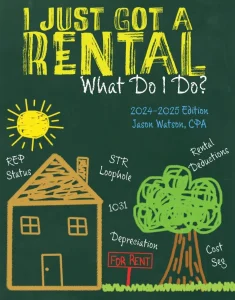
I Just Got A Rental, What Do I Do?

I just got a rental, what do I do? Purchasing a rental property is certainly challenging, but operating one to build wealth and find tax efficiency is equally challenging. This is our second book. Our first book, Taxpayer’s Comprehensive Guide to LLCs and S Corps, was first published in 2014 and was well-received by small business owners and tax professionals, so we thought a book on rental properties and real estate investments would be equally helpful. So, here we are with our second iteration, or the 2025 edition. We update it frequently throughout the year (last update was October 6, 2025).

Our rental property book starts with entity structures and moves into asset management such as acquisition, cost segregation, rental safe harbors, repairs versus improvements, accelerated depreciation, partial asset disposition, and 1031 like-kind exchange. From there we discuss various rental considerations like passive activity losses, short-term rental loophole, real estate professional status, and material participation including what time counts, and what time doesn’t count.

Finally, the good stuff! Rental property tax deductions such as travel, meals, automobiles, interest tracing, home office and common expenses. Fun!

It is available in paperback for $19.95 from Amazon and as an eBook for Kindle for 15.95. Our book is also available for purchase as a PDF from ClickBank for $12.95.

We Are Real Estate CPAs

WCG has a team of real estate CPAs ready to assist you with your rental property and real estate investments. Very few tax professionals and CPA firms specialize in real estate to provide you solid consultation, tax planning including tax reduction strategies, and tax return preparation. We are experts in-

This book is written with the general rental property in mind. Too many resources tell you the general rule but don’t bother to back it up with Internal Revenue Code, Treasury Regulations and Tax Court cases. Our book lays it all out, explains the madness, adds some humor and various conundrums. Example? Water heaters and hot tubs- crazy stuff to consider.

Enjoy! And please send us all comments, hang-ups and static. This book is as much yours as it is ours, except the tiny royalty part- that’s ours. Stop by and we’ll buy you a beer with the pennies.

How To Purchase Our Rental Property Book

If you buy our 480-page book and think that we didn’t help you understand rental property tax laws, let us know. We never want you to feel like you wasted your money. If you are ready to add some insightful reading into your day, click on one of the preferred formats. Amazon is processed by Amazon, and the PDF is safely processed by ClickBank who will email you the PDF as an attachment.

$19.95$15.95$12.95

Frequently Asked Questions

What is CSAP, exactly?

CSAP stands for Cost Segregation Authority Partners (also known as CSA Partners). They are a national firm focused exclusively on engineering-based cost segregation studies.

How is CSAP different from DIY or tech-enabled cost segregation?

CSAP uses a construction-informed, engineering-driven approach with deeper documentation, inspection components, and direct integration with assessor data rather than relying mainly on averages.

What is the “Digital Handshake” with county assessors?

CSAP uses a proprietary API that connects directly to county assessor databases to pull current land-to-improvement ratios for your specific parcel. No scraping, no estimates, no “close enough.”

Why does assessor integration actually matter?

Because land doesn’t depreciate. Getting that allocation wrong at the start shrinks your deductions and weakens defensibility before the study even begins. Frankly, most people and uninformed tax professionals peg land too low. $1.5m house in Malibu or suburbia Topeka, Kansas shockingly yield different land values.

Does this mean CSAP always uses assessor data instead of appraisals?

Not exactly. Assessor data often serves as an objective starting point, which can be adjusted when property-specific facts or appraisals support a different allocation. However, in Nielsen v. Commissioner, Tax Court Summary Opinion 2017-31 the court emphasized reasonableness and contemporaneous valuation data over arbitrary allocations including an unsupported appraisal.

Does every CSAP study require a physical site visit?

Not automatically. Their process includes a property-specific inspection component tailored to the engagement, rather than a one-size-fits-all site visit promise.

Is a fully engineered study always worth the extra cost?

Not always. It tends to make sense when property values, complexity, or audit exposure are high enough that incremental depreciation and documentation depth justify the fee. Let’s not forget the cost of equity- how much is your cash worth to you?

Is this approach more aggressive from an IRS standpoint?

No. It’s generally the opposite. Engineering-based analysis and objective data sources are about accuracy and support, not pushing numbers.

What happens if the IRS asks questions later?

CSAP provides no-cost audit support related to their studies, backing up the engineering and methodology behind the report.

Do I still work with WCG if CSAP is involved?

Yes. WCG remains your tax advisor and planner. CSAP provides the engineering analysis that supports the tax reporting- different roles, same team.

Getting Started with WCG CPAs & Advisors

Want to talk to us about tax return preparation, tax planning and strategy, and all the other things that go with it? We are eager to assist! The button below takes you to our Getting Started webpage, but if you want to talk first, please give us a call at 719-387-9800 or schedule an discovery meeting.

Jason Watson, CPA is a Partner and the CEO of WCG CPAs & Advisors, a boutique consultation and tax preparation CPA firm serving clients nationwide with 7 partners and over 90 tax and accounting professionals specializing in small business owners and real estate investors located in Colorado Springs.

He is the author of Taxpayer’s Comprehensive Guide on LLC’s and S Corps and I Just Got a Rental, What Do I Do? which are available online and from mostly average retailers.

Related Blogs

Posted Sunday, January 25, 2026
Tax Planning Season

Tax planning season is here! Let's schedule a time to review tax reduction strategies and generate a mock tax return.

Bookkeeping Services

Tired of maintaining your own books? Seems like a chore to offload?

Offsetting High W-2 Income

Did you have questions about how this works? Do you need to bounce some ideas off of our tax strategists?

The tax advisors, business consultants and rental property experts at WCG CPAs & Advisors are not salespeople; we are not putting lipstick on a pig expecting you to love it. Our job remains being professionally detached, giving you information and letting you decide within our ethical guidelines and your risk profiles.

We see far too many crazy schemes and half-baked ideas from attorneys and wealth managers. In some cases, they are good ideas. In most cases, all the entities, layering and mixed ownership is only the illusion of precision. As Chris Rock says, just because you can drive your car with your feet doesn’t make it a good idea. In other words, let’s not automatically convert “you can” into “you must.”

Let’s chat so you can be smart about it.

We typically schedule a 20-minute complimentary quick chat with one of our Partners or our amazing Senior Tax Professionals to determine if we are a good fit for each other, and how an engagement with our team looks. Tax returns only? Business advisory? Tax strategy and planning? Rental property support?

Text WCG Offices

Text WCG Offices

Need to get in touch through a quick text? We'll respond within a day.

Chat our amazing team

Call Our Team

Need to speak to a tax professional now? Give us a call 719-387-9800 and we'll get you connected.